That’s my description. From their newly released NBER Working Paper, Bilateral Conflict Risk and Trade: Military Wars, Trade Wars, and Diplomatic Noise, by Joshua Aizenman, Rodolphe Desbordes and Jamel Saadaoui:
We construct a monthly bilateral conflict indicator from GDELT v2 event data, calibrated
against the human-curated ICEWS dataset using Ridge regression. Although the indicator measures the hostile fraction of bilateral interaction, not its volume, calibration remains essential: GDELT systematically misclassifies routine interactions as hostile, inflating the hostile share for allied, high-trade pairs that dominate media coverage.Without correction, these measurement errors could strongly distort the estimated
conflict-trade relationship. Each observation decomposes into four additive components:
kinetic fighting, military posture, trade-context hostility, and baseline diplomacy. The
indicator is directed, allowing separate estimation of aggressive actions and retaliatory
responses.Three sets of findings emerge. First, the decomposed panel tracks the key geopolitical developments of the past decade. The Russia–Ukraine relationship militarises long before 2022. The US–China confrontation is overwhelmingly economic. These patterns are invisible to an aggregate indicator (Section 3).
Second, in a gravity equation, the aggregate indicator is negative, large, and statistically
significant, but the decomposition reveals that only two of the four layers drive the result. Kinetic conflict (“military war”) and trade-context hostility (“trade war”) are both economically large and precisely estimated. Routine diplomacy, despite dominating measured hostility, has a trade effect indistinguishable from zero. The directed structure uncovers a retaliation channel that compounds trade losses over several months. Against pre-escalation trade, the geopolitical deterioration since 2015 has put roughly $334 billion of bilateral trade at risk, with the US–China pair accounting for half (Section 4).Third, in a horse race against IntenSE (Chevalier et al., 2026), the closest existing bilateral
indicator, our decomposition remains both statistically significant and economically large.
Because the two indicators draw on the same underlying GDELT data, the comparison
isolates the contribution of our four design choices: Goldstein weighting, supervised calibration against human-curated ground truth, a directed (asymmetric) bilateral structure,
and sanctions-context reclassification (Section 5).
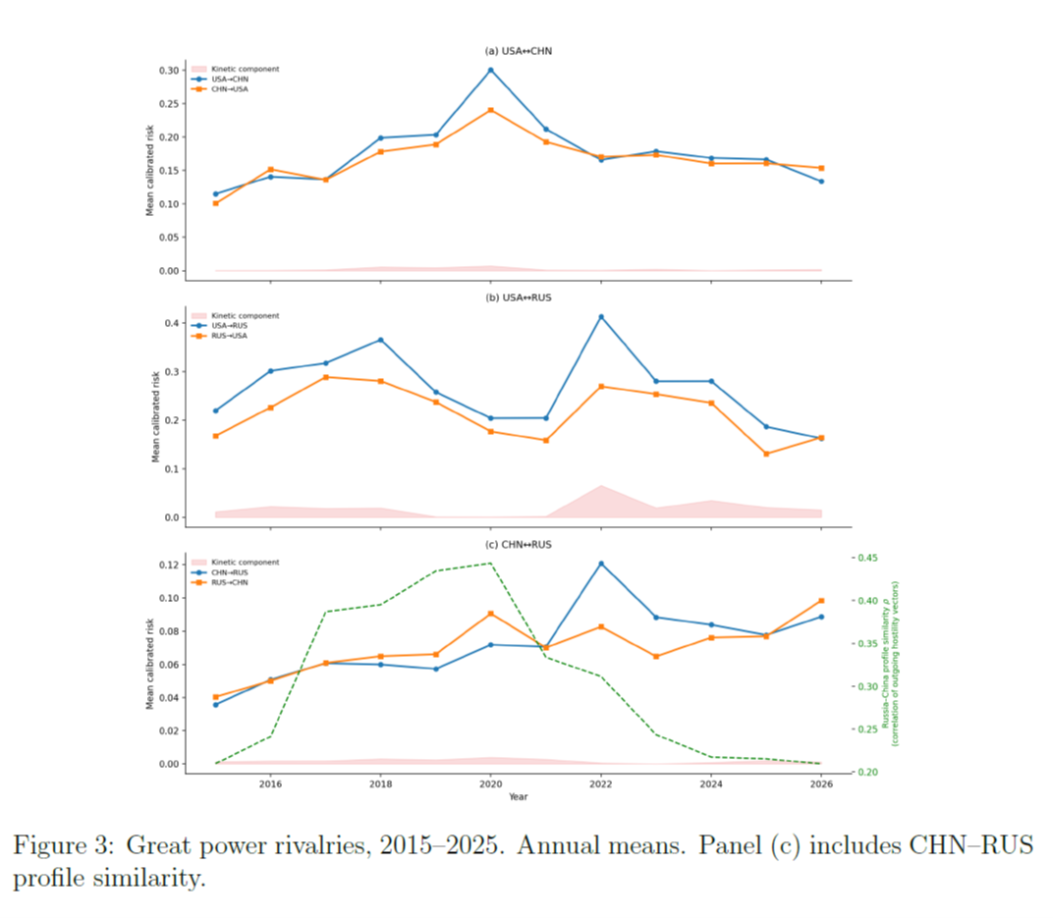
The construction of indices reveals some interesting patterns in the way conflicts are waged, including amongst the “Great Powers” of the last decade.
Their results also show interesting patterns in the weaponization of economic policy in international coercion:
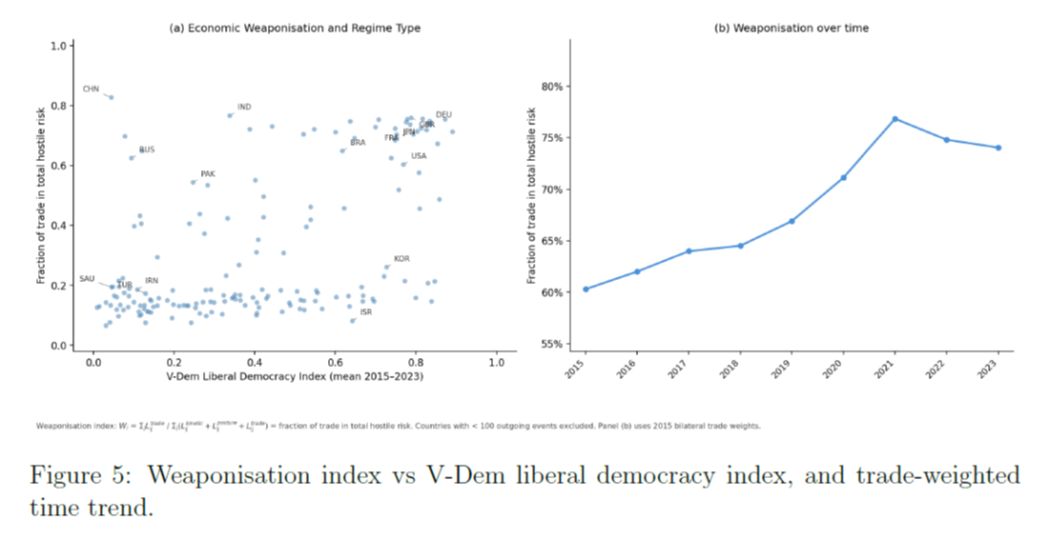
To me, the interesting result is that democracies are more constrained from exercising coercion through military action. At least this is true through 2023. Whether this would hold true for 2026, to me, is an interesting question (closely related to whether the US would still be classified as a democracy in 2025).
Using their estimates, the authors conclude that escalation since 2015 has reduced trade by $344 bn by 2023.
This is a partial equilibrium calculation that ignores trade diversion. It overstates bilateral welfare losses but gives an indication of the trade potentially destroyed by the conflict escalation of the past decade: roughly 2.4% of 2015 world bilateral trade.
“Kinetic conflict (“military war”) and trade-context hostility (“trade war”) are both economically large and precisely estimated. Routine diplomacy, despite dominating measured hostility, has a trade effect indistinguishable from zero.”
Action matter. Talk doesn’t. Makes sense, and is reassuring.