Lots of gushing praise by President Trump of President Xi. Not so much from Xi. I’d characterize this as anything but tough talk from the US side.
As for deliverables from the summit: None confirmed from the Chinese side. Maybe purchase of 200 Boeing aircraft — even that below the anticipated 300. Energy deal? Maybe? Trade deal? Tariff drawdown on the part of China? Elevated purchases of soybeans (2025 at $3bn, 10 yr average at $11 bn)? No details.
In response to President Xi’s comments regarding Taiwan (as noted by the NYT, from the Chinese readout):
“The Taiwan issue is the most critical issue in China-U.S. relations,” Mr. Xi said, according to an official summary of his remarks to Mr. Trump issued by Xinhua, China’s state news agency. If Chinese concerns over Taiwan were “handled well,” he added, relations between Beijing and Washington could remain stable.
“If handled poorly, the two countries will collide or even clash, putting the entire U.S.-China relationship in an extremely dangerous situation,” Mr. Xi said. “The U.S. must exercise the utmost caution in handling the Taiwan issue.”
President Trump did not commit to defending Taiwan (as President Biden had on four occasions). Just a reminder, here’s the DoD’s December 2025 assessment of the the PRC’s Eastern Theater, with the most forces dedicated to Taiwan.
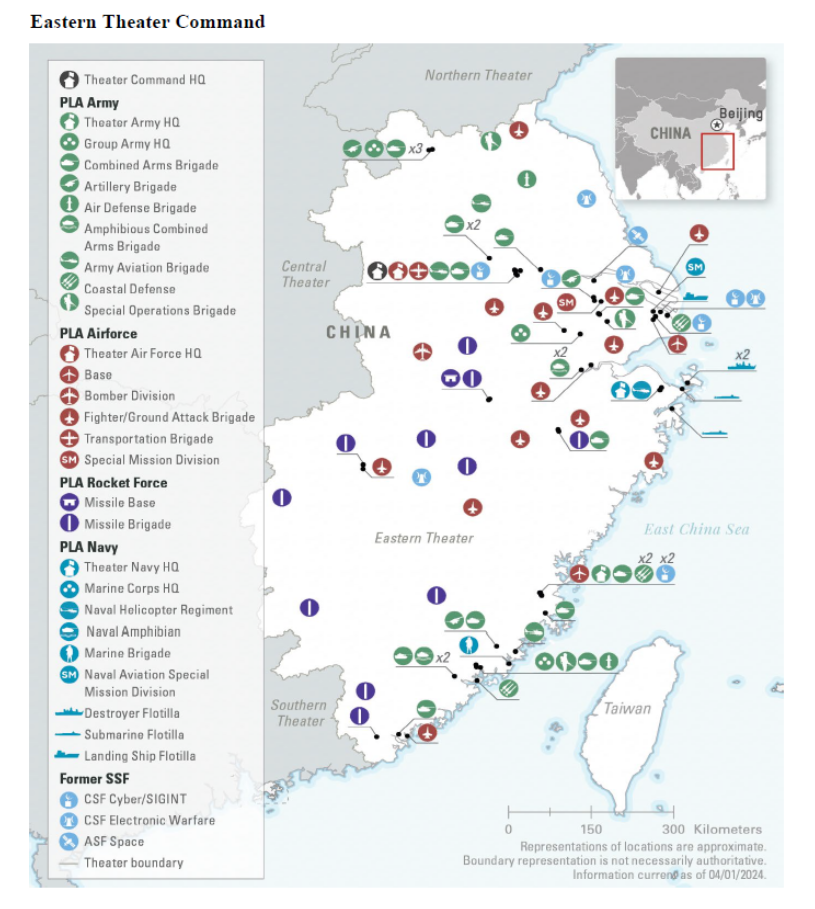
Source: DoD, Annual Report to Congress: Military and Security Developments involving the People’s Republic of China, 2025 (December 23, 2025).
The disposition of US forces are not shown. However, we do know that the deployment of the Tripoli Amphibious Ready Group (ARG), and its associated air defense capabilities, has diminished the US force posture in the South China Sea.
Moreover, Mr. Trump appeared willing to use the $14 bn arm sales approved by Congress as a bargaining chip for... who knows what. Refusing to sign off on the deal would be, in my opinion, another signal of weakness that we can ill afford given the centrality of Taiwan in the global economy. Or, 磕頭.
CRS (2026) summarizes the main points regarding importance to the US economy:
Taiwan is the United States’ 5th-largest merchandise trading partner ($256.1 billion in total goods trade), 9th-largest export market ($54.7 billion), and 5th-largest source of imports ($201.4 billion), according to 2025 U.S. data (and when the European Union is considered as one trading partner). The U.S. trade deficit with Taiwan reached $146.7 billion in 2025. U.S. agricultural exports to Taiwan in 2025 were $4.3 billion. In 2024, U.S. services exports to Taiwan were $13.7 billion, and Taiwan’s services exports to the United States were $13.2 billion.
Taiwan’s exports to the United States have been growing as firms have shifted some production and finished goods exports away from the PRC and with strong U.S. demand for semiconductors and electronics. Between 2018 and 2025, Taiwan’s goods exports to the United States grew by 341% while U.S. exports to Taiwan grew by 75%. In 2025, Taiwan’s U.S. exports rose by 73% while U.S. exports to Taiwan rose by 29% over 2024 levels.
…
In 2024, U.S. direct investment stock in Taiwan was $20.1 billion, and Taiwan’s direct investment stock in the United States was $14.8 billion, according to BEA. (Data do not include investments made through Hong Kong and offshore tax havens.) Taiwan is a top holder of foreign exchange reserves, with $604.5 billion in reserves as of January 2026. Taiwan is the 10th-largest foreign holder of U.S. Treasuries with $310.6 billion in holdings as of December 2025.
Semiconductors: About 90% of global advanced chips are made in Taiwan.
Ya know, if it weren’t for the attention-hpind in (what’s left of) the White House, we and much of the world would have Kevin Warsh under the microscope. Instead, a cursoey thought about the mess Arther Burns created, and back to the war-criminal-in-chief’s war of choice.
It is worth remembering, I think, that the war criminal appointed both Powell and Warsh – one a lawyer, the other a financier; Powell acquitted himself well – better than I at times gave him credit for. Neither one was a monetary policy specialist.
Yellen and Bernanke were both as expert as a human could be. Greenspan, though short on formal training and a partisan crank about fiscal policy, was very focused on monetary policy. Volcker? Big shoes to fill.
There is an intentional drift away from expertise at the Fed under the war criminal. Powell bravely, but not so surprisingly, stood against the drift he was meant to initiate. So he has been “demoted”. What now? The Fed is more than the FOMC, and Warsh has more authority over the rest of the Fed than over the FOMC.
For now, market participants don’t seem to expect Warsh to corrupt monetary policy. I am interested to see whether he’ll DOGE the place, or ICE it, or SCOTUS it.
Sheesh! Gotta edit better!
“… if it weren’t for the attention-hound in (what’s left of) the White House, we and much of the world would have Kevin Warsh under the microscope. Instead, a cursory thought…”