One of the reasons why the impact of higher gasoline prices might be muted relative to the past is the increased fuel efficiency of US autos, in small part due to a higher share of electric vehicles and hybrid vehicles in the US fleet. It could’ve been larger.
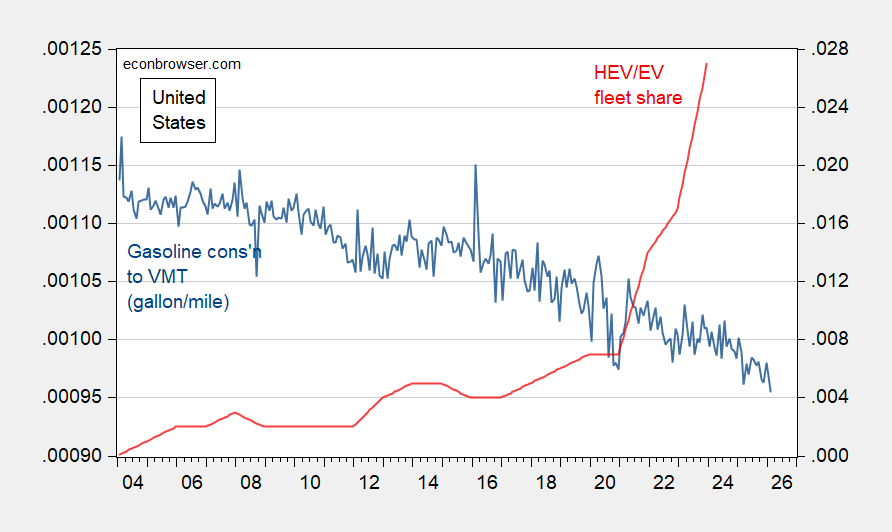
Figure 1: Gasoline consumption per vehicle mile traveled, gallon/mile (blue, left scale), and hybrid electric vehicle/electric vehicle share of fleet (red, right scale). Gasoline consumption seasonally adjusted by author using X-13 in logs. HEV/EV share linearly interpolated from annual data. Source: EIA, BTS, FHA, Argonne National Laboratory, and author’s calculations.
As of end 2024, Germany’s EV fleet share is about 6.4% If the US had a share like that, what would gasoline consumption look then look like?
A quick and dirty regression of log gasoline consumption on log vehicle miles traveled (vmt), EV share (EVRATIO) and a time trend (TIME), over the 2004-2023 period (available data) yields:
consgasoline = 1.34 + 0.98vmt – 1.17EVRATIO – 0.005TIME
Adj-R2 = 0.87, SER = 0.017, DW = 1.26, bold denotes significant at 5% level using HAC robust standard errors.
A one percentage point increase in the EVRATIO increases gasoline consumption by 1.17 percent. Hence, raising the US share to the German share would mean decreasing gasoline consumption by about 4.4 percent. Since gasoline consumption was 267 million gallons in February, the implied reduction from having a higher share of HEV/EVs would be about 11.8 million gallons, or $42 million in March. and $48 million in April. It’ll be $53.1 million in May, if gasoline prices average $4.50/gallon.
Unfortunately, policy under the Trump administration has worked in the opposite direction. Tax credits for EVs ended in September 2025, under provisions of the OBBBA. The impact on the share of sales is clear:
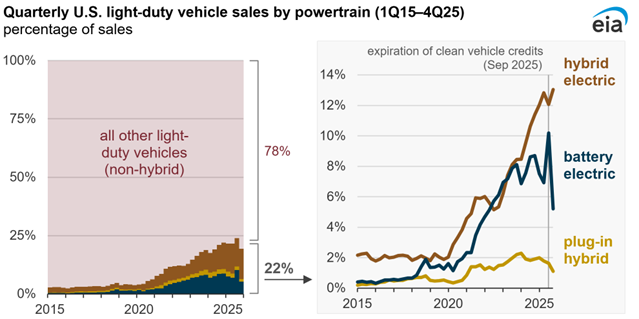
Source: EIA (2026).
In this sense, this provision of the OBBBA (like so many others) represents a missed opportunity to buttress the US economy against cost-push shocks.
Rejoinder to Bruce Hall’s citation of 2022 data regarding source of EV batteries:
Or, from Reuters, this year:
HONG KONG, Jan 2 (Reuters Breakingviews) – In 2026, U.S. battery supply will outstrip demand, ending dependency on imports. Former President Joe Biden’s policies set the changes in motion, and successor Donald Trump may take the credit. But the real winners are Korea’s LG Energy Solution (373220.KS), opens new tab, Samsung SDI (006400.KS), opens new tab and SK On, who will be better able to take on China.
U.S. demand for lithium-ion batteries, used to power cars and store energy, has been accelerating, but domestic supply failed to keep pace: consequently, for storage alone, the country has imported, opens new tab more than $100 billion in batteries and components since 2021, according to S&P Global, roughly half of which came from China. Increasing reliance on the People’s Republic – total lithium-ion battery shipments grew 15-fold in the decade to 2024, per International Trade Centre data – worried policymakers.
Maybe….
‘The United States primarily sources its electric vehicle batteries from China, with significant imports also coming from South Korea and Japan. In 2022, China accounted for the majority of U.S. battery imports, valued at approximately $9.3 billion.’
— World Economic Forum
Or, from Reuters, this year:
“HONG KONG, Jan 2 (Reuters Breakingviews) – In 2026, U.S. battery supply will outstrip demand, ending dependency on imports. Former President Joe Biden’s policies set the changes in motion, and successor Donald Trump may take the credit. But the real winners are Korea’s LG Energy Solution (373220.KS), opens new tab, Samsung SDI (006400.KS), opens new tab and SK On, who will be better able to take on China.
U.S. demand for lithium-ion batteries, used to power cars and store energy, has been accelerating, but domestic supply failed to keep pace: consequently, for storage alone, the country has imported, opens new tab more than $100 billion in batteries and components since 2021, according to S&P Global, roughly half of which came from China. Increasing reliance on the People’s Republic – total lithium-ion battery shipments grew 15-fold in the decade to 2024, per International Trade Centre data – worried policymakers.”
I guess Brucie does not want to count the lithium that will come from North Carolina’s Kings Mountain – since construction was approved under Biden:
http://www.albemarle.com/us/en/kings-mountain/proposed-mine
Count on Brucie to get the facts wrong, to do so in a partisan way and to avoid saying outright what he implies. “Who? Me? No! I was just doing my Glenn Beck imitation!”
Talk about insider trading!
Trump’s latest financial disclosure reveals that he executed an astonishing 3,700 stock trades since becoming president in January, a rate of 40 trades per day. Trades include millions in stock of companies such as Nvidia, Intel, Microsoft, Amazon and Boeing.
I’m so old I can remember when they made Jimmy Carter put his peanut farm in a blind trust before he could take office.
Sorry, that is 3,700 trades in just the first three months of 2026. Given there are 60 trading days in three months and that the market is open 6.5 hours per day, that’s one trade every 6 minutes for three months.
Update:
DETROIT, United States — May 12, 2026 — A landmark collaboration between Ford Motor Company and Contemporary Amperex Technology Co. Limited (CATL) is emerging as a defining moment for the global electric vehicle battery industry, potentially opening a new chapter in U.S.-China industrial cooperation amid evolving geopolitical tensions.
…
Ford’s decision to work with CATL underscores the growing dependence of Western automakers on advanced Chinese battery expertise. CATL remains one of the world’s dominant battery producers, with strong technological leadership in lithium iron phosphate (LFP) chemistry, a cost-efficient solution increasingly favored for mass-market electric vehicles.
https://www.nextmsc.com/news/ford-catl-ev-battery-deal-industry-update-2026
Local production of licensed technology does reduce the risk of supply disruptions for EV batteries, but it doesn’t lessen the dependence on China for the technology unless the technology is used as a stepping stone for a next generation of batteries developed by US manufacturers, which I think is unlikely as long as China keeps its foot on the new technology development pedal.
Seriously? Do you need a map? Kings Mountain. Look it up troll.
“which I think is unlikely as long as China keeps its foot on the new technology development pedal.”
bruce, your dear leader not only took our foot off the development pedal, he slammed on the breaks! deal with it. absurd leadership that was simply a knee-jerk reaction that whatever Biden and Obama did, he wanted to wreck.
cutting all of that research funding for nsf and nih will have significant impact on our ability to develop the next technologies for years to come. simply stooopid policy actions.