Nominal retail sales upside surprise (+0.2% vs consensus +0.1% m/m), but actual real declines. Manufacturing production +0.3% vs. consensus +0.2% m/m (industrial production down primarily because of utilities).
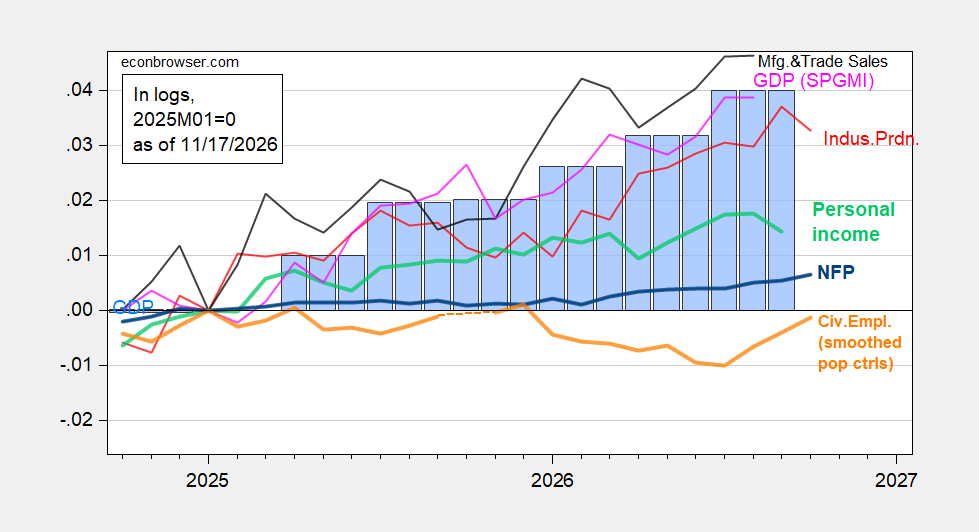
Figure 1: NFP employment (bold blue), civilian employment with smoothed population controls (bold orange), industrial production (red), personal income excluding current transfers in Ch.2017$ (bold light green), manufacturing and trade sales in Ch.2017$ (black), and monthly GDP in Ch.2017$ (pink), GDP (blue bars), all log normalized to 2025M01=0. Source: BLS via FRED, BLS, Federal Reserve, BEA 2026Q3 advance release, S&P Global Market Insights (nee Macroeconomic Advisers, IHS Markit) (10/2/2026 release), and author’s calculations.
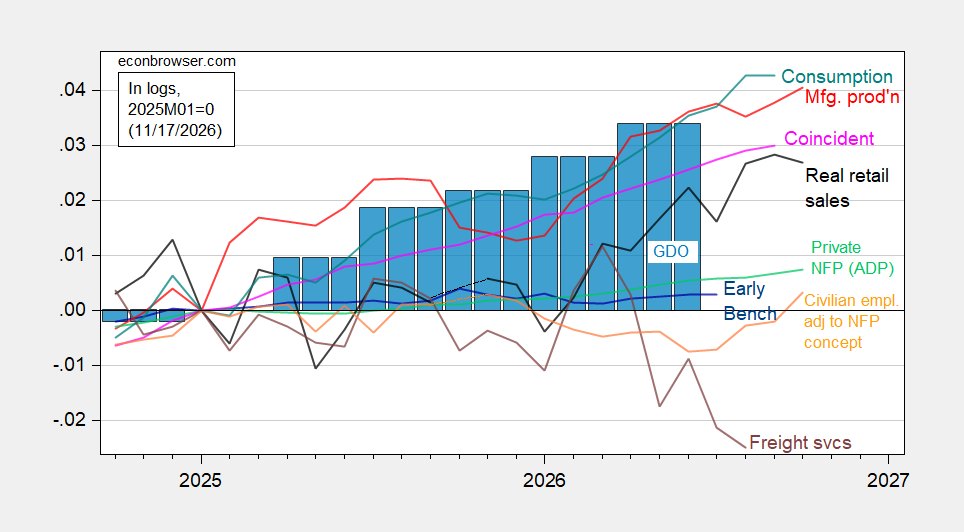
Figure 2: Civilian employment adjusted to NFP concept smoothed population controls, using experimental controls for 2025 (bold orange), manufacturing production (red), ADP private nonfarm payroll employment (light green), real retail sales, CPI deflated (black), freight services indexes (brown), and coincident index in Ch.2017$ (pink), GDO (blue bars), all log normalized to 2025M01=0. Source: BLS, ADP via FRED, Census, Philadelphia Fed, Philadelphia Fed, Bureau of Transportation Statistics, Federal Reserve via FRED, BEA 2026Q3 advance release, and author’s calculations.
Note that retail sales in previous month were revised up, so October inflation adjusted retail sales are still above what we thought a month ago they were in September. That said, both total retail sales and ex-gas station sales were down.
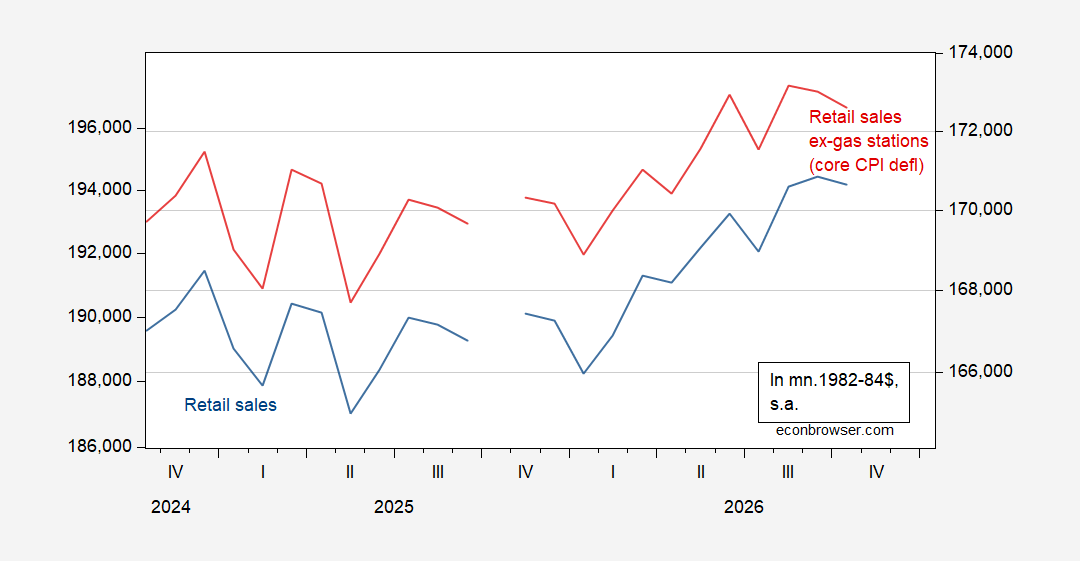
Figure 3: Retail sales, deflated by CPI (blue, left log scale), retail sales ex-gasoline station sales deflated by core CPI (red, right log scale), both in mn. 1982-84$. Source: Census, BLS, via FRED, and author’s calculations.
There’s some hand-wringing over Nvidia’s role in financing demand for it’s own product, given the loss of its randy CEO and some stock value.
I see the reason for concern, mostly because Nvidia is not regulated as a financial institution, so we know little about it’s financial dealings. I’m not so sure there’s a disintermediation risk, as long as Nvidia benefits from the circular financial relationship it has with its clients. Unless a new CEO leads to a re-evaluation of circular lending arrangements, I’m not sure how that arrangement can lead to disintermediation. A glitch in Nvidia’s cash positions? How? And to a large extent, Nvidia can engage in “60 days, same as cash” transactions so that business continues as usual, even if there is a cash glitch.
The problem, as noted above, is lack of transparency. And the potential for the entire arrangement to run into a bottleneck.
This is somewhat dated, from last June, but I saw it referenced in an NYT article and thought if any of Menzie’s regular readers who were healthcare economists might take an interest. I don’t normally read stuff this dense, but I kinda found this specific thing fascinating. Maybe because my elderly mother, I have no idea.
https://www.cbo.gov/publication/62491
Here’s the NYT article. Sorry for the paywall if you can’t get past it, I had an old hardcopy laying around the house.
https://www.nytimes.com/2026/06/29/upshot/assistant-surgeons-loophole-pay.html
Nvidia lends money to companies to buy chips, books the purchase order as an asset, then lends out the money again. Regular old fractional banking — with no regulatory oversight. What could go wrong?