With the December release, we have the following picture of key indicators followed by the NBER Business Cycle Dating Committee:
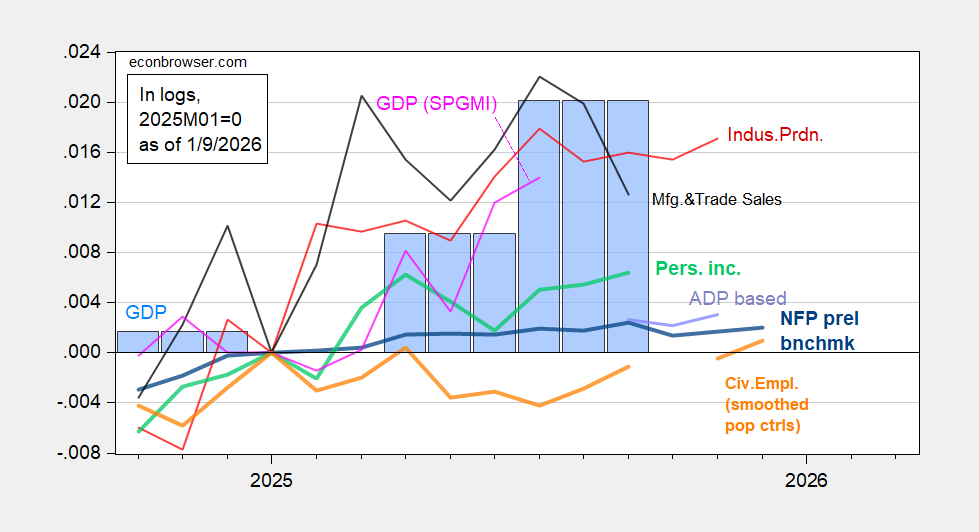
Figure 1: Implied NFP preliminary benchmark revision (bold blue), ADP based author’s estimate of November NFP (light blue), civilian employment with smoothed population controls (bold orange), industrial production (red), personal income excluding current transfers in Ch.2017$ (bold light green), manufacturing and trade sales in Ch.2017$ (black), and monthly GDP in Ch.2017$ (pink),GDP (blue bars), GDP (blue bar), all log normalized to 2025M01=0. Source: BLS, ADP, via FRED, Federal Reserve, BEA 2025Q3 initial release,S&P Global Market Insights (nee Macroeconomic Advisers, IHS Markit) (9/2/2025 release), and author’s calculations.
Overall emoyment growth has slowed sharply. In the second half of 2025, private education and healthcare have accounted for more than all the gains in payroll employment:
https://fred.stlouisfed.org/graph/?g=1QgUk
The only sector other than private education and healthcare in which there has been much job growth is leisure and hospitality.
Leaving aside the risk to employment that the cut to Obamacare subsidies represents when healthcare is keeping employmentfrom plunging, employment gains are now mostly in lower-paid professions. As a result, overall average hourly earnings are growing more slowly than earnings in individual sectors:
https://fred.stlouisfed.org/graph/?g=1QgYY
Just for fun, here’s the index of aggregate payrolls, inflation adjusted:
https://fred.stlouisfed.org/graph/?g=1Qh03
It’s clumsy measure, I know, but intended to show what’s happening to lower-and-middle-income households’ paychecks. Outside of the Covid recession, the latest quarter is the weakest in the past decade and more.
By the way, average hourly earnings are due for a boost from the bottom this month. The Economic Policy Institute estimates that 8.3 million workers will get a pay boost dur to minimum wage increases this month, adding about $5 billion to incomes. That is mostly just going to offset inflation, so that real incomes at the bottom don’t fall, or fall as much as they otherwise would have. Every little bit helps.
https://www.epi.org/