That’s the only way to think about it: We go from free navigation on the Strait of Hormuz on February 27 to de facto Iranian control on inbound shipping.
From NYT:
An arrangement with Iran to reopen the strait could come with a geopolitical cost for the United States. Iranian officials say they are designing the accord to ratify their capacity to control the strait and retain strategic leverage that they did not employ before the war.
Officials familiar with the emerging proposal have said that, under the new framework, vessels heading into the Persian Gulf would have to transit a channel controlled by Iran, while outbound ships would travel on a channel near Oman.
Such a deal allows traffic to resume (who knows at what dollar price).
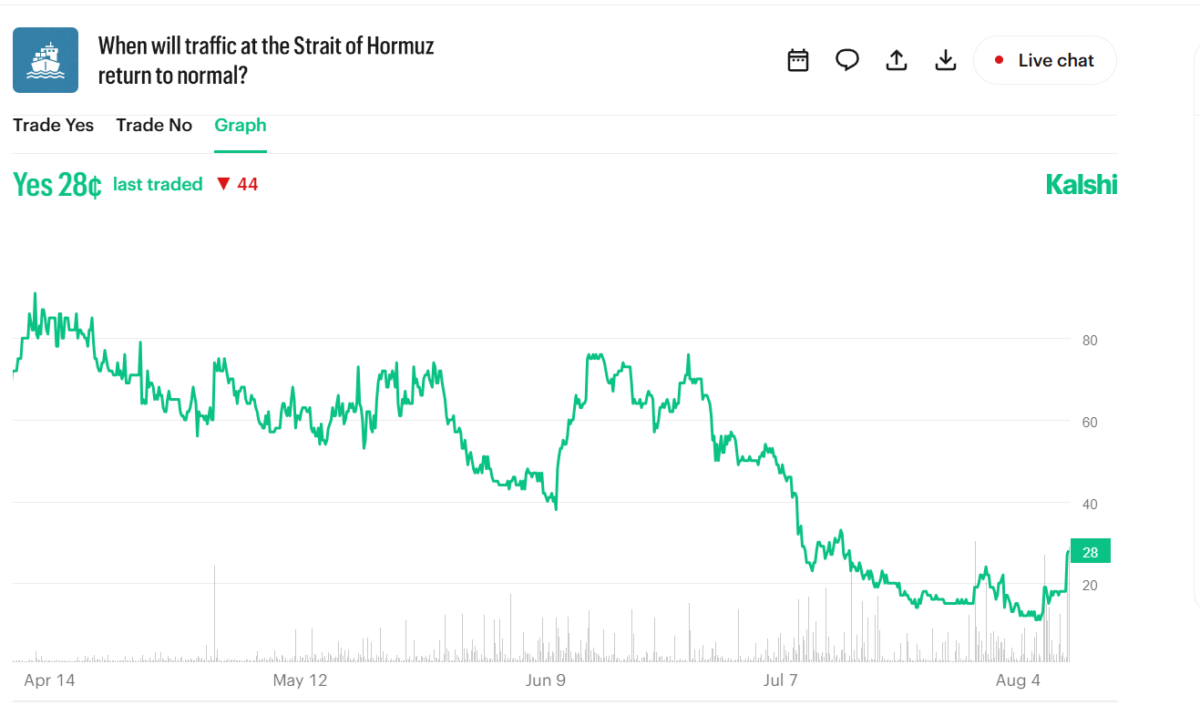
Source: Kalshi, as of 8/4/2026 noon CT.
This outcome would prevent the on-off-on nature of the oil market prices:
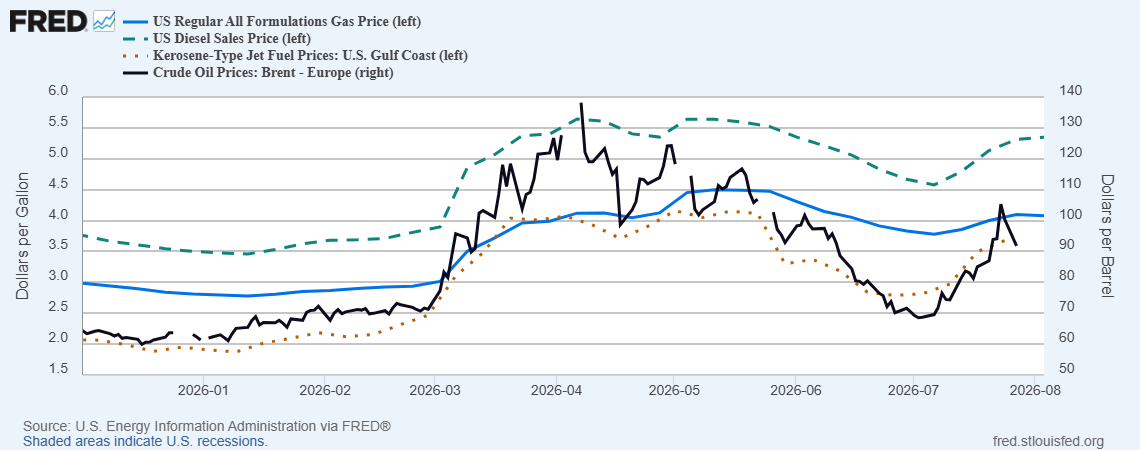
The only question — given Mr. Trump’s inability to hold steady to any approach — is whether any deal made would be sustained. One could imagine criticism of deal of this nature provoking recriminations about permitting the Iranians “a win”, and spurring another flip-flop.
Off topic, but not really…
Robert Reich thinks Elon Musk’s plan to spend another $100 million or so to buy elections for Republicans this year may be good for Democrats:
https://robertreich.substack.com/p/the-stink-of-musk
He cites Wisconsin’s Supreme Court election last year to suggest that Elon’s money so taints candidates that it is counterproductive.
Krugman extends this idea to all the billionaire supporters of the felon-in-chief:
https://paulkrugman.substack.com/p/the-oligarchs-are-doubling-down-on
Krugma is calling on Democratic politicians to, for once in their lives, hold the rich accountable for their actions.
As so many things do these days, the idea of holding the rich accountable, of having their Citizens United game blow up in their faces, reminds me of Peter Turchin’s book “End Times”, because holding the rich to any ethical standard would amount to a social revolution. (Insert Epstein sex-island joke here.) The premise of Turchin’s book is that when joining the moneyed elite is the only path to a good life, society always undergoes revolutionary change.
Maybe the signs are there. California is close to imposing a (tiny) wealth tax. AI, the new get-rich-quick sector, is the one thing Democrats and Republicans both despise. The oligarch-in-chief is, once again, the most hated president ever. His fat-cat-infested cabinet has shown the public how unspecial the moneyed elite really are.
Turchin identifies two paths, once the public decides to put an end to oligarchy: reform or disintegration. Mamdani or Schumer. El-Sayed or Stevens.
Of course, Turchin could be full of baloney, but leave me this one hope, OK?
El Sayed is nothing. The answer is in Bruno Bauer.
You seem to have only one thought in your head, and that’s not much of one.
from a sample of one (me), I don’t think the source of money has much impact on who somebody does/not support. it could certainly reinforce a positive or negative opinion about somebody. but I have not yet reached a point where I would/not vote for somebody based on who supplied the money. on the other hand, big donations can have considerable influence on how that candidate can be portrayed through advertisements, etc. I think that is a bigger deal, imo. sorry to squash your hope, md. again, only from a sample of one.
Certainly there are a lot of uninformed voters, but I can’t imagine any intelligent person not realizing that an endorsement or donation by Elon Musk means a racist and/or fascist.
I agree with Reich and Krugman that endorsements by the oligarchs should be exploited by Democrats.
Musk is mixed race(Dutch, Korean, Ashkenazi). He is a grifter pure and simple. His political groups are Putin scam groups via Nat De Rothschild. Pay attention.
I don’t see much evidence of voters changing their vote due to who is funding a candidate. maybe a couple of isolated incidents in the past. it just does not seem to be a strong factor when somebody goes into the voting booth. there are probably better ways to sway a voter than this issue. if character were an issue, trump would not have been elected to office twice.
Perhaps the best example is the 2025 Wisconsin Supreme Court race in which Elon Musk spent an unbelievable $25 million on a state judicial race. He also attempted to bribe voters by giving away $1 million checks to three voters who signed a petition against the Democratic judge candidate. He is now under criminal investigation for election bribery.
The result was a backlash of disgust from voters enabling the Democrat to win by 10 points in a state that Trump won twice.
Oligarchs like Musk, Bezos and Zuckerberg are toxic to the public and Democrats should highlight their participation in political races. Less engaged voters tend to be less interested in specific political issues and use social signalling in casting their votes.
On topic – the crack spread is still hugely elevated, but is down fairly sharply in recent days:
https://rbnenergy.com/market-data/3-2-1-crack-spread
Also, the spread between wholesale and retail gasoline is pretty normal. Station owners aren’t getting rich the way oil companies and refiners are.
i don’t follow the crack spread, but would note that our gasoline supplies fell by 1,643,000 barrels to a thirty-seven week low of 211,301,000 barrels during the week ending July 31st, while our distillate fuel supplies fell by 3,473,000 barrels to 107,159,000 barrels, the lowest summertime level in thirty years…our distillates supplies fell because the amount of distillates supplied to US markets, an indicator of domestic demand, rose by 417,000 barrels per day to 3,941,000 barrels per day, and because our exports of distillates rose by 98,000 barrels per day to a record high of 1,884,000 barrels per day…our distillate exports have been running at near record levels all war long because refineries from India to Japan that rely on Persian Gulf oil are at tank bottoms, and barely running…this week’s export record was exacerbated by refinery shutdowns in Northern Europe and seasonal agricultural demand in Latin America
There is no deal or arrangement. Why did you make this post??? Iran is irrelevant
The most important driver of inflation, and among the greatest global economic risks, and a war that threatens to involve a dozen countries and millions of people, and which has depleted U.S. defensive weapons stockpiles to a critical level is irrelevant?
Since you started showing up in comments here, you’ve yet to write anything worth reading, but this one beats ’em all.
Go ahead, explain. Entertain us.
Actually whether Trump goes back on this deal depends on what his stock “broker” (manipulator) tells him.
You can’t go back on a deal that not exist.
What pgl said is 100% correct. This is all market manipulation, and I don’t see anything different than what we’ve seen in the last 3 months. And yet Wall Street either keeps falling for it, or they’re also in on the scam.
There’s no reason the market should have boomed like this. Absolute garbage,
Speakung of the war, I had a look at Treasury’s Q2 Presentation to the Treasury Borrowing Advisory Committee, just to see what could be gleaned:
https://home.treasury.gov/policy-issues/financing-the-government/quarterly-refunding/treasury-borrowing-advisory-committee-tbac
For starters, the weighted average maturity of marketable debt oustanding, as of April, was 70.8 months, call it 6 years. So, averaging 5 and 7-year yields, the increase in Treasury borrowing cost since February (before the war in Iran) is 61 basis points. Jared Bernstein estimates that, at our current level of federal debt, an extra 10 bps adds $32 billion to annual interest costs:
https://econjared.substack.com/p/weekly-wrap-up-economic-strengths
So, as our debt rolls over, that’s an extra $195 billion in interest expense per year? Can that be right? If course, since we’re running a defict, the extra $195 billion is added to the deficit every year, so for any given set of interest rates, our interest payments go up because our interest payments go up. With r>g, that’s a poisonous situation.
Next, on page 13 we fund interest rate assumption through 2038. They come in three flavors: rates implied by forwards, CBO estimates and OMB estimates. Looks like OMB (run by a political appointee) forecasts the 10-year borrowing rate to fall through 2031, while the CBO expects rates to rise through 2032 and forward rates anticipate rates rising through 2037. By 2038, CBO puts 10-year rates about 1.1% higher than does OMB, and forwards price in 10-year rates 2.3% to 2.4% higher than does the grifter-in-chief’s pet OMB. I don’t recall ever seeing that large a difference between OMB and market projections.
Finally, a look at auction demand. Things are mostly OK, at least on the surface. Bid-to-cover ratios are holding fairly steady. Foreign and international bids have actually picked up this year, despite all the stories about Chinese demand falling off. That increase comes at the expense of domestic investment accounts, also not what we’re seeing from other sources. Confusing. The trend in primary dealer bids is steadily lower. Primary dealers can sell to foreign accounts, or anyone else, in the secondary market, and that can disguise fluctuations in demand.
ISW reports that Russia has had a near record high export of crude oil.
https://understandingwar.org/research/russia-ukraine/russian-offensive-campaign-assessment-august-4-2026/
Their problem is that their processing capacity has gone down by about 1/3 (from about 5.4 to 3.6 million barrels per day) due to Ukraines attack on refineries. So instead of exporting refined products (at higher profit) they are exporting crude oil.
he’d better come up with a deal to open that Strait soon, because low prices don’t generate more oil, as Mr. Trump seems to believe..
US commercial supplies of crude oil are at their lowest since September 2018; the Strategic Petroleum Reserve is at the lowest level since when it was being filled in March 1983, and the total of all US oil supplies are the lowest since March 1984…. the rate that our oil supplies are falling is also relevant; total crude inventories including the SPR were at 712 million barrels as of July 24th, down from 871 million on April 17th…here’s what that looks like on a historical graph: https://www.eia.gov/dnav/pet/hist/LeafHandler.ashx?n=PET&s=WCRSTUS1&f=W
US oil product supplies were also bouncing off a 23 year low a few weeks ago, but they’re up a bit now that our refineries are operating at 97.2% of their capacity, the highest rate since the summer of 2018…did anyone notice Trump is pushing to open our old decrepit refineries?
of course, we’re doing better than any of our allies…
The problem that Trump doesn’t get is that increases in production or refining oil are long term investments that takes time to get on-line, and then time to recover the original outlay of money. The same problem as with his tariff incentives to build factories in the US. If investors could look at a stable predictable situation over at least 2-5 years they would start a project – but with Trump in charge you have no idea what happens within the next few weeks. Even worse, you cannot use simple knowledge and logic to predict the most likely thing to happen. US used to be a stable and predictable place to invest and a lot of capital flowed in for that reason. Now you have to place an unpredictability premium on investments here. Investments in hydrocarbons are even worse because it is clear that the worldwide switch away from oil/gas is accelerating. The breakeven point in US is relatively high so the price where you flip to loosing money, is a lot closer in US than many other places in the world.
Here’s a press report out of Beirut addressing the state of talks between Iran and Oman, which mostly agrees with the NYT account:
https://english.almayadeen.net/news/politics/iran-says-hormuz-talks-are-only-with-oman–not-us
Iranian officials claim Iran and Oman are near an agreement on traffic through the Strait of Hormuz which would treat the Strait as their join territorial water rather than as international water. Oman is in contact with the U.S., but there are no direct talks between Iran and the U.S.
Iran insists that the U.S. military has to clear out in order for a deal to be struck. Presumably, that means clear out of the Strait, a recognition of Iran’s territorial claim. However, that raises the question of whether U.S. naval ships would be able to call at the Port of Jebel Ali in Dubai and whether the Fifth Fleet would continue to headquarter in Bahrain. Aside from relations with Iran, U.S. naval operations in the Persian Gulf are a big deal for other Gulf nations, and seem unsustainable is U.S. ships could not pass through the Strait. Somebody maybe should have thought of that before getting into a scrap with Iran.
Down the road, could the precedent of being chased out of the Gulf raise questions about U.S. naval operations through Bab el-Mandeb? That’s a stretch, I know, but who’d have thought, a year ago, that the U.S. Navy might be run out of the Persian Gulf?
don’t forget the pride factor here. Iran is deliberately taking the position that the strait is an agreement between Iran and Oman, without input from the USA. in essence, this deal will not have any trump approved component. in reality, trump and the usa military have a say. but who gets credit for the deal? Iran is intentionally irritating trump by claiming he has no say in the deal being struck. wonder how his ego will respond?
Remember when the MOU came out, and one response was “We agreed to let Iran and Oman work out who controls Hormuz!?!?!?!? What idiot decided that!?!?!?”
President Deals, the Great Negotiator, did.
latest agreement between Oman and Iran on the Strait says that any ship operated by the USA, Israel, or an enemy of Iran will not be given permission to transit the strait. this is what I call winning for Iran. there terms are almost like an unconditional surrender, and not by Iran. trump leadership at its best.
Product prices are high, relative to crude prices. That’s particularly true for heating oil, up about 70% from a year ago:
https://fred.stlouisfed.org/graph/?g=1XO8o
Heating oil prices aren’t a big concern for households right now, but will be as autumn approaches, particularly in the Northeast. Maine, upstate New York, Vermont, New Hampshire, Pennsylvania – they all heat with oil and all get cold early. Someone should ask Susan Collins about that.
back north in my old hometown, there is a crisis brewing. country roads need paving. they used to do it every 5 years, using a process called chip’n’seal. not glamorous but it worked. they cannot do it every 5 years now, looks like it may be a new 10 year window. why? costs have increased tremendously. not only for the extraction of the gravel, but petroleum products are needed in the mix process. locals are angry because their tax dollars are not covering the cost. its republican country. they cannot seem to understand that if you don’t pay taxes and material goods inflate in price, stuff doesn’t get done! chip’n’seal roads get some pretty nasty potholes when they degrade.
what appears to be the latest post at oilprice.com:
Iran Says Hormuz Stays Closed Until U.S. Meets Six Sweeping Demands
to wit: an end to U.S. threats and military action, a permanent end to the war, a withdrawal of U.S. naval and air forces from around Iran, compensation for war damages, sanctions relief and the release of frozen Iranian assets
Don’t kid yourself. Iran will control both inbound and outbound traffic through the Strait. Don’t put weight on legal documents. Rather, look at questions of will, power, and position. Oman will have neither the power nor the will to directly confront Iran. Enforcement of any such agreement will ultimately depend on the world’s policeman, who will be hiding out at Dunkin’ Donuts. The appropriate read for any Iran-Oman deal is as a cynical vehicle to gain uncontested control over the Strait by removing the US from the equation.
Further, Iran has not only stated a proposed tariff rate, but also the right to discriminate ship-by-ship as it so chooses. Thus, Iran could prevent any Gulf state allowing US vessels in their ports from using the Strait. Let’s think Bahrain, the home of the Fifth Fleet. In addition, Iran can use rates to punish adversaries. For example, our numbers say that container traffic through the UAE’s Jebel Ali would fall by half with even a 5% transit fee (by cargo value). In such an event, Iraq, Qatar and the UAE will become explicit Iranian vassal states and materially lose their sovereignty.
The Iranians (I think it’s the Iranians) anticipate a 7% transit fee would generate $100 bn per year in toll revenues. 7% at $75 / boe comes out at about $5 / barrel — really not that bad. However, the Iraqis were offering a $33 / barrel discount to anyone willing to load their crude. Therefore, the shadow value of the toll is likely in excess of $25 / barrel, and maybe more than $30 / barrel. Thus, the underlying economics of the energy trade may suggest that an energy toll of 35% of value may well prove viable. That’s a whole lot of money, close to the dollar value of Iran’s GDP. Don’t for a second believe the Iranians haven’t done their math.
Finally, Iran and Russia together will control about 20 mbpd of crude and product exports, thus making Iran “an OPEC of One”, with the power to dictate global oil prices all by itself.
And I have not even mentioned the potential to undermine the US’s Indian Ocean strategy.
I cannot overstate how dangerous ceding control of the Strait to Iran is. Yes, the US can live with it. We have gotten used to the fall of Afghanistan, as we did of Vietnam. At the end of the day, Iranian control of the Strait is a Gulf problem, maybe an Israeli problem as well. But Iran has an incentive to let the oil flow. And it will. In doing so, Iran will materially skim the surplus from Gulf oil sales and treat Iraq, Qatar and the UAE as de facto colonies. If the Israelis are edgy now, you ain’t seen nothin’ yet.
I would note that the Iranians have indicated that they are willing to make a financial settlement, and the numbers say such one is readily available. Nor should regime change to democracy be discounted. If we had a slightly more focused administration, that would be on the table, too.
Read our analyses here:
https://www.princetonpolicy.com/ppa-blog/