It’s a schizophrenic world. On one side, there are lots of people worried about hyperinflation [0], despite forward looking indicators of inflation signalling quiescence [1] and actual price indicators going downward.
Author Archives: Menzie Chinn
“Future Recession Risks”
That’s the title of a new FRBSF Economic Letter. From Future Recession Risks, by Travis Berge and Oscar Jorda:
An unstable economic environment has rekindled talk of a double-dip recession. The Conference Board’s Leading Economic Index provides data for predicting the probability of a recession but is limited by the weight assigned to its indicators and the varying efficacy of those indicators over different time horizons. Statistical experiments with LEI data can mitigate these limitations and suggest that a recessionary relapse is a significant possibility sometime in the next two years.
Vast Ice ‘Island’ Breaks Free of Greenland Glacier
From NYT, a quote of researcher Jason Box:
Petermann [glacier] is a sleeping giant that is slowly awakening. Removing flow resistance leads to flow acceleration… The coincidence of this area loss and a 30 square kilometer loss in 2008 with abnormal warmth this year, the setting of increasing sea surface temperatures and sea ice decline are all part of a climate warming pattern.
A Sputtering Economy?
The employment situation July release indicated a decrease in overall payroll employment. Does this outcome indicate a sputtering* economy
Contagion, Re-examined
For a while, contagion had dropped off the (research) map. But it’s now back (thanks to Greece et al!), in both research and policy arenas. A new symposium published in Pacific Economic Review covers the topic.
Macro Advisers on Expiration of EGTRRA/JGTRRA
From Macroeconomic Advisers “The impact of sunset of tax cuts on GDP, employment, inflation & interest rates”, released today:
Let Bush Be Bush…on Taxes
Recall the 2001 and 2003 tax cuts were written to expire, for the most part, in FY2011. I wrote in February that one way to start fixing the Nation’s finances is to let the EGTRRA and JGTRRA expire as they were originally designed to. Via EconomistMom comes Bill Gale’s additional reasons why we should, despite the lackluster recovery [0] (more on that below).
The 10Q2 Advance GDP Release: Cautionary Notes from Revisions
The 2010Q2 advance GDP release has been covered by Jim, as well as others. [RTE/Izzo] [CEA] [FreeExchange/RA] [CR] [MA] The release was accompanied by an annual revision of data extending back to data for 2007Q1. This revision alters our understanding (or lack of understanding in the cases of certain people) of the evolution of this recession. Here are the points I gleaned.
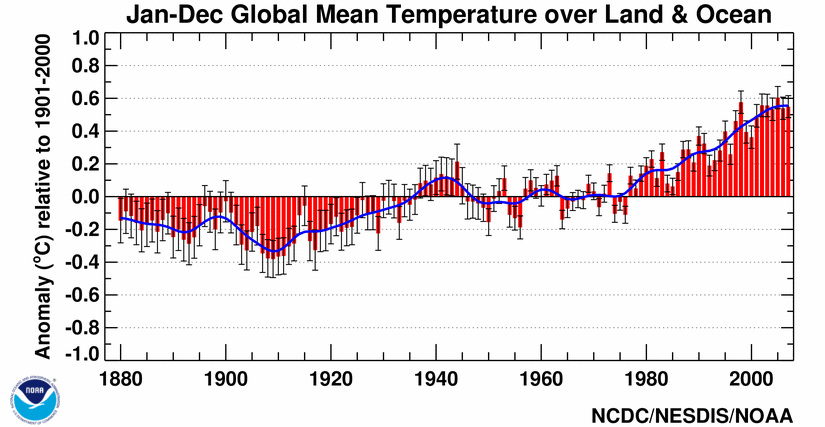
NOAA: Past Decade Warmest on Record
Conference: China in the Global Economy
Recently, I had the pleasure of participating in a CES-ifo workshop on “The Evolving Role of China in the Global Economy,” co-organized by Yin-Wong Cheung and Jakob de Haan. The conference agenda is here. The paper topics spanned issues ranging from monetary independence and integration into global financial markets, SOE access to credit and SOE efficiency, Chinese saving/consumption behavior, econometric models of China-global interactions, and the determinants of Chinese FDI in the rest-of-the-world.