Is the real interest rate set by the demand vs. supply of all savings, private and public? Or is it set by the demand for money vs. bonds emanating from liquidity preference and (outside) wealth demand? Got to answer this in anticipation of teaching this Fall semester.
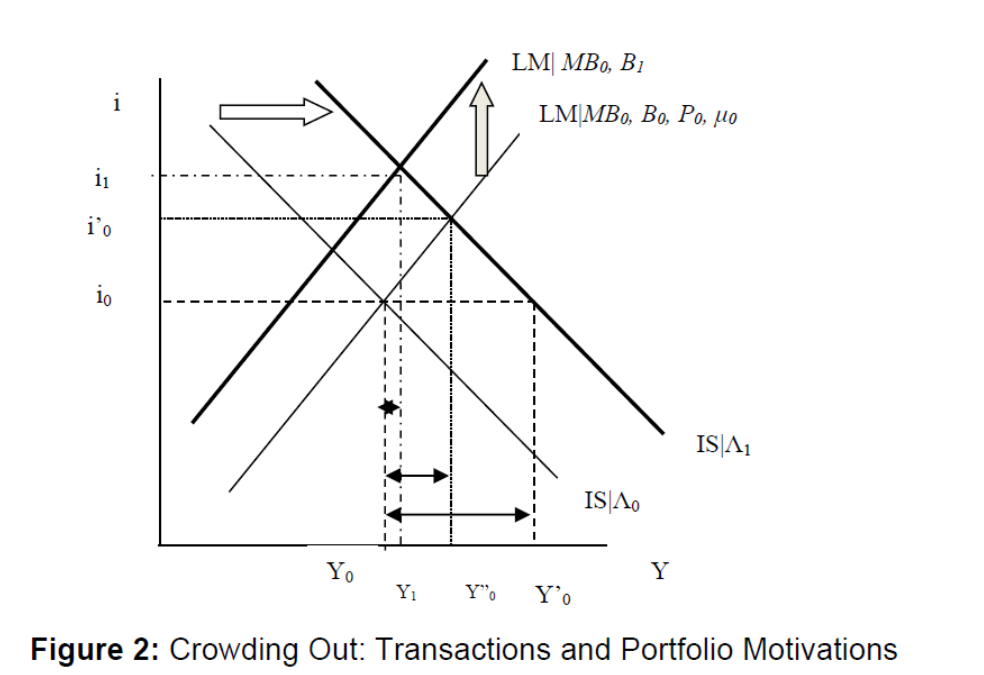
Usually, I use fthe latter in my classes, to illustrate portfolio crowding out arising from government budget deficits. Here’s an example of how I explain it, couched in IS-LM.
The loanable funds picture of increasing demand for savings due to running budget deficits looks like this.
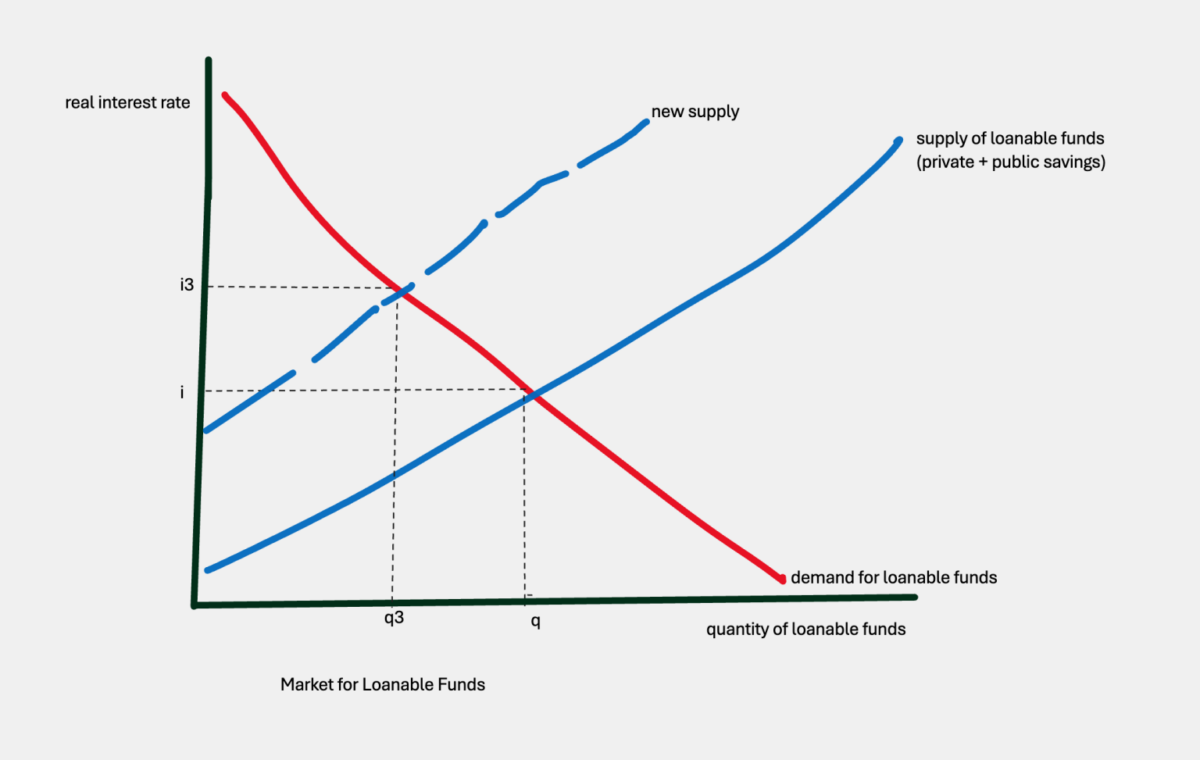
Both predict higher interest rates; I’d say both contain insights. However, it’s a good question which one is more accurate?
Well, if one could focus on outside assets only (which is consistent with a non-Ricardian equivalence world), then the former determines the interest rate on goverment debt.
However, recent journalistic accounts (e.g., [1]) have noted that demand for credit emanating from corporates, particularly those involved in AI capex, have had an influence. Hanno Lustig argues that in fact US government debt has become more “risky” so that government debt and other inside assets like high quality corporate bonds have become closer substitutes. Lustig deploys a picture of the AAA Treasury gap. I plot below the Glichrist-Zakrajsek spread, which controls for maturity.
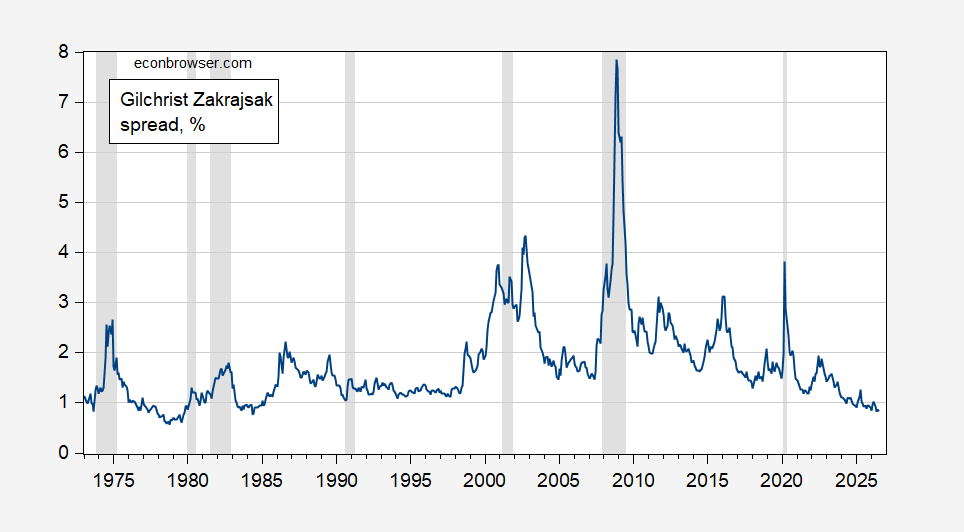
Figure 1: Gilchrist Zakrajsak spread, % (blue). Source: FRB.
The spread is quite low, suggesting that indeed the credit risk between US Treasurys and corporates has shrunk.
The corporate spread could be narrow because of lower default risk. Could be, but isn’t:
https://www.fitchratings.com/research/corporate-finance/us-private-credit-default-rate-reaches-new-high-in-2q26-30-07-2026
Defaults are up, not down. That doesn’t mean a worsening of credits within AAA or BBB, but it sure is suggestive.
As of Q1, the most recent I can find, Morningstar reported deterioration in private credit, also suggestive of worsening overall private credit quality.
So anyhow, a narrowing of corporate spreads doesn’t seem a function of improving private credit quality.
Aside from relative credit quality, there’s also the issue of relative supply. Portfolios simply have fuller tummies when it comes to Treasuries:
https://fred.stlouisfed.org/graph/?g=1XVdh
It is not a stretch, though, to associate a rapid increase in supply with deteriorating credit quality. So that FRED link reflects both a relative supply problem and a credit risk problem.
One more picture, having to do with g<r:
https://fred.stlouisfed.org/graph/?g=1XVdt
I used the 5-year yield, 'cause Treasury doesn't issue a six, which is closer to the weighted-average maturity of outstanding Treasury debt, but the story is the same. At today's rates, growth is going to be below the cost of borrowing for the foreseeable future. That's a poisonous situation.
Off topic – that war over there:
https://thecradle.co/articles/iran-reviewing-invitation-to-join-mecca-joint-defense-agreement-report
I can’t find mention of this among the big news outlets, but Iran has apparently been invited to join the Mecca defense thing. The Mecca defense thing has widely been characterized as Sunni countries banding together to protect each other from Iran. It has also been characterized as necessary to replace the U.S. defensive shield, now that the U.S. has been chased out of the Persian Gulf. And, it has been described as an anwer to Israel’s new expansionism. If Iran were to join, as a full member, it would oblige other members to defend Iran. Who’d attack Iran? Israel, the U.S. and other members of the Mecca defense thing, mostly.
So this report indicates the Mecca defense thing is about Israel more than anything else? On paper, at least, allowing Iran to join on the same terms as other members would commit other members to fight the U.S. and Israel should they attack Iran. There must be some really fancy fine print to this offer. Some fancy diplomacy. Some massive signaling to the U.S. and Israel about their recent behavior.
Not that either of the war-criminal heads of state are going to change their behavior over anpiece of paper.
If Treasury debt risk is rising, then we may have a problem. Here’s Adam Tooze knocking together a handful of recent papers on the functioning of the Treasury market:
https://adamtooze.substack.com/p/chartbook-469-the-risk-of-unwind
Turns out, hedge funds are the biggest source of new demand for Treasury debt. They are also more responsive to risk than,for jnstance, central banks or mutual funds. Back in 2020, there was a big hiccup in Treasuries, initially blamed on a cut in lending to hedgies. More recent research finds no cut in lending, but rather a response to internal hedge fund risk metrics. Back then, hedgies held about 1.5% of outstanding Treasuries. Now, they hold closer to 3.5%.
Risk is a potential trigger, and exposire is over twice as high. Back then, rates were headed down and were going to stay there for a while. Back then, the Fed was a buyer. Now, rates are headed up and the Fed is not a buyer. Thank goodness for…Scott Bessent?
Warsh: “We’re not going to give guidance. We’re going to let the bond markets speak.”
Bessent: “No, we aren’t.”
Trump: “The United States is giving serious consideration to changing the name of Lake Ontario to Lake America in that we don’t expect to doing much business with Ontario any longer.”
No more business with Ontario? Lake America?
This man is seriously mentally ill. The Republicans don’t want to say it. The Democrats don’t want to say it. The media doesn’t want to say. it.
Though not wrong, Fig 2 is confusing. Especially for someone not versed in the loanable funds theory. Fig 2 shows the supply of loanable funds decreasing which, in turn, causes the quantity demanded of loanable funds to decrease. I suggest changing Fig 2’s header.