Letter released today:
DoD’s Operational, Logistical, and Sustainment Costs. CBO estimates that as of August 1, 2026, the armed conflict with Iran has cost DoD approximately $38 billion. That amount reflects the costs of replacing expended munitions and equipment lost in battle, increased flying hours, other operations, and increased fuel costs. It also reflects that the initial,
intense phase of the conflict lasted just over a month (less intense combat operations are still ongoing) and that relatively few U.S. forces have been involved compared with the much larger and longer U.S. operations in Iraq and Afghanistan. CBO’s estimate does not include costs borne by other parts of the federal government, such as the increased cost of fuel used by the Postal Service. Nor does it include costs already accounted for in the federal budget, such as the basic operating costs of the military forces involved in the conflict.As the conflict persists, DoD’s costs will continue to increase—slowly if the level of violence remains low and sporadic (as it did in May and June) and rapidly if the intensity of the conflict escalates (as it did in July). CBO estimates that if the level of violence remained as low as it was in May and June, an additional month of conflict would cost $2 billion; if the intensity
of the conflict increased to roughly the level experienced in July, the cost per month would increase to $3 billion. Monthly costs could be higher still if the violence escalated further.
One observation: While CBO notes that the cost of repairing damaged bases is a real one, it does not explicitly include in its numerical calculation such costs.
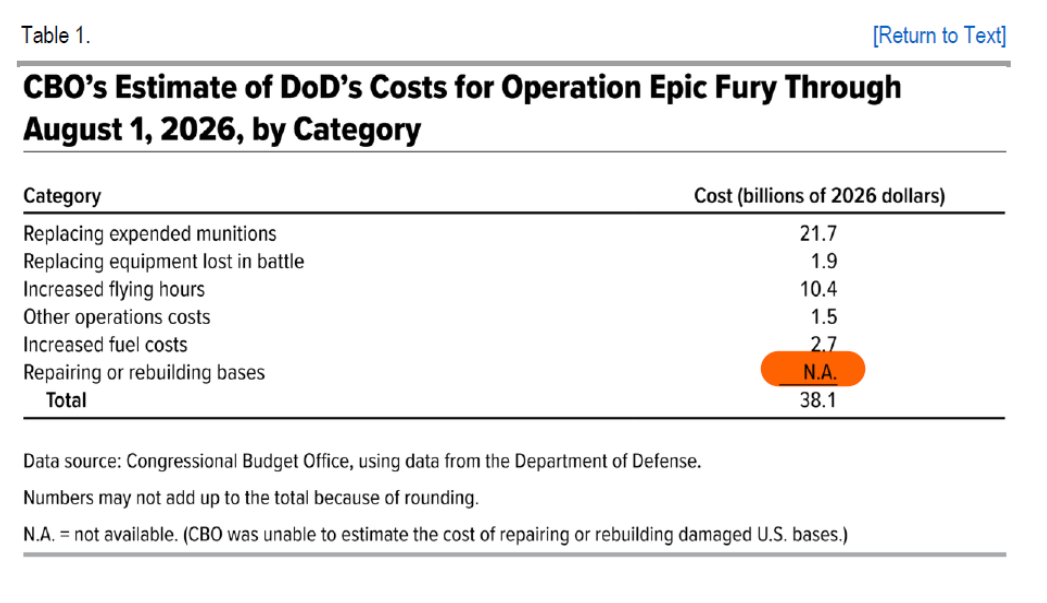
CBO on the bases:
Repairing or Rebuilding U.S. Bases. CBO is unable to estimate the cost of damage to U.S. bases and facilities in the Middle East for two reasons. First, DoD has not provided CBO with information about the value of damaged or destroyed equipment and property. Second, the extent of repairs or rebuilding that DoD plans to undertake is unclear. And even if the bases were fully repaired or rebuilt, a portion of the costs of doing so could be paid by host nations.
Regarding economic impacts:
In CBO’s assessment, the effects of those higher energy prices will put upward pressure on consumer prices. As a result, in the first quarter of 2027, inflation (measured year over year) in the price index for personal consumption expenditures (PCE) is now estimated to be 0.5 percentage points higher than the agency projected in February 2026, and core PCE inflation is estimated to be 0.3 percentage points higher than previously projected. (The core PCE price index excludes prices for food and energy.) In CBO’s baseline projections, the paths of overall and core PCE inflation differ: Overall PCE inflation reflects the direct effect of increased energy prices, which, in CBO’s estimation, added 2.3 percentage points to the annualized rate of inflation in the second quarter of 2026. (PCE inflation in that quarter was 5.3 percent.) As energy prices decline, that effect diminishes in subsequent quarters in relation to CBO’s projections. The conflict has affected core PCE inflation more gradually than it has affected
overall inflation. But in CBO’s estimation, core PCE inflation will remain elevated longer because higher energy prices take longer to affect prices of nonenergy goods and services than they do the price of gasoline or other energy-related products.