Letter released today:
DoD’s Operational, Logistical, and Sustainment Costs. CBO estimates that as of August 1, 2026, the armed conflict with Iran has cost DoD approximately $38 billion. That amount reflects the costs of replacing expended munitions and equipment lost in battle, increased flying hours, other operations, and increased fuel costs. It also reflects that the initial,
intense phase of the conflict lasted just over a month (less intense combat operations are still ongoing) and that relatively few U.S. forces have been involved compared with the much larger and longer U.S. operations in Iraq and Afghanistan. CBO’s estimate does not include costs borne by other parts of the federal government, such as the increased cost of fuel used by the Postal Service. Nor does it include costs already accounted for in the federal budget, such as the basic operating costs of the military forces involved in the conflict.As the conflict persists, DoD’s costs will continue to increase—slowly if the level of violence remains low and sporadic (as it did in May and June) and rapidly if the intensity of the conflict escalates (as it did in July). CBO estimates that if the level of violence remained as low as it was in May and June, an additional month of conflict would cost $2 billion; if the intensity
of the conflict increased to roughly the level experienced in July, the cost per month would increase to $3 billion. Monthly costs could be higher still if the violence escalated further.
One observation: While CBO notes that the cost of repairing damaged bases is a real one, it does not explicitly include in its numerical calculation such costs.
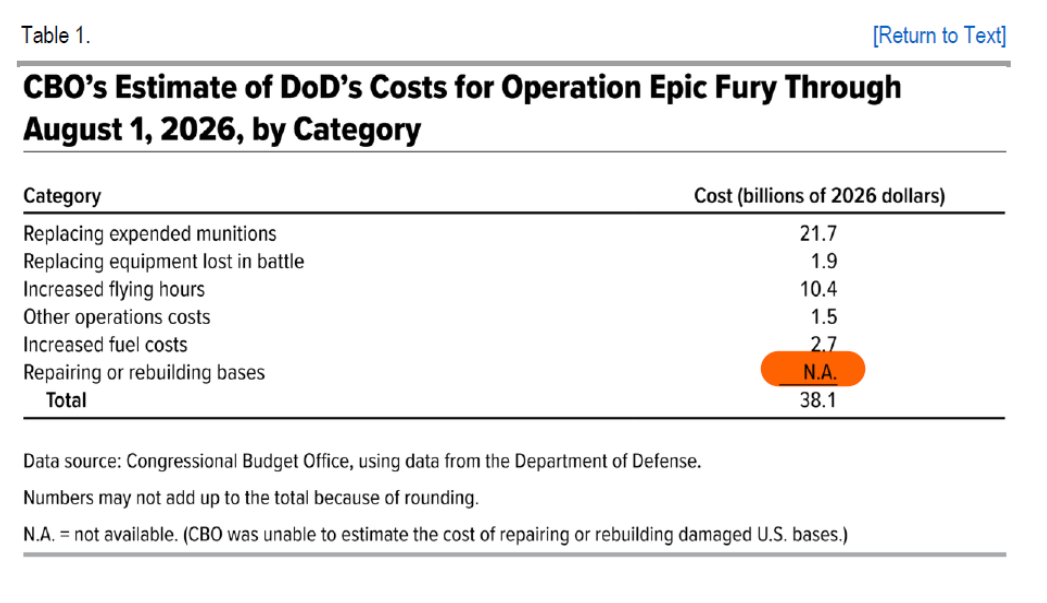
CBO on the bases:
Repairing or Rebuilding U.S. Bases. CBO is unable to estimate the cost of damage to U.S. bases and facilities in the Middle East for two reasons. First, DoD has not provided CBO with information about the value of damaged or destroyed equipment and property. Second, the extent of repairs or rebuilding that DoD plans to undertake is unclear. And even if the bases were fully repaired or rebuilt, a portion of the costs of doing so could be paid by host nations.
Regarding economic impacts:
In CBO’s assessment, the effects of those higher energy prices will put upward pressure on consumer prices. As a result, in the first quarter of 2027, inflation (measured year over year) in the price index for personal consumption expenditures (PCE) is now estimated to be 0.5 percentage points higher than the agency projected in February 2026, and core PCE inflation is estimated to be 0.3 percentage points higher than previously projected. (The core PCE price index excludes prices for food and energy.) In CBO’s baseline projections, the paths of overall and core PCE inflation differ: Overall PCE inflation reflects the direct effect of increased energy prices, which, in CBO’s estimation, added 2.3 percentage points to the annualized rate of inflation in the second quarter of 2026. (PCE inflation in that quarter was 5.3 percent.) As energy prices decline, that effect diminishes in subsequent quarters in relation to CBO’s projections. The conflict has affected core PCE inflation more gradually than it has affected
overall inflation. But in CBO’s estimation, core PCE inflation will remain elevated longer because higher energy prices take longer to affect prices of nonenergy goods and services than they do the price of gasoline or other energy-related products.
Update, 9/19:
From CSIS, base repair cost, $4bn-$9.4bn.
Speaking of the effects of our war on Iran, the FOMC is expected to hike it’s target rate band by 25 basis points tomorrow, and is not the only major central bank meetingthis week. The BoE meets Thursday, the BoJ Friday. The BoJ is widely expected to hike its target rate by 25 bps, while the BoE is expected to hold steady for now. Futures price in 100 bps in BoE hikes by end 2027, 50 bps of hikes from the BoJ by the end of 2026.
Japan’s 10-year cleared 3% today, to close at 3.04%, the highest since 1996. The UK 10 closed at 5.41%, the highest since 2007. The Treasury 10-year touched 5% today, to close at 4.99%, also the highest since 2007.
All three countries have above-target inflation, and their central banks have given up waiting around for it to come down. If only somebody had some way to take the pressure off of central banks.
Feels like another wave of inflation is moving through the retail sector, at least based on my latest trip to our big box store.
Increased cost of diesel fuel will push up produce prices – and pretty immediately.
Funny thing is that China banned export of diesel so did Russia (not that they had any to export – Trump did not. So Trump doesn’t want to cut the huge profits of the oil companies by demanding that refined products (diesel/gasoline) cannot be exported out of US.
I have seen an estimate of about $100 billion paid by consumers for the additional cost due to gasoline and diesel, from to the war. the war is expensive.
Interesting that Kevin Warsh chose to try and preserve Fed credibility rather than stay in Trumps grasses. Undercurrent must have gotten him worried. You do not want to make yourself a joke (like Hassett did) just before stuff hits the fan.
Two things. First, Warsh doesn’t call the shots, so we don’t know what decision he’d have made, left to his own devices. We only know that Warsh didn’t dissent.
But yeah, he probably agreed with the hike. Even an average mind with Warsh’s background can imagine a spiral into something much worse than we have now if the Fed does nothing. Given that current inflation is the result of a supply shock, rates hikes aren’t a good solution and aren’t likely to have much effect. Expectation, confidence and credibility are the channels of influence here, not so much the cost of credit and the wealth effect. Bad situation for the Fed and other central banks. Bad situation for us. But doing nothing would have caused even more problems.
trump is going to prefer high inflation to recession, hence his call for 1% rates. 8% inflation can be uncomfortable, but it is not the same as a deep recession with 10% unemployment. not sure which side of the fence warsh really stands on in this regard. most steep recessions are forgotten over time, because they are done inside of a year. but inflation (or stagflation) episodes can last for years, and define a legacy.