From Steve Kamin:
Until early in President Donald Trump’s second term, the sensitivity of the dollar to the difference between the slope in the U.S. yield curve and foreign yield curves was mainly positive, as expected. Increases in U.S. 10-year yields relative to those abroad boost the dollar.
But immediately after “Liberation Day” in April 2025, when Trump shocked the world with his announcement of “reciprocal” tariffs, that sensitivity turned negative and started fluctuating widely around a lower baseline. The change in the dollar’s sensitivity is even more apparent when we compare its average value over the pre-Liberation Day period with that during the post-Liberation Day period.
If you think the real interest differential model is the proper lens to think about a big driver of dollar movements, then rising yields and non-appreciation suggest heightened risk, rather than a higher path for short horizon interest rates.
Torsten Slok reports the change in the ten year yield since the beginning of the year is about a percentage point, of which about a half is from higher real short rates, the other half from real risk premium, inflation expectations and inflation risk…
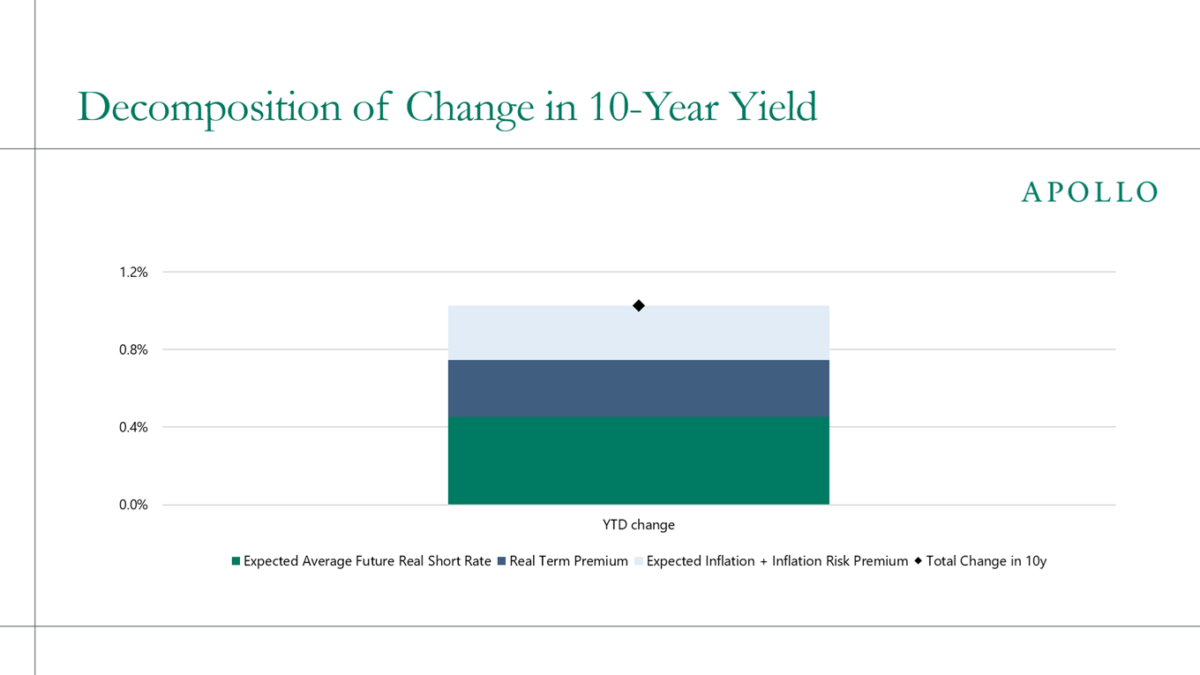
Source: Torsten Slok.