From Steve Kamin:
Until early in President Donald Trump’s second term, the sensitivity of the dollar to the difference between the slope in the U.S. yield curve and foreign yield curves was mainly positive, as expected. Increases in U.S. 10-year yields relative to those abroad boost the dollar.
But immediately after “Liberation Day” in April 2025, when Trump shocked the world with his announcement of “reciprocal” tariffs, that sensitivity turned negative and started fluctuating widely around a lower baseline. The change in the dollar’s sensitivity is even more apparent when we compare its average value over the pre-Liberation Day period with that during the post-Liberation Day period.
If you think the real interest differential model is the proper lens to think about a big driver of dollar movements, then rising yields and non-appreciation suggest heightened risk, rather than a higher path for short horizon interest rates.
Torsten Slok reports the change in the ten year yield since the beginning of the year is about a percentage point, of which about a half is from higher real short rates, the other half from real risk premium, inflation expectations and inflation risk…
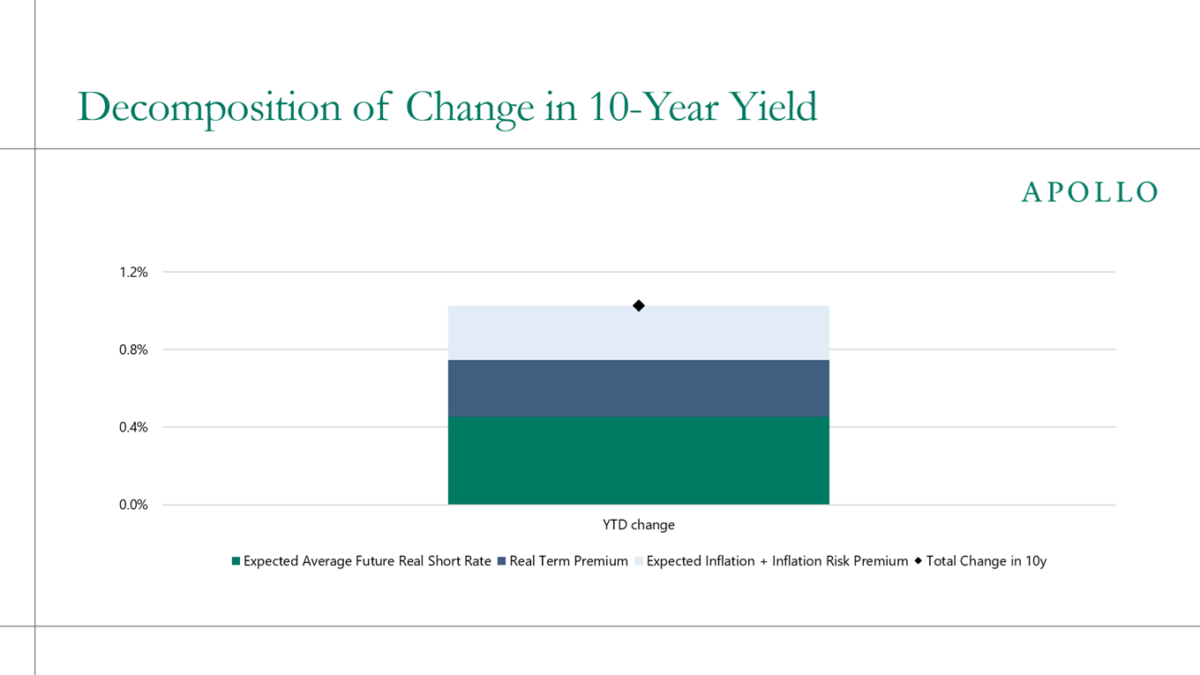
Source: Torsten Slok.
Not so much off topic – Two of the big stories in international economics this year have been China’s continued deterioration and the rapid rise in interest rates. As is often the case in economics, the big stories overlap:
https://finance.yahoo.com/economy/policy/articles/china-debt-interest-costs-soaring-195647431.html
China’s economic story has always been a debt story. The official line, at least since Covid came a’calling, has been that debt has to be carefully managed to avoid over-capacity and inefficiency, so it’s pretty interesting that China’s debt burden is worse than ours and worsening faster. Not surprising, but interesting. This year, 19% of China’s government budget is devoted to debt service, as opposed to 14% for the U.S.
Japan is at 26%, which is also kinda interesting. Japan has been able to goose growth through government spending for decades because of low borrowing costs, but now faces a debt roll-over problem. Japan’s prolonged need to goose growth started with a real-estate bust and has persisted because of a demographic bust. Not to be glib, but the similarities to China seem kinda obvious here. One significant difference is that Japan was not spending like crazy on its military through much of its period of debt accumulation.
For the rest of the world, there’s another connection between the debt story and the China story. China is a big economy, so when borrowing is a large fraction of China’s GDP, it means a large part of global credit goes to China, even though China remains a net creditor. When we tally up the sources of crowding out in credit markets, we should include China with AI and the U.S. government and the French and Japanese governments and every other major country’s government. And wars and rearmament. And tax cuts for the rich.
I was totally with you until that last sentence. /sarc
The fact that the effect of interest-rate differentials on exchange rates has flipped is important. It matters not just as information for currency traders, but also for those evaluating policies and risk. It’s important.
With that said, I do wish that otherwise careful writers would stop saying things like this:
“…the 10-year Treasury yield has inched upward to nearly 5%, a critical psychological threshold for investors around the world.”
Do we have a test for “critical psychological thresholds”? I’ve never seen one. Market technicians, the guys who draw magic lines in time-series charts of financial prices, often claim that some price is psychologically important, and I strongly suspect their repetition of such claims has made the idea of “critical psychological thresholds” popular.
Over a few decades, I have asked every technician I’ve worked with to justify their claim that price levels have psychological importance, and not one ever could. They say it, but cannot show it to be true. Market technicians’ standards are not as rigorous as the standard economists claim to apply, so no surprise they keep repeating claptrap. It should be a scandal when economists do it.
Trump refuse to let us know the outcomes of the “Big Beautiful Taxbreaks for Millionaires Act”.
https://www.politico.com/news/2026/10/14/administration-delays-irs-data-gop-tax-cuts-01116807
Classic GOP; if the data doesn’t fit the narratives, alter or suppress the data.
To release the data now would be election interference. Can’t have that.
Take it back, take it back right now!!! You are the fake news.
Have you gotten your $5,000 check from trump yet?? I was looking at this $7 Hot Wheels 1970s Plymouth hot rod “in lieu of” my trump check windfall. What you spending yours on?? ; )
http://www.yahoo.com/finance/economy/article/surging-gas-prices-pushed-cpi-inflation-to-37-in-september-the-fed-is-watching-133518198.html
We were told inflation would fall. It rose. But it’s only gasoline prices so people like Bruce Hall cheered!