Political pressure seems to be mounting for yuan appreciation. [0] Figure 1 depicts the stability in the USD/CNY nominal exchange rate over the past year.
Monthly Archives: March 2010
Modeling problems in credit markets
On Friday I joined fellow blogger Mark Thoma (and a good many other economists) at a very interesting conference on financial markets held at the Federal Reserve Bank of San Francisco. Here I share some ideas I expressed at the conference about the directions I feel this research ought to go.
Aspirin
Russ Roberts writes:
Menzie Chinn invokes the CBO “estimates” to argue against those who say the stimulus didn’t work. Did the stimulus help turn the economy around and create jobs? I’m skeptical on logical grounds but I confess that I do not have strong empirical evidence on my side.
But those who defend the stimulus have no empirical support either…
Speaking of Unfunded Liabilities: Medicare Part D
The Financial Report of the United States Government, 2009 was released last week. Perusing the tables, one encounters the gigantic new, unfunded entitlement enacted in 2003, namely Medicare Part D.
A new index of financial conditions
What do current financial indicators tell us about where the economy is headed?
The Global Financial Crisis: Explaining Cross-Country Differences in the Output Impact
From “The Global Financial Crisis: Explaining Cross-Country Differences in the Output Impact,” IMF WP 09/280, by Pelin Berkmen, Gaston Gelos, Robert Rennhack, and James P. Walsh:
We provide one of the first attempts at explaining the differences in the crisis impact across
developing countries and emerging markets. Using cross-country regressions to explain the
factors driving growth forecast revisions after the eruption of the global crisis, we find that a
small set of variables explain a large share of the variation in growth revisions. …
Who Are You Going to Believe?
Professor Casey Mulligan says (and yesterday unequivocally reiterates) the stimulus program would not stimulate the economy. The nonpartisan CBO says otherwise:
…CBO estimates that in the fourth quarter of calendar year 2009, ARRA’s policies:
- Raised real GDP by between 1.5 percent and
3.5 percent,- Lowered the unemployment rate by between 0.5 percentage
points and 1.1 percentage points,- Increased the number of people employed by between
1.0 million and 2.1 million, and- Increased the number of full-time-equivalent jobs by
1.4 million to 3.0 million compared with what those
amounts would have been otherwise (see Table 1).
Crawling forward
Another month of weakly improving auto sales.
Net Fiscal Stimulus
From the abstract to “On the ease of overstating the fiscal stimulus in the US, 2008-9”, by (my sometime coauthor) Joshua Aizenman and Gurnain Kaur Pasricha:
This note shows that the aggregate fiscal expenditure stimulus in the United States, properly adjusted for the declining fiscal expenditure of the fifty states, was close to zero in 2009. While the Federal government stimulus prevented a net decline in aggregate fiscal expenditure, it did not stimulate the aggregate expenditure above its predicted mean. …
What Are These Three Numbers?
These numbers are expressed in billions of FY2010 dollars.
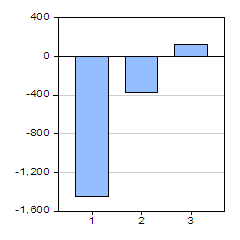
Figure 1, in billions of FY2010 dollars.