What’s the betting on closure by March 31? According to Polymarket, it’s 82% right now…
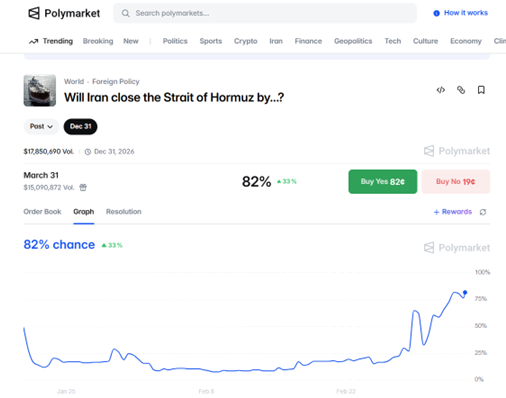
Source: Polymarket, 5 March 2026, 9pm CT.
The terms of the contract are:
Per the rules, this market requires Iran to halt or severely restrict international maritime traffic through the Strait of Hormuz. “Severely restrict” will be defined as a 80% or greater decrease in the 7 day moving average of commercial vessel transits (both cargo and tanker ships) on a given date when compared to the seven-day moving average 30 days prior, as reported by the IMF’s PortWatch service (see: https://portwatch.imf.org/pages/cb5856222a5b4105adc6ee7e880a1730), with the decrease being directly caused by actions taken by the Iranian regime. A consensus of credible reporting or government sources confirming that Iran has halted maritime traffic through the Strait of Hormuz will also qualify.
I don’t have up-to-date data, but the IMF’s Portwatch system provides data through March 1:
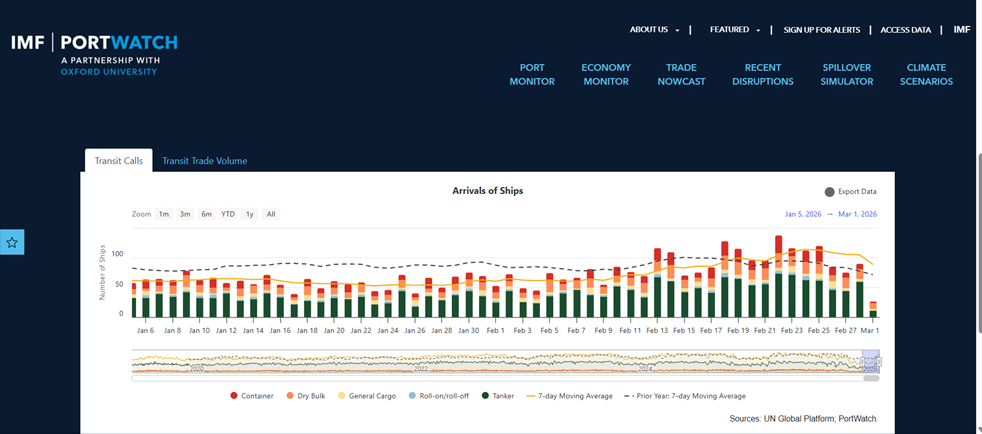
Source: IMF PortWatch, accessed 5 March 2026.
20% of oil exports go through the Strait; complete closure results in a spike in Brent to $108, according to Bloomberg Economics.
Here’s the current picture (red arrows are tankers):
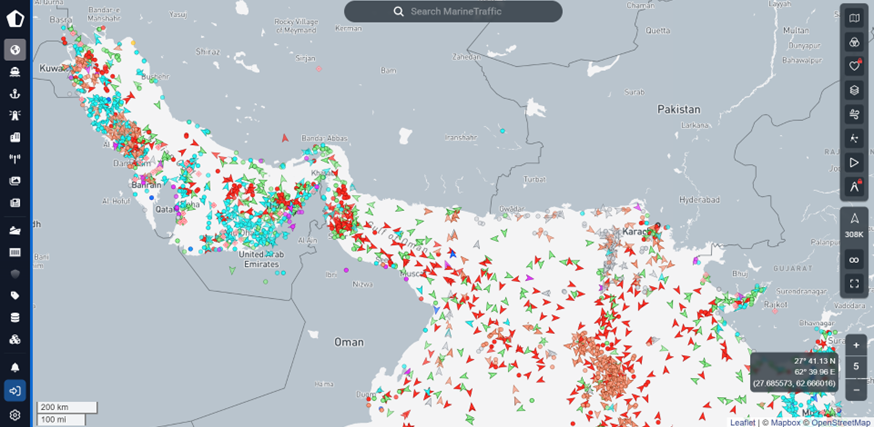
Source: MarineTraffic.com, accessed 5 March 2026, 10pm CT.
As Krugman points out – one of the biggest reason why every country in the world is moving to renewable energy is for security reasons. Also renewables help reduce emissions and air pollution. Also – I did find it interesting that the Middle East Gulf accounts for 16-18% of global seaborne fertilizer exports (sulfur and urea – hello farmers – although farmers in Northern Hemisphere have already secured supply for this season.). Besides that – this is a brewing humanitarian crisis for the whole region because 25-30 million tons of grain and oilseed imports are transited via the Strait. While grains can be stored – refrigerated produce can not – Jebel Ali handles approximately 15,500 TEU per year, roughly double the next largest port in the region. It serves as the supply lifeline for around 50 million people for produce. https://www.kpler.com/blog/how-the-strait-of-hormuz-shutdown-is-disrupting-dry-bulk-lng-freight-and-trade-compliance?utm_source__c=substack&utm_medium__c=email
Financial Times: Traffic Through the Strait of Hormuz has come to a virtual standstill.
https://www.nakedcapitalism.com/wp-content/uploads/2026/03/Screenshot-2026-03-06-at-5.27.32%E2%80%AFPM.png
Brent is over $90 and WTI is almost $90.
What amazes me is that it took the speculators so long! Did they really believe Trump’s typical hopium about a quick victory? Were they really that gullible?
As for me, I thought there was a very good chance, esp. with Khameini getting killed around day 2 or 3, that he would just bomb for a couple more days then declare victory and come home, sort of like last year and Venezuela. In retrospect, I think I would have put the odds of that at somewhat better than 50-50. So, I was wrong, but I’m guessing a lot of other people were wrong in the same way.
That is what he was going to do – but then Netanyahu found out and ordered him to continue bombing.
A reasonable explanation for the moderate initial respo se from financial markets is the expectation of a brief war.
The felon-in-chief has that he’s “allowing” Russia to export oil to ease prices and that the war will continue for as long as it takes and that he wants Iran’s unconditional surrender. WTI is up nearly 10 bucks today.
I think you’re onto something about how we’re adjusting our expectations for the duration of the war.
it looks like February, especially later February, saw a distinct increase in shipping traffic in the strait. any reason for why that might have occurred? looks like a bulge in tanker traffic in particular. was it an event, or did somebody know something was about to happen?
We know that Iran sped up oil exports in February. Whether other countries did the same, I don’t know.