Central Banking news account from the conference The ECB and Its Watchers, on Wednesday:
Bank of Finland governor Olli Rehn, UBS chief economist Tao Wang and economics professor Menzie Chinn discussed the changing global environment. The Bank of Finland governor focused on Europe, which in his view is would face “asymmetric” effects from the war in the Middle East due to its energy dependency. Wang said China’s considerable energy buffers would shield it from the effects of the conflict. Chinn said central banks’ credibility would be tested over the coming year as they navigated the crisis.
The conference agenda is here.
In my presentation, while mentioning the oft-mentioned points regarding different sensitivities and vulnerabilities of the various key economies, I also noted the different de facto preferences and credibility of the associated central banks. By de facto preferences, I mean voting in the face of pressure (government tweets, illegitimate prosecutions, etc.).
With respect to central bank credibility in an era of unprecedented presidential pressure, I noted the Bordo-Siklos measure of inflation credibility:
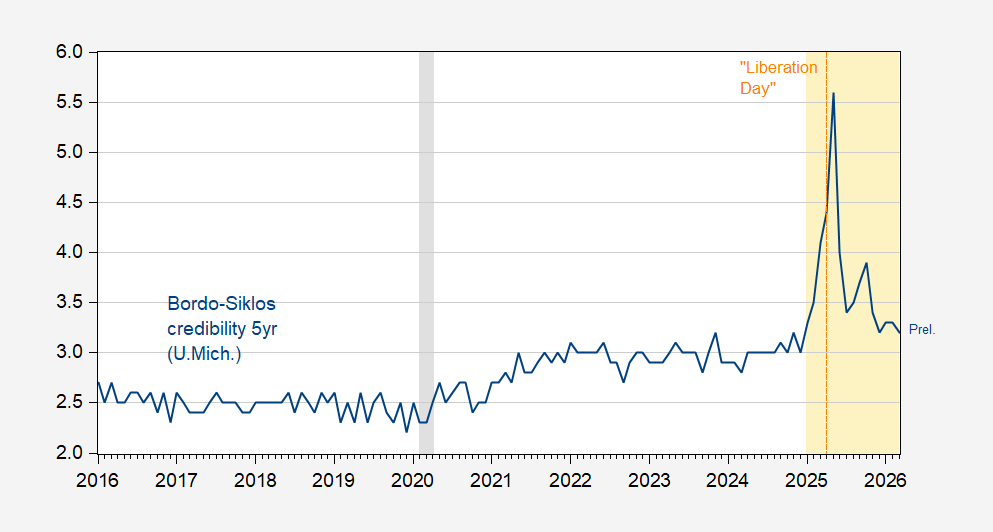
Figure 1: Bordo-Siklos measure of Fed inflation credibility (blue). Calculation assumes CPI target consistent with PCE target is 2.45%. Light orange shading denotes Trump administrations. Orange dashed line at “Liberation Day”. NBER defined peak-to-trough recession dates shaded gray. Source: BLS, NBER, author’s calculations.
And in terms of the dollar’s role as key international currency, this (merely suggestive) graph:
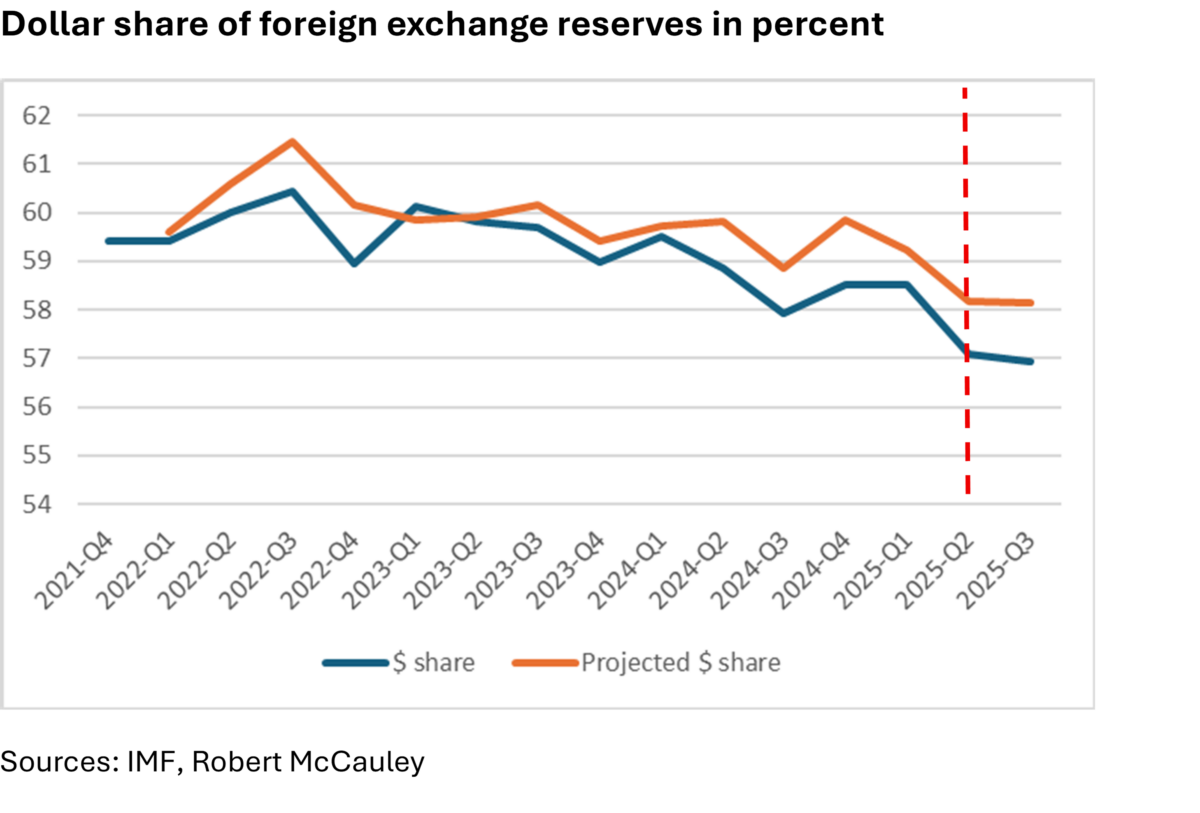
Source: McCauley (2026). Red dashed line at “Liberation Day”. Projected share adjusts for valuation changes (e.g., exchange rate changes).
While this last graph is not proof that the Administration’s recent actions have degraded the dollar’s role as key international currency, there is more evidence of an empirical nature regarding the impact of tariffs on individual central bank dollar reserves in Chinn, Frankel and Ito (2026). We don’t have 2025 data on individual central bank reserves (let alone 2024); however in data up to 2023, we do know that central banks in countries subjected to Section 232 tariffs seem to increase holdings of other reserve currencies, and possibly reduce holdings of the US dollar. (I presented these results at the ECB on Tuesday; slides here).
Suppose Trump is able to exert sufficient pressure on the Fed — either by verbal assault, intimidation via intermediaries, prosecution, or by otherwise sidelining current FOMC members in favor malleable supplicants — then monetary policy on this side of the Atlantic might become simultaneously less credible and more loose (on top of incredibly loose fiscal policy). In an environment of diminished credibility, it might not be too much to see something like what was witnessed in the 1970’s.
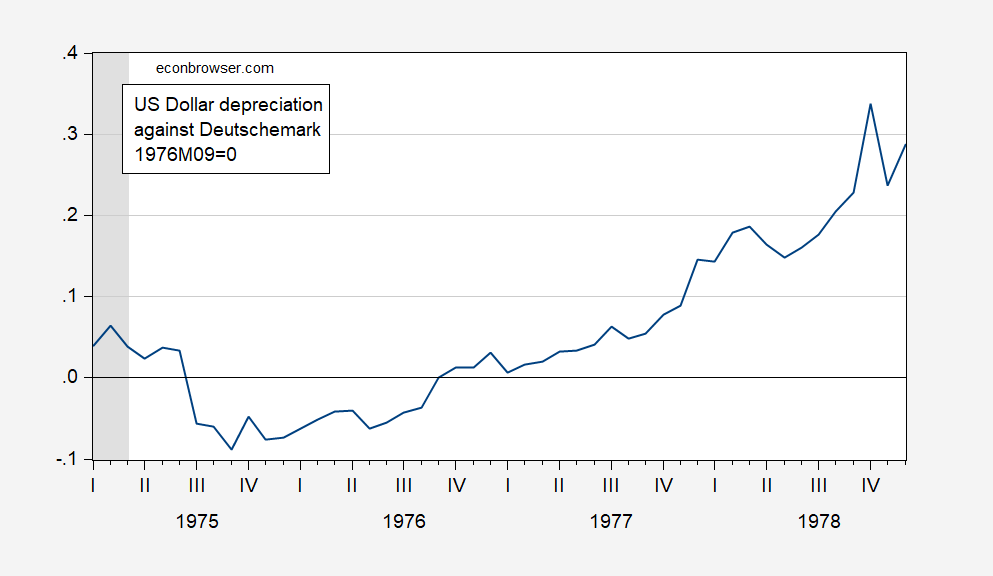
Is it possible that the dollar loses some of its attributes as a safe haven currency? I doubt that we’ll see a large change, but erosion can come slowly. Five year CDS prices suggest some effects from measures the administration has already taken.
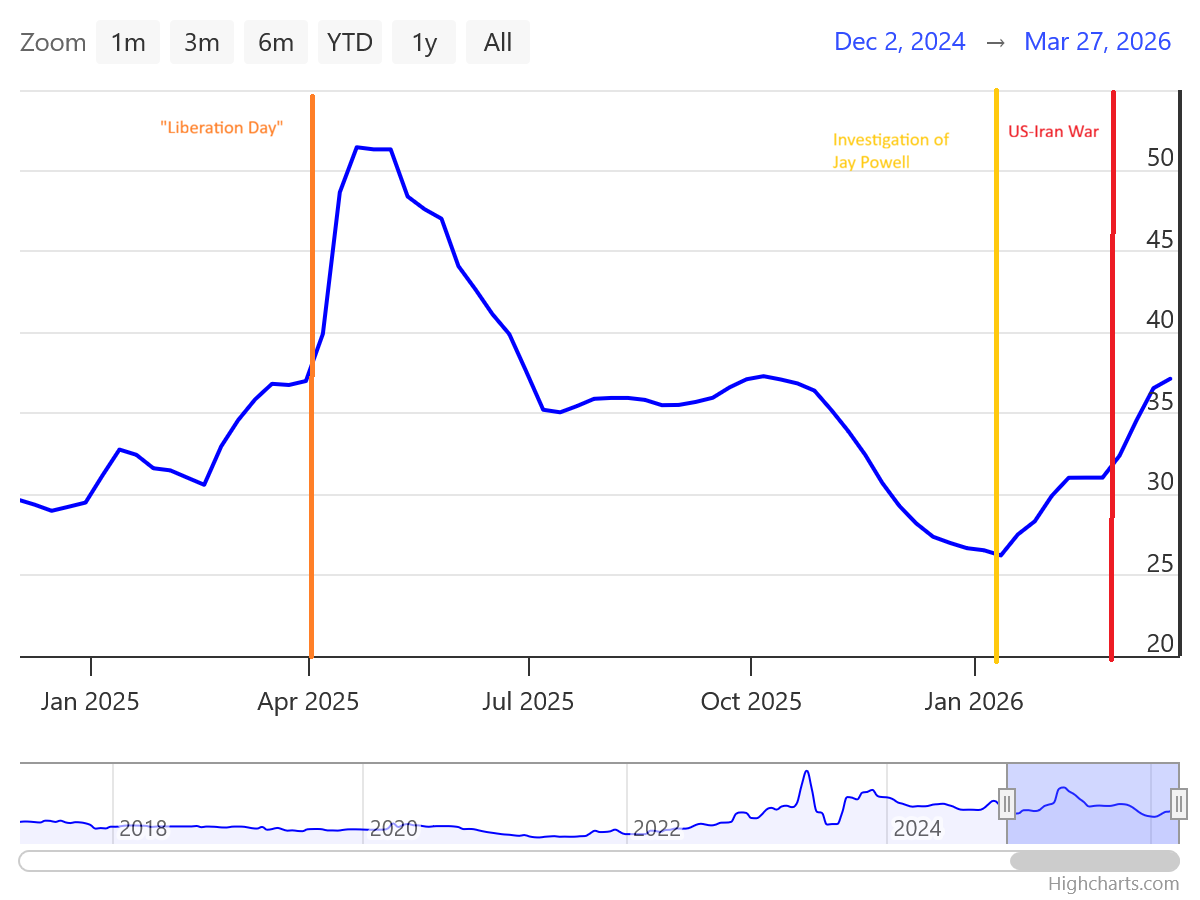
Source: worldgovernmentbonds.com, accessed 3/27/2026.