Possibly one factor in the impact of oil shocks (although Blanchard and Gali (2007) place greater weight on greater wage flexibility and central bank credibility):
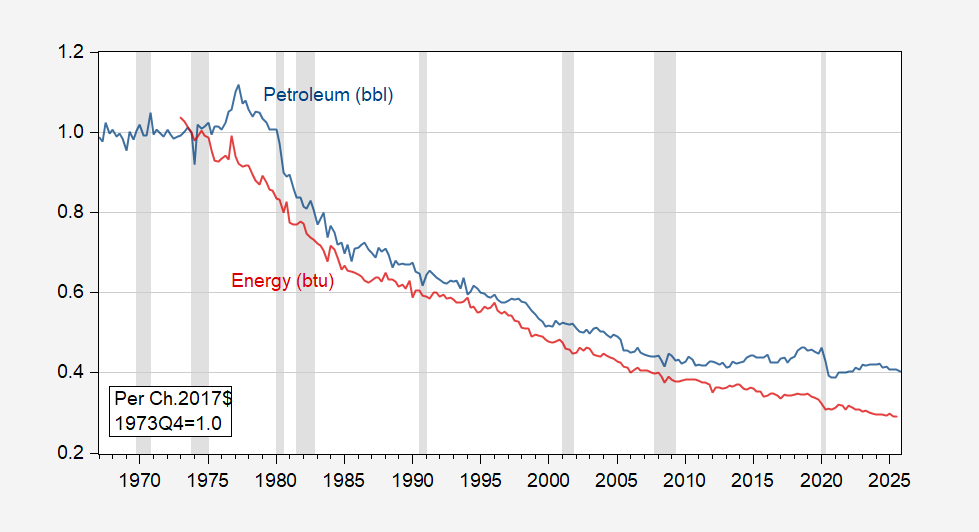
Figure 1: Petroleum intensity of real GDP (blue), and energy intensity of real GDP (red), normalized 1973Q4=1. Petroleum is in billions of barrels. Energy is sum of residential, commercial and industrial production, plus transportation production, in trillions of BTU. NBER defined peak-to-trough recession dates shaded gray. Source: EIA, BEA 2025Q4 second release.
Given the size of the oil price shock, it’s a good thing — at least in my mind — that the oil intensity of US GDP has decreased so much since 1973, even if other factors are important in the propagation mechanism. One might even go so far as to conclude the administration’s recent attempts to sabotage moves toward greater reliance on renewables has proved foolhardy.
For more on explanations for the decreased impact on output and inflation, see Hamilton (2018).
I’m picturing a book title: “The Man Who Killed Oil: How Donald Trump Made the World Embrace Renewable Electricity”
Feels a little clunky, but could turn out to be true.
still considering buying a new car. a year ago, i was going electric and tesla. then the tax benefit was eliminated and musk puked all over trumps shoes. i was looking at gas or hybrid, perhaps a rav4 for a few years until the trump administration leaves and EV becomes viable again. but with the recent war and potential oil crisis, an EV is back on the table. looked at a honda prologue the other day. and the lexus rz is in play. both are still expensive without the tax break. and neither is perfect. but if gas looks to stay at $3.50 or higher for a couple of years, then the EV is much more desirable. if i get a really good lease deal i will get one. otherwise just buy a rav4 and trade in a few years later. overall very disappointed in the autos available today.
Before we get too carried away, compare where we are to 2022 when, you know, the economy was great.
https://gasprices.aaa.com
Bruce Hall: In the four weeks (28 days) following the expanded Russian invasion of Ukraine, gasoline prices rose 70.5 cents/gallon. In the 18 days since the US-Israel attacks on Iran, the price of gasoline has risen 76 cents/gallon. So, the question is whether levels or changes are important (I think both). In addition, my guess is that households are more stressed financially in 2026 than in 2022.
I’ll agree that many households are stressed because of the 20+% rise in prices during the Biden administration and have not had the wherewithal to increase their incomes commensurately. So additional price increases are definitely an issue for them. It all depends on how long the Persian Gulf remains a dead zone.
I received a couple of pretty nice pay raises during the Biden administration. now I see employers threatening layoffs. bruce, your comment is inaccurate, as usual. Americans are paying for those trump tariffs without any corresponding bump in pay. and now is seems the tariffs are illegal, but trump does not want to pay them back. that is theft. typical of a grifter.
Huce Brall posting on MLBbrowser:
Before we get too carried away, compare where Shohei Ohtani’s stats are now to the 2020 season when, you know, he gave up over 6 walks plus hits per inning pitched.
https://www.espn.com/mlb/player/stats/_/id/39832/category/pitching
So, yeah, QED and all that.
Brucie, Brucie, Brucie…
You seem to have forgotten why gasoline prices were high in 2022 and again now. In 2022, Putin attacked Ukraine. Now, the felon-in-chief has attacked Iran. We didn’t have any control over Putin. The felon chose to attack Iran.
You also seem to have forgotten that Biden inherited a pandemic recession that caused massive supply-chain dosruptions, while the felon inherited an economy at full employment, and has caused a supply-chain disruption.
I keep reminding you that this isn’t a faux news circle jerk where facts don’t matter, but you just don’t seem to catch on.