Following up on comments to the post “Where did all the affordable cars go”, a typical new vehicle bought in 1960 was $1900; in October 2025, it was over $50000. What does that mean?
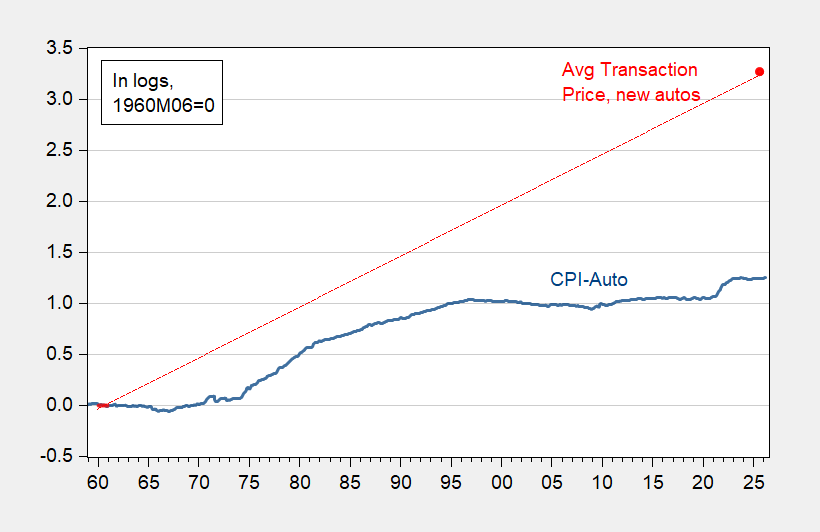
Figure 1: CPI-new autos (blue), average transaction price of a new auto (red), both in logs 1960M06=0. Source: BLS, Cox, and author’s calculations.
It means that the quality of new cars has advanced tremendously, and the mix has moved towards larger, more amenity-laden, vehicles. Holding constant those factors, the price of a new auto has only risen by some 125%, compared to 325% using just the average price (both in log terms).
The relative price of autos has declined:
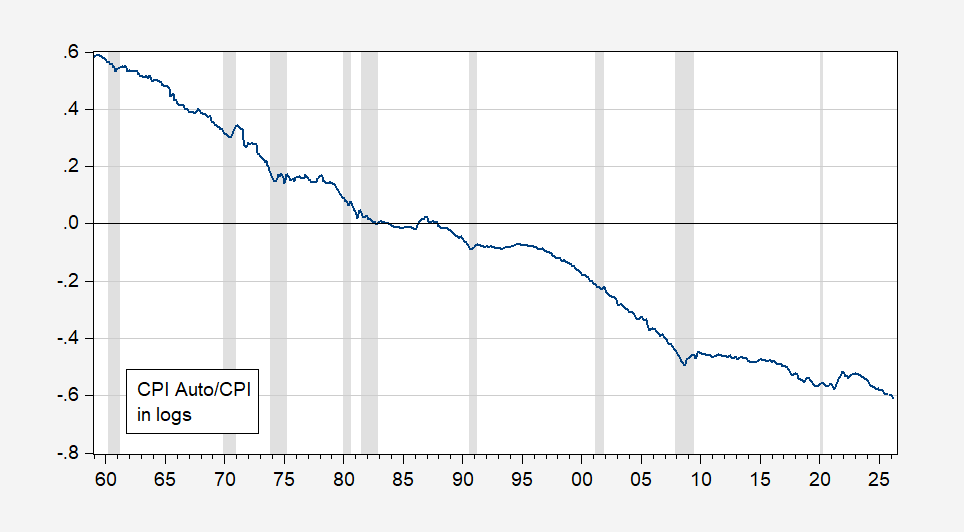
Figure 2: CPI – new auto to CPI, in logs (1982-84=0) (blue). NBER defined peak-to-trough recession dates shaded gray. Source: BLS, NBER and author’s calculations.
The relative price of autos, quality/mix adjusted, has indeed fallen. However. what’s true is that to the extent that autos are tradable (and were more tradable under NAFTA/USMCA pre-IEEPA), one should expect the relative price of cars to fall (Balassa-Samuelson!). The question is whether they could have fallen more if tradability was enhanced (maybe by opening up to EVs).
Heck, having more EV’s might even make the US economy less susceptible to self-inflected oil-based price-cost shocks…
There has been tremendous improvement in durability and reliability of cars over those decades. In 1960 the average age of cars on the road was only about 6 years. By 100,000 miles most cars were ready for the junk yard in those days. In 2000, the average age was 9 years and by 2025 it was 14 years. A car today with 100,000 miles is just getting started if it hasn’t been wrecked.
Average age is a pretty good proxy for durability because cars are not simply abandoned for age. They are just traded down to lower and lower budget customers as long as they are drivable and so remain on the road. Today’s cars are much higher quality than those in the past. The higher average age reflects many more years of drivability. Even assuming higher average price, the amortized cost is lower because cars last longer.
Absolutely correct. In the 1970s, you could expect to replace shock absorbers about every 3-4 years along with exhaust systems. Spark plugs were good for 10-15K miles. Oil needed to be changed every 5K miles (you can go a lot farther on synthetics). Bodies in the “salt” states started deteriorating in a few years. Not sure your new vehicles even need an alignment if there has been no suspension damage. The mechanicals are definitely far superior.
One issue, however is the cost of all of the electronics. which is approaching 40% of the vehicle price or double that in 2000.
“Electronics account for approximately 40% of the cost of a new car. This percentage has increased significantly from 18% in 2000, reflecting the growing importance of technology in automotive design and manufacturing.”
— fleetmanagementweekly.com — bccresearch.com
While that is great for all sorts of reasons, it does mean that “basic transportation” is harder to come by.
“Used vehicles accounted for approximately 55% of total vehicle sales in the U.S. as of early 2026, reflecting a strong retail sales pace in the used vehicle market.”
— coxautoinc.com — Federal Reserve Bank of St. Louis
Off topic – Seems Clarence Thomas doesn’t expect the Supreme Court to utterly eradicate independent federal agencies:
https://www.realclearpolitics.com/video/2026/04/16/justice_clarence_thomas_progressivism_seeks_to_replace_the_basic_premises_of_our_form_of_government.html
The whole “Progressive Era”, “Woodrow Wilson” harangue has to do with Thomas’s objection to government bureaucracy acting to fulfill their legal mandates without each action being subject to political oversight; you know, like changing overnight interest-rate targets or banning carcinogenic chemicals or requiring consumer products to be safe. Sounds like he’s yelling at his fellow abortion-prohibitors and dark-campaign-money-enablers to engage in some let ‘er rip libertarianism.*
Not that the Court is going to preserve independent federal agencies as they are. Roberts likes to chip away at settled law and Court precedent a little at a time. Thomas wants independent agencies swept away with a single Court opinion. And, boy, is he mad.
*Probably because Ginny told him he should.