Big operations have already mostly purchased fuel and fertilizer for the spring planting season. That means they have mostly locked in lower prices and that even in the face of upward price pressure, they’re unlikely to alter planting intentions.
Smaller operations are less well buffered against price swings, but more importantly may face outright shortages of fertilizer.
The U.S. winter wheat crop is suffering from drought and high winds – about 34% of the crop is rated ‘good’ or above, which is lower than average.
The corn planting season is underway and while fields are wet (different part of the country than the main winter wheat plantings), prospects are reasonable for a slight new record for corn output.
Soy bean margins have improved from last year and so acreage plans are about as they were last year. Beans are somewhat cheaper to grow than corn, but again, large operations are buffered for now against high spot prices for inputs. Next year, the choice between beans and corn will reflect higher fuel and fertilizer prices. The meeting between Xi and the felon-in-chief may change soy prices, especially in the western states, but planting is already underway. This year, only the replanting of failed corn fields with beans (see below) is likely to reflect the results of the Xi meeting, that and bean margins.
Finally, something that happens every year: Failed corn plantings – this year, it would be due to wet fields – can boost bean plantings. You try again with beans because they can be planted later in the year.
My own guess is that U.S. farmers may benefit from fuel and fertilizer shortages overseas – another case in which a U.S. war of choice hurts the rest of the world more than it hurts us.
Lava
Maybe, but their production exceeds demand, a problem hidden for so long. The real problem is the twin corporate and consumer debt bubbles financed by private credit. Or the debt ponzi that replaced the investment bank model used from 1983-07. All parties end eventually. The proxy war just drains debt capacity quicker. AI is just another bubble on a long list of bubbles since 2011. Once private credit can no longer finance it, we are back to 2008, just in the reverse, sorta like 29.
So Iran recently decided that oil tankers had to pay a buck a barrel for passage through the Strait of Hormuz, something that had never been done in the OPEC era. They have the power to enforce tolls and, already under attack, face no additional consquences for doing so. The U.S., long an advocate of freedom of navigation, said “OK, but you have to split it with us” – negotiations are still underway. Now Malaysia is thinking about imposing tolls on ships traveling through the Strait of Malacca, which carries more commercial traffic than any other waterway in the world.
Indonesia may have something to say about that, and has just signed a new military agreement with the U.S. China, not a fan of freedom of navigation for others, is on something of a worldwide crusade to ensure freedom of navigation for its own ships, and China sends an enormous amount of cargo through the Strait of Malacca.
The original “Raubritter” were aristocrats who imposed tolls on shipments passing through or near their lands. Not coincidentally, the great era of Germanic Raubritter was during the “Great Interregnum”, when the Holy Roman Empire was weak. In England, the heyday of robber barons was during the reign of King Stephen, known as “The Anarchy”. It’s what happens if no Great Power says “stop it”.
Under the felon-in-chief, the world’s most influential country has actively undermined the rule of law, violating treaties and committing war crimes with impunity. Israel noticed and expanded its war crimes outside of Gaza. Malaysia has also noticed; monkey see, monkey do. Expect more of the same.
Macroduck
The clock is ticking on the war-criminal-in-chief’s authority to wage war without Congressional approval:
The criminal-in-chief is, obviously, not particularly inclined to follow the law. That puts Republican lawmakers on the spot. As the article notes, they have declined to legislate against U.S. attacks on Iran, but as of May 1, they either legislate in favor of the war, demand an end to the war, or ignore the law. Two of these options are unattractive due to public opposition to the war, the other a repudiation of their capo.
Fun times.
Anonymous
I wrote my U.S. Senator expressing my opposition to an AUMF.
The reply was less than I expected. The Fox News lies on Iran.
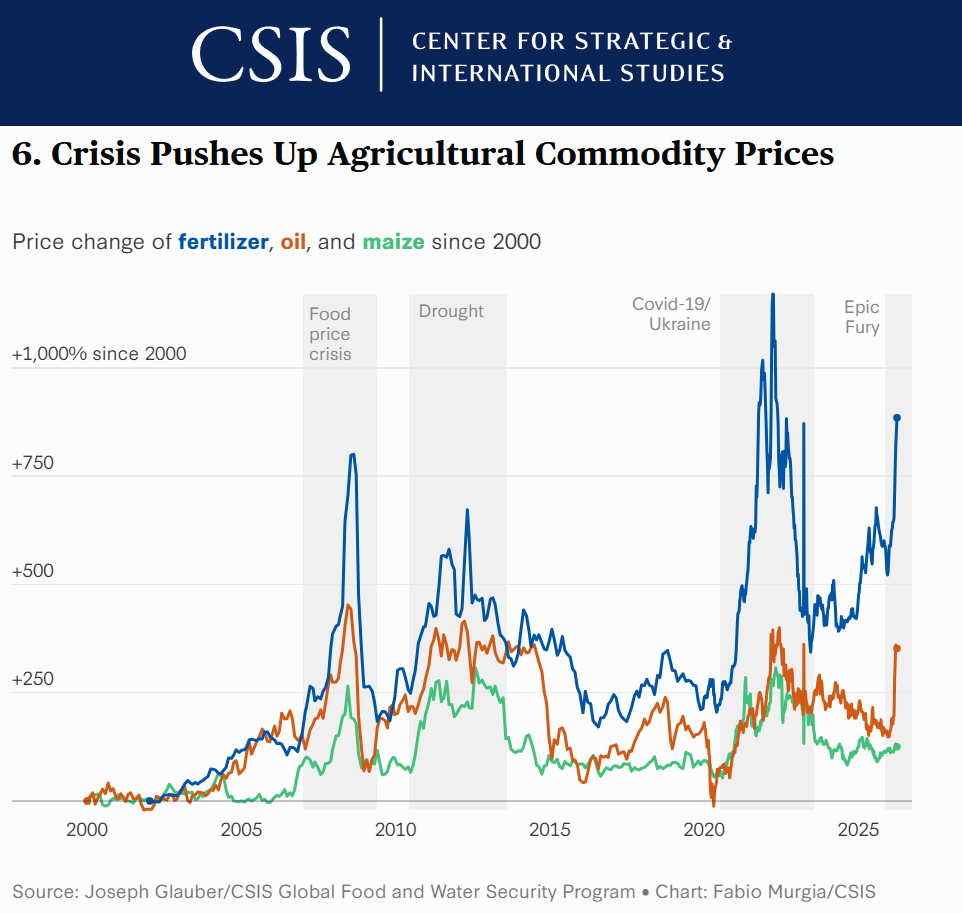
Gleanings from ag reports and the farm press:
Big operations have already mostly purchased fuel and fertilizer for the spring planting season. That means they have mostly locked in lower prices and that even in the face of upward price pressure, they’re unlikely to alter planting intentions.
Smaller operations are less well buffered against price swings, but more importantly may face outright shortages of fertilizer.
The U.S. winter wheat crop is suffering from drought and high winds – about 34% of the crop is rated ‘good’ or above, which is lower than average.
The corn planting season is underway and while fields are wet (different part of the country than the main winter wheat plantings), prospects are reasonable for a slight new record for corn output.
Soy bean margins have improved from last year and so acreage plans are about as they were last year. Beans are somewhat cheaper to grow than corn, but again, large operations are buffered for now against high spot prices for inputs. Next year, the choice between beans and corn will reflect higher fuel and fertilizer prices. The meeting between Xi and the felon-in-chief may change soy prices, especially in the western states, but planting is already underway. This year, only the replanting of failed corn fields with beans (see below) is likely to reflect the results of the Xi meeting, that and bean margins.
Finally, something that happens every year: Failed corn plantings – this year, it would be due to wet fields – can boost bean plantings. You try again with beans because they can be planted later in the year.
My own guess is that U.S. farmers may benefit from fuel and fertilizer shortages overseas – another case in which a U.S. war of choice hurts the rest of the world more than it hurts us.
Maybe, but their production exceeds demand, a problem hidden for so long. The real problem is the twin corporate and consumer debt bubbles financed by private credit. Or the debt ponzi that replaced the investment bank model used from 1983-07. All parties end eventually. The proxy war just drains debt capacity quicker. AI is just another bubble on a long list of bubbles since 2011. Once private credit can no longer finance it, we are back to 2008, just in the reverse, sorta like 29.
Who coulda knew? ¯\_(ツ)_/¯
Beyond the sarcastic comment – the FAO is warning of severe global food security risks from disruption to Strait of Hormuz trade corridor – https://www.fao.org/newsroom/detail/fao-chief-economist-warns-of-severe-global-food-security-risks-from-disruption-to-strait-of-hormuz-trade-corridor/en – besides fertilizer – Over 80% of fresh produce in some Gulf states is imported, and with shipping restricted, food costs are soaring, threatening to push over 30 million people into poverty. https://www.agroberichtenbuitenland.nl/actueel/nieuws/2026/03/31/impact-of-the-middle-east-war-on-food-systems-in-the-gcc – by the way, Trump’s wars and incoherent expenditure of U.S. military power – have made China into the single most stable global superpower that the rest of the world is turning to for trade and aid –
On topic – Robber Barrons:
https://jakartaglobe.id/news/indonesia-floats-ship-tax-in-malacca-strait-as-singapore-defends-free-passage#goog_rewarded
So Iran recently decided that oil tankers had to pay a buck a barrel for passage through the Strait of Hormuz, something that had never been done in the OPEC era. They have the power to enforce tolls and, already under attack, face no additional consquences for doing so. The U.S., long an advocate of freedom of navigation, said “OK, but you have to split it with us” – negotiations are still underway. Now Malaysia is thinking about imposing tolls on ships traveling through the Strait of Malacca, which carries more commercial traffic than any other waterway in the world.
Indonesia may have something to say about that, and has just signed a new military agreement with the U.S. China, not a fan of freedom of navigation for others, is on something of a worldwide crusade to ensure freedom of navigation for its own ships, and China sends an enormous amount of cargo through the Strait of Malacca.
The original “Raubritter” were aristocrats who imposed tolls on shipments passing through or near their lands. Not coincidentally, the great era of Germanic Raubritter was during the “Great Interregnum”, when the Holy Roman Empire was weak. In England, the heyday of robber barons was during the reign of King Stephen, known as “The Anarchy”. It’s what happens if no Great Power says “stop it”.
Under the felon-in-chief, the world’s most influential country has actively undermined the rule of law, violating treaties and committing war crimes with impunity. Israel noticed and expanded its war crimes outside of Gaza. Malaysia has also noticed; monkey see, monkey do. Expect more of the same.
The clock is ticking on the war-criminal-in-chief’s authority to wage war without Congressional approval:
https://www.nytimes.com/2026/04/22/us/politics/war-powers-act-explanation.html
The criminal-in-chief is, obviously, not particularly inclined to follow the law. That puts Republican lawmakers on the spot. As the article notes, they have declined to legislate against U.S. attacks on Iran, but as of May 1, they either legislate in favor of the war, demand an end to the war, or ignore the law. Two of these options are unattractive due to public opposition to the war, the other a repudiation of their capo.
Fun times.
I wrote my U.S. Senator expressing my opposition to an AUMF.
The reply was less than I expected. The Fox News lies on Iran.