If it seems that the BLS CES nonfarm payroll employment series has looked a bit more variable than usual, you might not be imagining it (although one would be very hard pressed to show it’s a statistically significant difference). To see this, compare against the ADP measure.
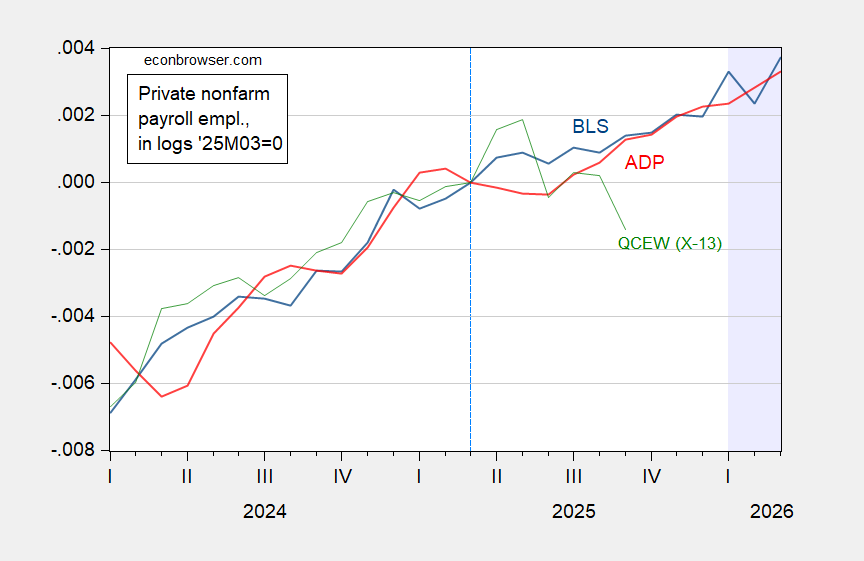
Figure 1: Official BLS private nonfarm payroll series (blue), ADP series (red), QCEW series, seasonally adjusted by author using X-13 (in logs) (green), all in log differences from last benchmark 2025M03 (marked in dashed light blue line). Light blue shading denotes 2026 observations. Source: BLS, ADP via FRED, BLS, and author’s calculations.
One might think this increased variability — not evidenced in the ADP series — is due to either (1) differing coverage of, for instance, the nurses strike in February, or (2) use of a new birth-death model. On the first point, the Kaiser nurse’s strike should have been covered by ADP as well as by BLS (as far as I can tell). On the second point, the new birth-death model was retroactively applied to the post-benchmark data, with application to preliminary release starting with January 2026 data. Hence, it’s not clear that this is the exact poinnt.
For a more agnostic assessment, see J.Coronado.
One thought on ADP’s treatment of the nurses’ strike. ADP takes its count from payroll processing. If employers submitted payroll data which showed striking nurses as employed, but not paid, it might create a difference between ADP and BLS counts.