Food at home prices are outpacing the CPI.
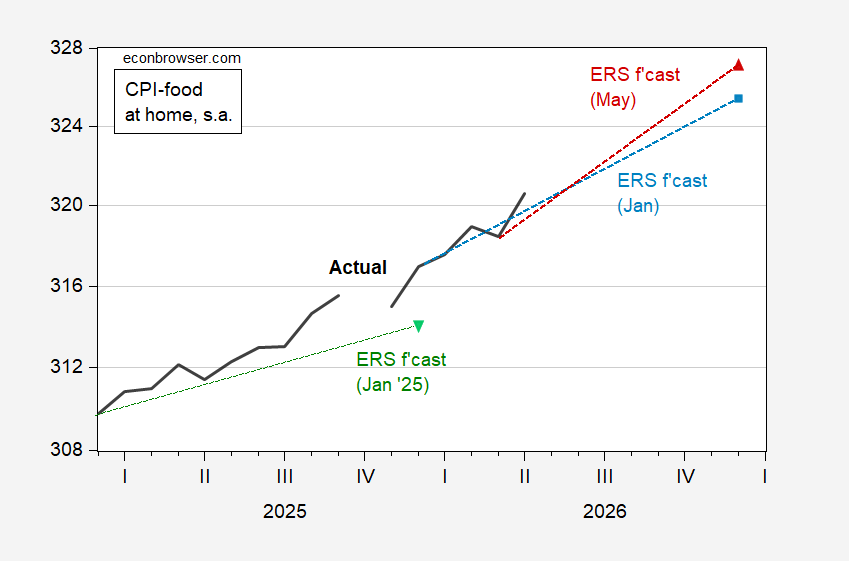
Figure 1: CPI – food at home (black), January 2025 ERS forecast (inverted green triangle), January 2026 forecast (light blue square), May 2026 forecast (red triangle), all on log scale. Source: BLS, ERS, and author’s calculations.
Since the series are plotted against a log scale, the steepening of the trajectory for May vs. January indicates accelerating grocery price inflation. This suggests an upside surprise in 2026, following on the heels of the 2025 upside surprise. In other words, don’t look for grocery prices to fall…
The ERS forecast is based on a time series model (see documentation here). Hence, the forecast conditions only on the previous path of grocery prices. What about a conditional forecast?
A regression 2024-26M04 of CPI food-at-home on core CPI and diesel prices suggests that each 1% increase in diesel price leads to an 0.01% increase in food prices, while the elasticity of food prices with respect to core is 0.79. Assuming core CPI rises 2.6 y/y by December, and diesel costs the same as in May (so far), then grocery prices will only rise by 2.3% y/y (compared to ERS’s 3.2%). Of course, should diesel rise by a greater amount, then the conditional forecast level could be higher than ERS’s estimate.
Ah yes but Kevin Hassett says being able to buy less groceries is good for the waist line!
As Covid was good for the funeral industry.
Hassett says grocery prices are going to go down because Trump reversed a Biden EPA rule in order to deregulate climate warming HFC refrigerants in grocery stores.
Who knew? The high grocery prices are not due to tariffs and blockades. It due to grocery refrigerators.
Prepare yourselves as texas exports ken paxton to the nation. The most decrepit human being i know of. The more you learn about this guy, the more you wonder about the mental makeup of your fellow Americans who vote for him. Bad news if he wins.