From WisPolitics:
“We’re going to come out and your fertilizer prices are going to go way down just like they were four months ago. Your fertilizer’s down, your energy’s down, your oil, your gas is all coming way down. And frankly, I thought it would go much higher than it did,” Trump said during the visit, his first in Wisconsin of his second term.
So far, the situation has not been improving during the course of the war:
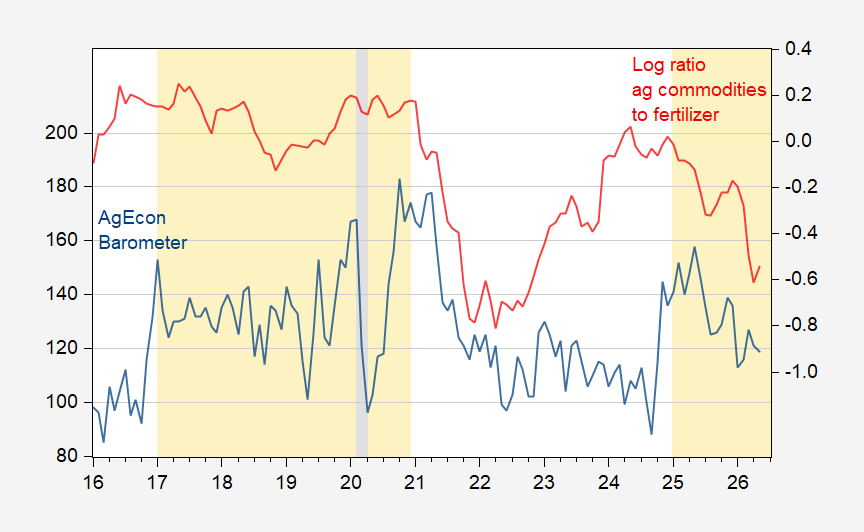
Figure 1: Ag Econ Barometer index (blue, left scale), log ratio of world price of agricultural commodities over fertilizer (red, right scale). NBER defined peak-to-trough recession dates shaded gray. Orange shading denotes Trump administrations. Source: Purdue/CME, World Bank, NBER, and author’s calculations.
Is it likely to improve soon? Here is the current betting on reopening by September 1, October 1, and January 2027.
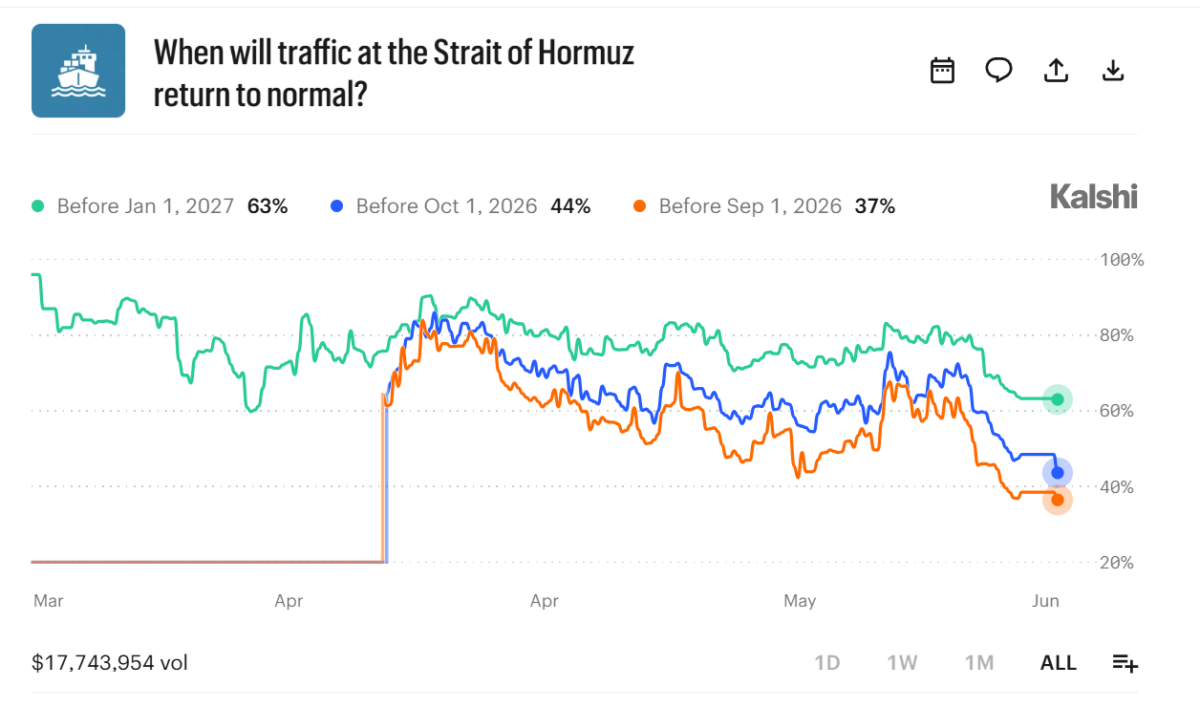
Source: Kalshi, accessed 6/6/2026.
The prediction markets are suggesting non rapid resolution.
Not only have input costs risen as commodity prices fallen or stagnated, export opportunities have been further restricted after the closure of the Strait of Hormuz (WisPolitics):
Also on the call, Menomonie kidney bean farmer Cindy Brown said exports are a major part of her business and tariffs have hit them hard. She said Chippewa Valley Bean can’t ship to customers in Dubai amid a blockade in the Strait of Hormuz and that freight costs have increased.
“There’s no clear end in sight right now and the longer this goes on, the more money farmers lose and the darker the outlook becomes,” Brown said.
Preliminary March figures for Wisconsin nonmanufactured exports are out, but April data will only be released June 9th.
In light of the low likelihood for a rapid reduction in oil and fertilizer prices, and the reduced export revenue, it seems likely that Trump will return to buying off farmers with another dollop of federal funds (ProgressiveFarmer):
Trump touched on trade wars in his first administration, pointing to the $28 billion that went to farmers under the Market Facilitation Program (MFP). Trump then said his administration was looking at another payment program, coming off the $11 billion paid in March and April under the Farmer Bridge Assistance (FBA) payments. “We’re looking at increasing it,” Trump said.
USDA Economic Research Service forecasts direct government support for 2026 at 44.3 bn 2026$, up from 30.5 bn in 2025 (and $10.1 bn in 2024). I don’t know how ERS comes up with this particular forecast in the absence of legislation to authorize and appropriate (there being no five year budget in place).
Here’s a little thought experiment regarding the oil market.
OPEC is an oil cartel. Cartels like OPEC operate like monopolists, limiting supply to raise prices, or increasing supply to drive competitors out of the market. OPEC has run into a sharp reduction in its market power due to the closure of the Strait of Hormuz, and also due to defections growing out of the Iran war.
We have reason to think that, however soon Hormuz reopens, oil exports from the Persian Gulf will be limited for months or years to come. That is reflected in WTI futures, which are priced above $69 per barrel through February, 2029, above $63 through September, 2031.
The Dallas Fed estimates the break-even oil price for new wells in the Permian basin runs between $63 (Delaware sub-basin) to $69 (Midland). Given likely positive margins from new wells, in a competitive market we’d expect to see an expansion of output. In the oil business, that would mean an increase in drilling. That’s not what’s happening. Here’s a look at drilling rigs in operation:
https://ycharts.com/indicators/us_rotary_rigs
Flat as a pancake since the war began.
Meanwhile, U.S. oil inventories are 3% below the 5-year average for this time of year:
https://www.oilandgas360.com/weekly-crude-oil-inventories/
Global inventories are also falling, rather like a stone. (Notice the rise in inventories prior to the war, which has proven to be a stroke of luck, or of foresight.):
https://en.macromicro.me/charts/107158/world-observed-change-in-crude-oil-inventories
Tight inventories are another reason for U.S. oil producers to add rigs. But they aren’t adding rigs. They are, however, adding profits:
https://finance.yahoo.com/sectors/energy/articles/oil-companies-making-billions-iran-162000102.html
Oh, and there is plenty of room for new wells, given the number of idle oil leases held on government land. That was true under Biden, and is even truer now, but it doesn’t matter, ’cause they’re idle.
A shortage of supply, falling inventories, untapped capacity, rising profits and no significant effort to boost production – that’s what cartel behavior looks like, and we ain’t talkin’ about OPEC.
https://www.msn.com/en-us/money/markets/federal-oil-lease-sale-in-texas-and-new-mexico-shatters-us-record-with-4-billion-haul/ar-AA247M3Q indicates that companies are indeed rushing to acquire leases. So there is that. Of course, that doesn’t mean they will drill on them; that takes time to set up, but they seem to be at least hedging against Hormuz being closed or facing high fees for ship passage for a long time.
I found this article interesting as well: https://vadica.com/how-long-do-oil-and-gas-leases-last/ .
Excellent. Thank you.
The Congressional Record of April 30, 2026 contains a statement from 36 mental health professionals, Republican and Democrat. Not that the statement will have any effect, given the quality of individual inhabiting the Cabinet, but this is the heart of the statement:
“Prior to the presidential election in the Fall of 2024, a statement assessing Donald J. Trump’s mental fitness for the presidency was issued. At that time, serious signs of cognitive decline were identified, and in our expert opinion, these signs warranted disqualification from office. It is our professional opinion, based on previous and ongoing assessments, that Donald Trump’s mental state since our 2024 statement has deteriorated even further. In keeping with our professional ethics, and for those of us who are physicians, with the Declaration of Geneva—the successor to the Hippocratic Oath that binds us to the humanitarian principles of medicine since the Nur-
emberg trials—we are compelled to warn of a President of the United States who is increasingly a danger to the public.”
https://www.govinfo.gov/app/details/CREC-2026-04-30/CREC-2026-04-30-pt1-PgS2162
Thought you should know.