Latest Kalshi estimates on re-opening by September 1:
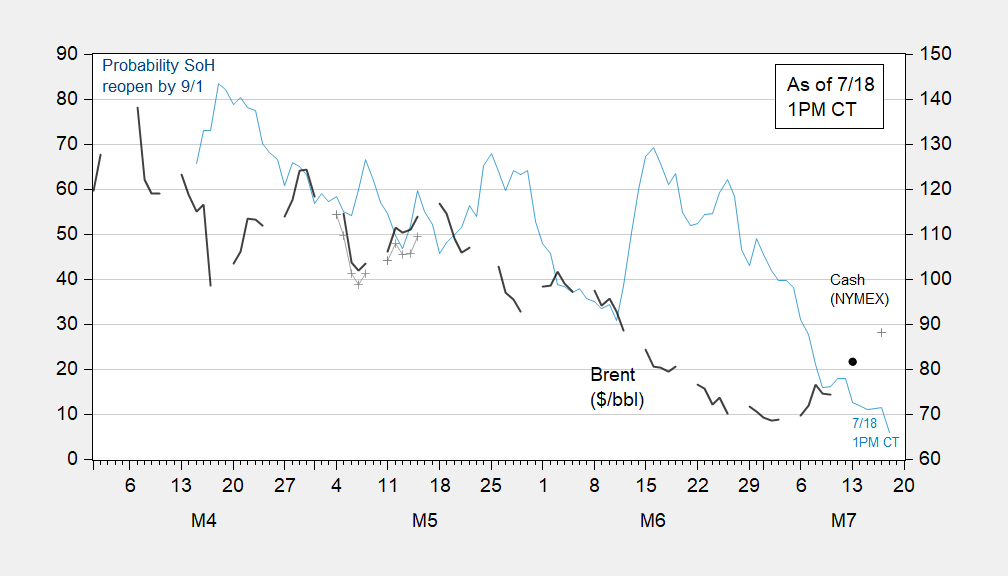
Figure 1: Oil price, Brent $/bbl (black, left scale), cash NYMEX for 7/17 (gray +), and Kalshi prediction of Sept 1 re-opening of Strait of Hormuz (blue, right scale). Source: EIA, NYMEX via barchart, Kalshi.
One would think the two series would have moved inversely but until the 6th or so, they have not. That is something of a mystery.
The cash reading was for 7/16 closing (NYMEX) at $88.
Some of the decline in odds of reopening by any fixed date is time-value of the option. A rolling contract – will Hormuz reopen within X number of days? – would eliminate the erosion of time value.
Time value absolutely does not clear up the mystery of oil pricing. It’s just a small issue.
I have read that speculative accounts are wary of long oil position after they lost money because of the MOU. That could be a made up explanation – analysts are paid to explain stuff, so they explain stuff, no facts needed. I think the scared speculator claim is thin, true or not. Final demand should drive prices with very little lag, no matter what intermediaries do.
Maybe final users think the felon will TACO? He is the TACO president. If so, prices will head higher soon unless Hormuz reopens. Even under the MOU, it never really opened.
Your fixed-date option point is important. I would also separate three meanings that often get collapsed into “reopening”: an official statement, physical transit, and restored export volumes. Brent is pricing expected marginal barrels, inventories, demand, and disruption risk; the Kalshi contract is pricing a binary event by a deadline. They need not move inversely one-for-one.
A strait can be described as open while outbound laden-tanker counts remain depressed, Gulf terminal loadings are constrained, and war-risk premiums stay high. The reverse can also happen: a handful of escorted transits can add barrels without satisfying the binary contract’s resolution criteria. For this divergence, I would watch outbound laden tankers, terminal loading notices, JMIC/UKMTO advisories, and insurance pricing—not the headline word “open” alone.
Disclosure: I run a free, no-login feed that translates selected Persian and Arabic reporting on Iran, Hormuz, and oil while keeping the original source visible: https://whenbuy.kr/en. It is a news-reading tool, not a trading signal.
Bookmarked your link. Very useful. Thanks.
So, your point about pricing vs Hormuz opening. Agreed, and that’s part of the mystery. With inventories trending lower, (my) intution is that each additional day of closure should lead to a greater price increase than the day before. Seems to be the opposite.
By the way, welcome to the party.
By the way, it’s beginning to look like the exchange of attacks between Saudi Arabia and Yemen this past week could escalate:
https://www.aa.com.tr/en/middle-east/houthis-threaten-to-attack-oil-facilities-in-saudi-arabia-amid-yemen-tensions/4000598
The Houthis are threatening to hit Saudi oil facilities if there Saudi Arabia attacks again.
A bit of context – there has been a ceasefire since 2022, during which time Iran has mostly been unable to fly into Yemen. An Iranian aircraft landed at Sanaa airport (hard to do, because it’s mostly blown up), and Saudi Arabia then bombed the airport. The Houthis responded. So we have one side trying to change the status quo, the other side using violence to maintain the status quo, with further escalation a likely result. Lots of oil-market implications here.