Among the list of demands is a bunch of money as compensation for the U.S. breaching the June ceasefire. Aside from the obvious attraction of the money, the payment would represent an admission of wrongdoing and defeat by the U.S. So yeah, it complicates efforts to reopen Hormuz.
Iran’s demands probably aren’t a direct response to Friday’s story about Joint Chiefs Chair Dan Caine, but are rather a reflection of the same set of facts:
“Trump’s top general is ‘looking for an off-ramp’ from Iran war as US military options remain limited, sources say”
CNN says Caine has been telling other senior officials “over the last few weeks” that we need to end the war. Well, this was in WaPo on July 20th, and probably available to Caine before that:
“U.S. strikes unlikely to move Iran, intelligence reports say”
Caine and like-minded insiders are leaking their advice to the press, which is what you do when your advice is ignored. How do we know their advice is being ignored, other than the fact that the war-criminal-in-chief routinely rattles his sabor and that insiders are leaking? Here’s how:
“Donald Trump accuses Washington Post of treason over Hegseth report”
The “Hegseth report” in question has to do with the war criminal being mad that we’re running out of weapons and blaming Hegseth, who naturally blamed another guy. This is depite the fact thay our weapons shortage is common knowledge:
Someone with real juice inside Iran is making the reopening of Hormuz even harder than it already was. The war-criminal-in-chief’s ego makes that easy to do.
Anonymous
Those 6 or 10 “demands” are identical to the MOU signed in June, by Trump. Trump immediately reneged particularly over Israel ongoing full scale invasion of Lebanon, and WestBank.
Trump went to war with the set of air munitions specified for the ancient NATO air land battle. Turns out relatively lightweight precision missiles are unsuited to overcome buried, hardened targets, decoys and moving targets. Running low is hiding the fact the ordnance is too small in blast for most targets, except schools and hospitals.
Iran position is to go big because Trump is not trustworthy.
Macroduck
Worse is that military history gives littl evidence that an air campaign leads to “victory” by most any definition, or even that artillery bombardment does. NATO (Clinton) had pretty good luck with Operation Deliberate Force in Bosnia and Herzegovina, but 60,000 NATO troups were still needed to assure compliance with the Dayton Accords. And that is about the best example of air power resolving a war. Our rookie leadership somehow missed that message, and thought bombing could buffalo Iran’s leaders. It was a dumb idea from the start.
Ivan
The NATO battle against USSR in Europe was war gamed countless times and always ended in less than a month, with a nuclear blow-up ending the world – or with ending of hostilities. Nobody ever imagined conventional warfare for extended time – or it having any other role than posturing. So Europe never wasted a lot of money on conventional weapons – and US insisted that Europe should not build big dangerous nuclear arsenals themselves (we had their back).
The new NATO has to deal with the possibility that the conventional phase may run at least a few months longer than predicted and they would have to prevent Russia from much land grab before end of hostilities. The military industrial complex is using the opportunities to blow military budgets up way beyond anything that will ever be needed. But it’s a good opportunity for Europe to disconnect from the US military industrial complex, and provide the economy of Ukraine a way back up in the post-war era (as Ukraine produce and provide the weapons of the future).
Russia has turned out to be a paper tiger backed by a tiny economy the size of Spains. The only thing is that you cannot back Russia into an existential threat corner. But why would you, they are a small “used to be a contender” country that has nothing important to offer the world.
Anonymous
In early 1980’s we who were in line to deploy to Germany figured the days from first shot to nukes because the Soviets were advancing too fast was single digit days.
Ithaqua
It would be funny if it weren’t happening to us. Fortunately for Trump, we still have lots of oil in the strategic reserve to kind-of sort-of keep gas prices down (about 300M barrels at the end of July, https://en.wikipedia.org/wiki/Strategic_Petroleum_Reserve_(United_States) .) This has been getting released at a rate of about 1M barrels / day over the last three months, ~ 5% of domestic consumption, and obviously that can go on for a couple more months before starting to hit a point at which getting the oil out becomes more difficult – but not impossible. We could even double the release rate and not be in serious difficulty until after the election.
So the strategic reserve is serving its purpose – but who would have thought the future supply disruptions it was intended to mitigate would have been caused by us?
James
With continued deportations of frontline caregivers and massive cuts to healthcare and SNAP spending – watch for services cost inflation and more drops in employment to the only sector that was growing – healthcare workers.
Johnnydean
What deportations??? You still fall for the gift I see.
Arrests, detentions and deportations are all higher in the latest full month of data. johnny says deportations are lower, then talks down to us about the “gift”.
Since well before there was an internet, there have been people making unfounded claims to know more than the rest of us. “Open your eyes!” they shriek. “Think for yourselves!” they shout, while trying to tell us what to think. johnny is one of them, the know-nothing know-it-alls.
pgl
Kevin Hassett lying again. Inflation is not as high as that 20% inflation under Biden aka ‘helicopter money’. Come on Kevin – even a two year old knows you are lying.
And real wages are soaring because we have the highest investment rate ever. Gee Kevin – that 2001 stock market boom put the DOW at 36000 – right?
Macroduck
A telling point, but only for those who have patience for detail, is that U.S. inflation was lower than in most of the OECD during the Biden-era Covid episode, and is now higher than in most of the OECD in the grifter-in-chief’s tariff-and-oil fiasco. Over and over, we hear that budget profligacy was a big cause of the Biden-era inflation, without recognizing what happened globally without recalling that Covid was the ultimate cause. Sure, we could have spent less. So could everybody. But Biden chose people over Pete Peterson. The grifter-in-chief has screwed up so badly that a massive rise in the deficit has left employment nearly flat. Facts is facts
Macroduck
More Iran – Scott Bessent to the rescue!
“What we are going to see over the next two years, the Strait [of Hormuz] is going to become irrelevant. It is going to become just another body of water. And I would say that more than 50 or 70% of the energy that moves through the Strait now is going to go through underground pipelines.”
Underground? To suggest that the pipelines will be safe from attack? Baloney. Besides which, the greater issue is security of all products which have till now transited Hormuz. Will fertilizer, natual gas and aluminum all no longer transit Hormuz? Will containerized goods no longer arrive in Gulf countries through Hormuz? Will Iran no longer threaten oil and gas production facilities in the region? Bessent is being glib to the point of dishonesty.
This idea is not original to Bessent. It has been around for months. What it ignores is that ocean transport has till now been the best and cheapest option. In a world in which Hormuz is no longer used, the best and cheapest option will have to be some other, less cheap and less good option. And that’s our fault.
Macroduck
Off topic – Much as I hate to say the least little thing in defense of Scott Bessent, “Fortune” has done a hack job with this:
“How Scott Bessent used financial engineering to finance the $2 trillion deficit while leaving it untouched—and created a $1.45 trillion shortfall”
If you read the source cited in the article, you find that there is no shortfall. From the TBAC minutes:
“He [Director of the Office of Debt Management Fred Pietrangeli] noted that, while current issuance sizes are adequate to cover expected borrowing needs for the remainder of FY2026, the median primary dealer forecast for privately-held net marketable borrowing implies a $1.45 trillion funding shortfall in FY2027-28 based on current coupon auction sizes and privately-held bill supply.”
In other words, Treasury auctions will need to be bigger in the future. The “$1.45 trillion shortfall” in the title might otherwise be stated “the federal deficit is rising”.
Why bother pointing out just another case of bad journalism? Because there is a seriously bad implication that the article ignores. Treasury auctions are going to get much bigger during the next fiscal year. That’s the result of the deficit getting bigger, but that’s not the whole story. Bigger auctions are harder to swallow.
Auctions have to be funded. When auction sizes are steady, or increase moderately, it’s mostly money from maturing debt that pays for new debt, and that makes auctions go smoothly. However, if auction sizes increase by $1.45 trillion, then roll-overs will be a smaller part of the auction bid; lots of new money has to show up. We might think of this new money as the “marginal” part, in the sense of prices being set at the margin.
Put dimply, we could have some bad auctions, and bad auctions induce interest-rate spikes. A spike needn’t mean a persistent rise in yields, but it sure as heck won’t contribute to a decline. Volatility, itself, induced upward pressure on rates – you need a higher return to hold a volatile asset. Big auctions could cause of higher interest rates in themselves, aside from the effect od an increased stock of debt.
This isn’t a problem Bessent has caused. This is tax cuts and a massive military budget snd rising inflation premia from tariffs and war. Bessent just runs the auctions to pay for it.
By the way, one thing the article gets right is that if the Fed shortens the duration of its portfolio, as Warsh wants to do, that’ll add to upward pressure on long rates.
Ivan
From what I remember, Trump also has been issuing more short and fewer long treasuries. That was a shortsighted attempt to save a little on interest cost, but it also means that a lot more debt needs to be reissued (at then current rates). So the auctions get bigger from that, as well as from the budget deficit.
Trump doesn’t mind if everything blows up after he leaves office. I imagine he knows that MAGA morons would buy the idea that the destruction was because Trump was no longer President, and would demand that the “good old days” be brought back by making Trump President for life.
Johnnydean
Output only supports around 90000 jobs a month in creation. AI may be modestly pushing down the rate. Its been this way since the fall of 2024. Worldcup distortions are what they are.
joseph
From Axios: “Warsh has told associates that before taking office, he built AI bots named “Milton” and “Tobin” that ingested the collected works of the great 20th-century economists Milton Friedman and James Tobin. Warsh then turned to the bots for their insights on contemporary economic questions.”
So Warsh is completely unqualified to run the Fed and ignorant about economics so he is just going to google it.
This explains a lot. There have been comments about how Warsh strings together lots of smart sounding words and phrases to make him sound intelligent but none of it makes much logical sense. It turns out he is just regurgitating AI slop.
Keep this in mind every time he makes a Fed announcement.
pgl
Is this the young Dr. Friedman advocate of floating rates and a serious scholar or the old guy who got stuck on the Quantity Theory of Money?
pgl
I got to sit in on Tobin’s graduate class back in 1980/81. He stuttered a lot but some of the most brilliant lectures ever. No AI could ever match that
joseph
Macroduck: “This isn’t a problem Bessent has caused.”
He certainly abetted it. He’s been very vocal in his lying about tariffs being paid by foreigners, tariffs don’t cause inflation, the war will pay for itself when we get the oil, tax cuts pay for themselves in GDP growth. He’s lying to provide cover for bad policies.
So I disagree. Bessent shouldn’t get a bye. As Treasury Secretary he was one the most important players in causing these rapidly growing deficits and the resulting interest rate increases. Rate increases which compound the deficits.
Macroduck
You disagree? Again? You’re disagreeing with something I didn’t say. I didn’t say Bessent was right about tariffs or about inflation or the war. And if you think Treasury Secretaries cause deficits, you don’t understand much about the budget process.
By the way, I’m still waiting for you to explain how you know so much about currncy intervention. Here’s you:
“No, it is absolutely false that the desk had to start selling euros instantly with no delay.”
When I asked your source of information, you deflected: “Do you listen to yourself?” was your only answer. You piled up a bunch of words, but none of them explained how you know that the Fed has discretion to spill the beans once instructed to buy yen. Keeping in mind that billions of dollars are at stake and that we have laws about disseminating material nonpublic information.
I aks again, what’s the source of your knowledge? As I’ve noted elsewhere in response to you statement, I’ve never worked at the Fed, but I worked on interagency operations with a number of government agencies while I was at State. Never did I have the discretion to tell anyone anything that wasn’t permitted by the other agency. Except when there were explicit instructions to share information, tasking cables were always marked “NOFORN”. So I’m pretty sure the Fed, acting on behalf of Treasury, doesn’t not have duscretion to tell the ECB what they’ve been instructed to do. That’s Treasury’s prerogative.
And what evidence do you have for your claim that the Fed can delay in buying yen once Treasury instructs them to do so? Coordinated intervention is, after all, coordinated. You claim to know. Tell us how you know. Stop pretending and tell us.
Meanwhile, here’s a little backgrounder which should clear things up for you:
“The Treasury has authority over US exchange rate policy and funds operations through the Exchange Stabilization Fund. The New York Fed executes as agent. So a US intervention is a Treasury decision, not a Federal Reserve monetary decision, which is why it can happen without any FOMC involvement at all.”
Macroduck
Since you’ve claimed ” As Treasury Secretary he [Scott Bessent] was one the most important players in causing these rapidly growing deficits and the resulting interest rate increases.” I thought you might need a refresher on how the federal budget is drafted and passed:
As you should be able to tell, the Treasury’s Secretary’s only official role in the budget process is his own Department’s budget request. Does he promote the felon-in-chief’s agenda? Yes. That’s not the same thing as “causing thwae rapidly growing deficits”.
If all of this is a bit much, maybe start with a video entitled “I’m Just a Bill”.
joseph
Macroduck: “The Treasury has authority over US exchange rate policy and funds operations through the Exchange Stabilization Fund. The New York Fed executes as agent. So a US intervention is a Treasury decision, not a Federal Reserve monetary decision, which is why it can happen without any FOMC involvement at all.”
Are you dense? Go back and you will see that is exactly what I wrote. That is the normal process. The Treasury uses money from its own Exchange Stabilization Fund and the Fed is a mere agent in the transaction using the Treasury’s money. They just push the buttons. Exchange rates normally are an executive policy of the White House and Treasury, not the Fed. Rare exceptions are severe international crises which this is not.
But that isn’t what happened in this case. Bessent didn’t want to be seen as selling off Treasury dollars so he ordered Warsh to intervene using the Fed’s own assets, not the Treasury’s. This is not normal procedure. You have Treasury issuing orders on how the Fed should use their own assets and it is also not normal to order the Fed not to coordinate with its counter-parties when intervening, using the Fed’s own money.
And no, while Bessent can keep confidential the transactions of their own funds, if you are giving orders to the Fed on how to transact the Fed’s own assets, you don’t also get to tell them what they can say to their counter-parties. Unless you are an obedient toady like Warsh. This would never have happened under Powell. He would have told Bessent to use their own money intended for that purpose, as this was a political intervention, not a monetary one.
You should be very concerned about this because it is exactly what Warsh said he was going to do in his confirmation hearing. He said he wanted a “new accord” in which the Fed aligns itself with White House policies. This incident is the first sign that this “new accord” is taking place, meaning the end of Fed independence and transparency. Warsh is now just a tool of Trump and Bessent at the Treasury.
Macroduck
You still haven’t said how you know that the Fed has discretion in telling the ECB about intervention. You still haven’t said how you know that the Fed has discretion about the timing of intervention. Those are the things you said I was wrong about. When I challenged you, you ran away. You’re running away again.
Oh, and when you claim that what I quoted at you is what you already wrote? You left out the part that makes you wrong:
“So a US intervention is a Treasury decision, not a Federal Reserve monetary decision, which is why it can happen without any FOMC involvement at all.”
The Fed doesn’t make the decisions. You claim they do make the dicisions. And you ignore evidence that proves you wrong.
You’re also getting awfully emotional. You’ve engaging in ad hominem attacks rather than answering. As you have done in earlier jnstances when you tried to correct me, and were wrong. You engage in ad homenim because your a sniveling, childish, intellectual coward whose unwilling to admit that you’re not as smart as you pretend to be. See? I can play, too! Wasn’t that fun?
You were dead wrong. You’re changing the subject to avoid admitting it. I’m happy to correct you as many times as it takes.
joseph
Nothing says “We’re winning the war” like cowering in a food cart while leaving behind your staff and journalists as unwitting expendable decoys.
Macroduck
Still waiting…. You claim to know things about currency intervention and about Treasury’s role in the budget. How? What’s the source of your claim that Bessent is a major cause of deficits and that the Fed could have spilled the beans to the ECB? Or were you just throwing tantrums?
joseph
Macroduck: “As you should be able to tell, the Treasury’s Secretary’s only official role in the budget process is his own Department’s budget request.”
Oh, please. Apparently your view of the budget process is the cartoon for five year olds in your posting. Instead, it is a months long, highly political process of selling it to members of congress and the public. And the chief salesman is Bessent. Few know the heads of the congressional budget committees and even fewer know who the White House director of the budget is.
But everyone knows who Scott Bessent is because he is on every network news show every weekend relentlessly pimping the White House budget — lying about tariffs, lying about inflation, lying about tax cuts paying for themselves, lying about GDP growth, lying about the war, lying about the military needing $1.5 trillion. All the while using his status as Secretary of the Treasury as his budgetary authority. He’s as responsible as anyone for the deficits.
And your excuse is that he is just a passive player in all this? Apparently your take is that Bessent can say “Don’t blame me. You f’ed up. You believed me!”
Macroduck
“But everyone knows who Scott Bessent is…”
So your argument is that because his name is known by “everyone” (clearly not true – members of yhe public often cannot name Cabinet members), that he’s to blame for deficits? I guess you must think Dr. Fauci caused Covid because “everybody” knows his name? Rand Paul will be so pleased.
You’ve got your little story and you’ve thrown your little tantrum, neither of which makes Bessent responsible for the deficit. In fact your misunderstanding of how the budget works is the same widely-held, naive view of how Washington works that allows massive deficits, endless wars, rotten health care, and a host of other bad picy outcomes. Policy-making is complex, and takes place mostly behind closed doors. You want it to be a simple as what you see on TV. Congress passes laws. Cabinet members are responsible to carry out those laws. That’s how it actually works, however much your TV view of the world says otherwise. You want some figurehead to blame; simple-minded and childish.
But the problem right now is your simple-minded, childish behavior in comments. You want your emotions to dictate what other people are allowed to write. I pointed out that a journalist mistook a future need to increase Treasury auction sizes for a current problem. You decided to pick a fight over Bessent, demanding that we always say Bessent is a very bad man, no matter the issue at hand. Get over yourself.
joseph
Macroduck: “Childish, simple-minded behavior”?
Do you listen to yourself talk? You’ve gone completely unhinged on your rants. You should take a break. You’ll feel better.
Macroduck
ff topic – Syptoms of distress in China:
Recently, China has imposed a tax on its citizen’s offshore assets going back 25 years, with a special focus on investment trusts. Perhaps because this tax affects people and assets outside of China, it has garnered a good bit of press coverage in the U.S.. The revenue goal is to raise $300 billion.
China has announced another, purely domestic, tax enforcement drive which hasn’t gotten much notice outside of China. The domestic effort is to collect unpayed social insurance wage taxes:
“Beijing Targets Corporate Pension Shortfalls as Social Security Pressures Mount”
“Chinese tax authorities have launched a nationwide crackdown on companies underpaying social security contributions, closing a long-standing loophole as Beijing scrambles to shore up its strained pension system.”
In the case of the offshore wealth tax, the press has focused on the implications of the tax for wealthy families. We might want to consider the government’s motives, because they highlight an economic weakness. The government is interested in a couple of things. First is capital flight. Here’s an article on Chinese capital flight, with overseas trusts featured in the section entitled “Real Estate Purchases via Intermediaries”:
Capital flight highlights the “trilemma” of trying to control exchange rates, monetarily policy and capital flow. China tries to do all three, always with the risk that one – or more – of them will go “splat”.
The other motive is revenue, and this motive applies to both tax enforcement efforts. Here’s a good backgrounder relating the income tax enforcement drive to China’s revenue problems:
China’s government-debt/GDP ratio is now around 100, compared to 123 in the U.S. Not so bad for China, right? Well, there’s more to the story. China’s non-financial debt/GDP ratio, which includes debt from households, firms and lower levels of government, stands at 308% vs 257% for the U.S. Among large economies, only Japan is in the same league as China and while China’s ratio is trending higher, Japan’s is falling steadily.
There’s good reason to focus on that 308% figure. China’s central government debt is rising fast in part because it is taking on the obligations of shaky local and provincial governments. In the U.S., federal debt is much larger than state and local debt. It’s the other way around in China because provincial governments are large conduits for Chinese fiscal policy. That arrangement is faltering now because provincial and local finances are a mess, so the central government is filling the gap. That means China’s effective government debt/GDP ratio is well north of 100%.
As an example if the problem, last week, a Local Government Finance Vehicle (LGFV) had to cancel a debt auction because investors weren’t interested. That auction was intended to roll over existing debt, so a failed auction meant a scamble to find cash. China has been shutting down LGFVs in order to contain risk, but they are still around, and struggling. Shutting LGFVs means the debt ends up as the government’s responsibility.
As part of the transition away from relying on the provinces, about 6 months ago, Chinese officials arranged a trillion yuan ($148 billion) lending package to settle provincial governments’ unpaid bills:
Seems big for unpaid bills, yeah? Just wait. Three days ago, a 10 trillion yuan ($1.4 trillion) debt swap facility was created, to swap “hidden” local government debt for central government debt:
So that’s $1.55 trillion in new central government obligations in six months, just to clean up the mess at other levels of government. And I may have missed some.
Each time the central government erases local or provincial debt, its need for revenue increases. By taxing offshore accounts, China raises revenue for domestic purposes and hopes to discourage capital flight (Eight Ball says “ask again later”). The only first-round cost is to rich families’ offshore investments, which do nothing to support domestic growth. The wage-tax enforcement drive is a very different matter. It takes money out of workers’ checks and domestic employers’ tills. It’s a direct tax on labor, when youth unemployment is through the roof, and creates a drag on consumption when domestic demand is soft.
So, China’s domestic finances are in turmoil, and those finances have a large role in Chinese growth. The push for revenue is based on overturning longstanding practices, delivering a shock to rich families with oveeseas holdings – mean, but clever – and also to employers and workers – mean and probably not clever.
Real earnings have not increased over the last year despite what Bessett, Hassert, and Antoni might tell you. In fact they fell. But you knew that already.
Macroduck
The war-criminal-in-chief’s airplane switch during his recent trip to Turkey has caused a bit of a stir. An Israeli intelligence report that Iran might attempt to kill our war criminal incited the plane change.
It turns out, Israel might have lied. Here’s the Middle East Eye yesterday:
“Turkish officials now say they believe the Israeli intelligence report was probably a ruse by Netanyahu’s government to portray itself as protecting Trump, derail negotiations with Iran and undermine Trump’s apparently close relationship with Erdogan.”
U.S. and Turkish intelligence services are in regular contact, so our war criminal could already be aware of the Turkish view, if his minions are willing to tell him.
For what it’s worth, crude is up about 16% since the Ankara airplane switch.
Anonymous
What it says: “those expensive science projects installed on large aircraft to defend against MANPADS are not reliable “.
Macroduck
Looks like tax-cut-and-spend Republicans have done it again. The budget numbers for July are out:
“Deficit of $1.8 trillion for first 10 months of fiscal 2026 exceeds entire deficit of prior fiscal year”
“Accounting for…calendar shifts brought the adjusted July deficit to $333 billion, up $50 billion, or 18%, from the prior year, the Treasury said.”
Remember how tariffs were going to narrow the budget deficit, paying for the tax cuts in the Big, Bloated Bill? Turns out, not so much:
“That figure included an outflow of $8.55 billion in net customs receipts after tariff refunds totaling $33.38 billion for the month, marking the third straight month of tariff outflows.”
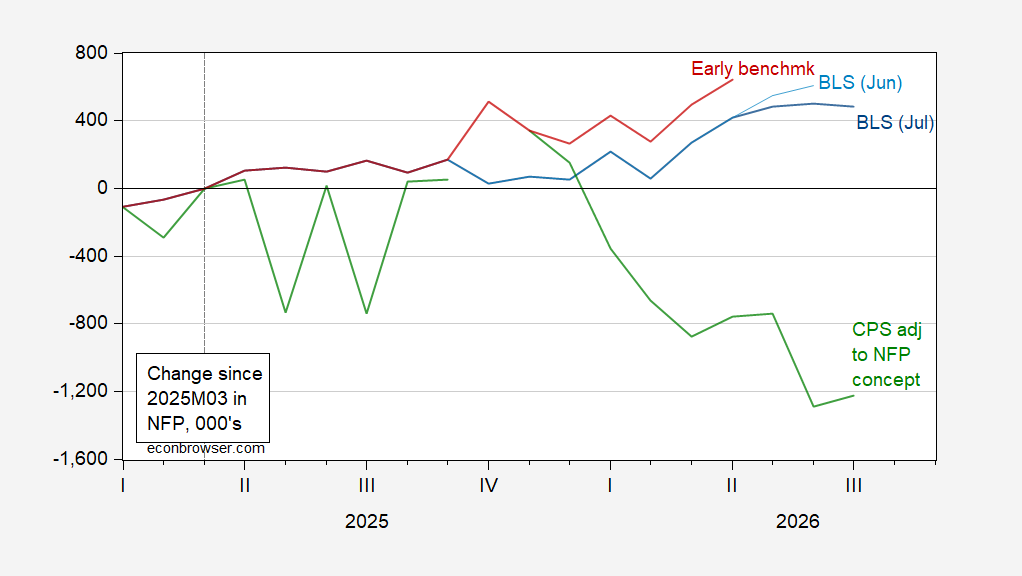
Kevin Hassett has done his deep drive into these numbers saying growth is solid. And yea the DOW hit 36000 in 2001.
Off topic – “Iran Issues List of Demands, Complicating Efforts to Reopen Strait”
https://www.nytimes.com/2026/08/08/world/middleeast/iran-us-oman-strait-of-hormuz.html?eafs_enabled=false
Among the list of demands is a bunch of money as compensation for the U.S. breaching the June ceasefire. Aside from the obvious attraction of the money, the payment would represent an admission of wrongdoing and defeat by the U.S. So yeah, it complicates efforts to reopen Hormuz.
Iran’s demands probably aren’t a direct response to Friday’s story about Joint Chiefs Chair Dan Caine, but are rather a reflection of the same set of facts:
“Trump’s top general is ‘looking for an off-ramp’ from Iran war as US military options remain limited, sources say”
https://www.cnn.com/2026/08/07/politics/general-dan-caine-off-ramp-iran-war
CNN says Caine has been telling other senior officials “over the last few weeks” that we need to end the war. Well, this was in WaPo on July 20th, and probably available to Caine before that:
“U.S. strikes unlikely to move Iran, intelligence reports say”
https://www.washingtonpost.com/national-security/2026/07/20/us-strikes-unlikely-move-iran-intelligence-reports-say/
Caine and like-minded insiders are leaking their advice to the press, which is what you do when your advice is ignored. How do we know their advice is being ignored, other than the fact that the war-criminal-in-chief routinely rattles his sabor and that insiders are leaking? Here’s how:
“Donald Trump accuses Washington Post of treason over Hegseth report”
https://www.msn.com/en-us/news/politics/donald-trump-accuses-washington-post-of-treason-over-hegseth-report/ar-AA29Fw3n
The “Hegseth report” in question has to do with the war criminal being mad that we’re running out of weapons and blaming Hegseth, who naturally blamed another guy. This is depite the fact thay our weapons shortage is common knowledge:
https://econbrowser.com/archives/2026/07/estimates-of-current-inventories-of-patriot-and-thaad-interceptors
Someone with real juice inside Iran is making the reopening of Hormuz even harder than it already was. The war-criminal-in-chief’s ego makes that easy to do.
Those 6 or 10 “demands” are identical to the MOU signed in June, by Trump. Trump immediately reneged particularly over Israel ongoing full scale invasion of Lebanon, and WestBank.
Trump went to war with the set of air munitions specified for the ancient NATO air land battle. Turns out relatively lightweight precision missiles are unsuited to overcome buried, hardened targets, decoys and moving targets. Running low is hiding the fact the ordnance is too small in blast for most targets, except schools and hospitals.
Iran position is to go big because Trump is not trustworthy.
Worse is that military history gives littl evidence that an air campaign leads to “victory” by most any definition, or even that artillery bombardment does. NATO (Clinton) had pretty good luck with Operation Deliberate Force in Bosnia and Herzegovina, but 60,000 NATO troups were still needed to assure compliance with the Dayton Accords. And that is about the best example of air power resolving a war. Our rookie leadership somehow missed that message, and thought bombing could buffalo Iran’s leaders. It was a dumb idea from the start.
The NATO battle against USSR in Europe was war gamed countless times and always ended in less than a month, with a nuclear blow-up ending the world – or with ending of hostilities. Nobody ever imagined conventional warfare for extended time – or it having any other role than posturing. So Europe never wasted a lot of money on conventional weapons – and US insisted that Europe should not build big dangerous nuclear arsenals themselves (we had their back).
The new NATO has to deal with the possibility that the conventional phase may run at least a few months longer than predicted and they would have to prevent Russia from much land grab before end of hostilities. The military industrial complex is using the opportunities to blow military budgets up way beyond anything that will ever be needed. But it’s a good opportunity for Europe to disconnect from the US military industrial complex, and provide the economy of Ukraine a way back up in the post-war era (as Ukraine produce and provide the weapons of the future).
Russia has turned out to be a paper tiger backed by a tiny economy the size of Spains. The only thing is that you cannot back Russia into an existential threat corner. But why would you, they are a small “used to be a contender” country that has nothing important to offer the world.
In early 1980’s we who were in line to deploy to Germany figured the days from first shot to nukes because the Soviets were advancing too fast was single digit days.
It would be funny if it weren’t happening to us. Fortunately for Trump, we still have lots of oil in the strategic reserve to kind-of sort-of keep gas prices down (about 300M barrels at the end of July, https://en.wikipedia.org/wiki/Strategic_Petroleum_Reserve_(United_States) .) This has been getting released at a rate of about 1M barrels / day over the last three months, ~ 5% of domestic consumption, and obviously that can go on for a couple more months before starting to hit a point at which getting the oil out becomes more difficult – but not impossible. We could even double the release rate and not be in serious difficulty until after the election.
So the strategic reserve is serving its purpose – but who would have thought the future supply disruptions it was intended to mitigate would have been caused by us?
With continued deportations of frontline caregivers and massive cuts to healthcare and SNAP spending – watch for services cost inflation and more drops in employment to the only sector that was growing – healthcare workers.
What deportations??? You still fall for the gift I see.
Hmmm…what to believe, the data, or johnny?
https://www.theguardian.com/us-news/ng-interactive/2025/aug/29/trump-immigration-ice-cbp-data
Arrests, detentions and deportations are all higher in the latest full month of data. johnny says deportations are lower, then talks down to us about the “gift”.
Since well before there was an internet, there have been people making unfounded claims to know more than the rest of us. “Open your eyes!” they shriek. “Think for yourselves!” they shout, while trying to tell us what to think. johnny is one of them, the know-nothing know-it-alls.
Kevin Hassett lying again. Inflation is not as high as that 20% inflation under Biden aka ‘helicopter money’. Come on Kevin – even a two year old knows you are lying.
And real wages are soaring because we have the highest investment rate ever. Gee Kevin – that 2001 stock market boom put the DOW at 36000 – right?
A telling point, but only for those who have patience for detail, is that U.S. inflation was lower than in most of the OECD during the Biden-era Covid episode, and is now higher than in most of the OECD in the grifter-in-chief’s tariff-and-oil fiasco. Over and over, we hear that budget profligacy was a big cause of the Biden-era inflation, without recognizing what happened globally without recalling that Covid was the ultimate cause. Sure, we could have spent less. So could everybody. But Biden chose people over Pete Peterson. The grifter-in-chief has screwed up so badly that a massive rise in the deficit has left employment nearly flat. Facts is facts
More Iran – Scott Bessent to the rescue!
“What we are going to see over the next two years, the Strait [of Hormuz] is going to become irrelevant. It is going to become just another body of water. And I would say that more than 50 or 70% of the energy that moves through the Strait now is going to go through underground pipelines.”
https://www.msn.com/en-us/news/other/bessent-the-strait-of-hormuz-is-going-to-become-irrelevant-in-2-years/ar-AA29FUY3
Underground? To suggest that the pipelines will be safe from attack? Baloney. Besides which, the greater issue is security of all products which have till now transited Hormuz. Will fertilizer, natual gas and aluminum all no longer transit Hormuz? Will containerized goods no longer arrive in Gulf countries through Hormuz? Will Iran no longer threaten oil and gas production facilities in the region? Bessent is being glib to the point of dishonesty.
This idea is not original to Bessent. It has been around for months. What it ignores is that ocean transport has till now been the best and cheapest option. In a world in which Hormuz is no longer used, the best and cheapest option will have to be some other, less cheap and less good option. And that’s our fault.
Off topic – Much as I hate to say the least little thing in defense of Scott Bessent, “Fortune” has done a hack job with this:
“How Scott Bessent used financial engineering to finance the $2 trillion deficit while leaving it untouched—and created a $1.45 trillion shortfall”
https://fortune.com/2026/08/08/treasury-borrowing-tbac-145-trillion-shortfall-bessent-debt/
If you read the source cited in the article, you find that there is no shortfall. From the TBAC minutes:
“He [Director of the Office of Debt Management Fred Pietrangeli] noted that, while current issuance sizes are adequate to cover expected borrowing needs for the remainder of FY2026, the median primary dealer forecast for privately-held net marketable borrowing implies a $1.45 trillion funding shortfall in FY2027-28 based on current coupon auction sizes and privately-held bill supply.”
https://home.treasury.gov/news/press-releases/sb0592
In other words, Treasury auctions will need to be bigger in the future. The “$1.45 trillion shortfall” in the title might otherwise be stated “the federal deficit is rising”.
Why bother pointing out just another case of bad journalism? Because there is a seriously bad implication that the article ignores. Treasury auctions are going to get much bigger during the next fiscal year. That’s the result of the deficit getting bigger, but that’s not the whole story. Bigger auctions are harder to swallow.
Auctions have to be funded. When auction sizes are steady, or increase moderately, it’s mostly money from maturing debt that pays for new debt, and that makes auctions go smoothly. However, if auction sizes increase by $1.45 trillion, then roll-overs will be a smaller part of the auction bid; lots of new money has to show up. We might think of this new money as the “marginal” part, in the sense of prices being set at the margin.
Put dimply, we could have some bad auctions, and bad auctions induce interest-rate spikes. A spike needn’t mean a persistent rise in yields, but it sure as heck won’t contribute to a decline. Volatility, itself, induced upward pressure on rates – you need a higher return to hold a volatile asset. Big auctions could cause of higher interest rates in themselves, aside from the effect od an increased stock of debt.
This isn’t a problem Bessent has caused. This is tax cuts and a massive military budget snd rising inflation premia from tariffs and war. Bessent just runs the auctions to pay for it.
By the way, one thing the article gets right is that if the Fed shortens the duration of its portfolio, as Warsh wants to do, that’ll add to upward pressure on long rates.
From what I remember, Trump also has been issuing more short and fewer long treasuries. That was a shortsighted attempt to save a little on interest cost, but it also means that a lot more debt needs to be reissued (at then current rates). So the auctions get bigger from that, as well as from the budget deficit.
Trump doesn’t mind if everything blows up after he leaves office. I imagine he knows that MAGA morons would buy the idea that the destruction was because Trump was no longer President, and would demand that the “good old days” be brought back by making Trump President for life.
Output only supports around 90000 jobs a month in creation. AI may be modestly pushing down the rate. Its been this way since the fall of 2024. Worldcup distortions are what they are.
From Axios: “Warsh has told associates that before taking office, he built AI bots named “Milton” and “Tobin” that ingested the collected works of the great 20th-century economists Milton Friedman and James Tobin. Warsh then turned to the bots for their insights on contemporary economic questions.”
So Warsh is completely unqualified to run the Fed and ignorant about economics so he is just going to google it.
This explains a lot. There have been comments about how Warsh strings together lots of smart sounding words and phrases to make him sound intelligent but none of it makes much logical sense. It turns out he is just regurgitating AI slop.
Keep this in mind every time he makes a Fed announcement.
Is this the young Dr. Friedman advocate of floating rates and a serious scholar or the old guy who got stuck on the Quantity Theory of Money?
I got to sit in on Tobin’s graduate class back in 1980/81. He stuttered a lot but some of the most brilliant lectures ever. No AI could ever match that
Macroduck: “This isn’t a problem Bessent has caused.”
He certainly abetted it. He’s been very vocal in his lying about tariffs being paid by foreigners, tariffs don’t cause inflation, the war will pay for itself when we get the oil, tax cuts pay for themselves in GDP growth. He’s lying to provide cover for bad policies.
So I disagree. Bessent shouldn’t get a bye. As Treasury Secretary he was one the most important players in causing these rapidly growing deficits and the resulting interest rate increases. Rate increases which compound the deficits.
You disagree? Again? You’re disagreeing with something I didn’t say. I didn’t say Bessent was right about tariffs or about inflation or the war. And if you think Treasury Secretaries cause deficits, you don’t understand much about the budget process.
By the way, I’m still waiting for you to explain how you know so much about currncy intervention. Here’s you:
“No, it is absolutely false that the desk had to start selling euros instantly with no delay.”
When I asked your source of information, you deflected: “Do you listen to yourself?” was your only answer. You piled up a bunch of words, but none of them explained how you know that the Fed has discretion to spill the beans once instructed to buy yen. Keeping in mind that billions of dollars are at stake and that we have laws about disseminating material nonpublic information.
I aks again, what’s the source of your knowledge? As I’ve noted elsewhere in response to you statement, I’ve never worked at the Fed, but I worked on interagency operations with a number of government agencies while I was at State. Never did I have the discretion to tell anyone anything that wasn’t permitted by the other agency. Except when there were explicit instructions to share information, tasking cables were always marked “NOFORN”. So I’m pretty sure the Fed, acting on behalf of Treasury, doesn’t not have duscretion to tell the ECB what they’ve been instructed to do. That’s Treasury’s prerogative.
And what evidence do you have for your claim that the Fed can delay in buying yen once Treasury instructs them to do so? Coordinated intervention is, after all, coordinated. You claim to know. Tell us how you know. Stop pretending and tell us.
Meanwhile, here’s a little backgrounder which should clear things up for you:
https://kenmacro.com/currency-intervention-explained/
This is from that backgrounder:
“The Treasury has authority over US exchange rate policy and funds operations through the Exchange Stabilization Fund. The New York Fed executes as agent. So a US intervention is a Treasury decision, not a Federal Reserve monetary decision, which is why it can happen without any FOMC involvement at all.”
Since you’ve claimed ” As Treasury Secretary he [Scott Bessent] was one the most important players in causing these rapidly growing deficits and the resulting interest rate increases.” I thought you might need a refresher on how the federal budget is drafted and passed:
https://www.usa.gov/federal-budget-process
As you should be able to tell, the Treasury’s Secretary’s only official role in the budget process is his own Department’s budget request. Does he promote the felon-in-chief’s agenda? Yes. That’s not the same thing as “causing thwae rapidly growing deficits”.
If all of this is a bit much, maybe start with a video entitled “I’m Just a Bill”.
Macroduck: “The Treasury has authority over US exchange rate policy and funds operations through the Exchange Stabilization Fund. The New York Fed executes as agent. So a US intervention is a Treasury decision, not a Federal Reserve monetary decision, which is why it can happen without any FOMC involvement at all.”
Are you dense? Go back and you will see that is exactly what I wrote. That is the normal process. The Treasury uses money from its own Exchange Stabilization Fund and the Fed is a mere agent in the transaction using the Treasury’s money. They just push the buttons. Exchange rates normally are an executive policy of the White House and Treasury, not the Fed. Rare exceptions are severe international crises which this is not.
But that isn’t what happened in this case. Bessent didn’t want to be seen as selling off Treasury dollars so he ordered Warsh to intervene using the Fed’s own assets, not the Treasury’s. This is not normal procedure. You have Treasury issuing orders on how the Fed should use their own assets and it is also not normal to order the Fed not to coordinate with its counter-parties when intervening, using the Fed’s own money.
And no, while Bessent can keep confidential the transactions of their own funds, if you are giving orders to the Fed on how to transact the Fed’s own assets, you don’t also get to tell them what they can say to their counter-parties. Unless you are an obedient toady like Warsh. This would never have happened under Powell. He would have told Bessent to use their own money intended for that purpose, as this was a political intervention, not a monetary one.
You should be very concerned about this because it is exactly what Warsh said he was going to do in his confirmation hearing. He said he wanted a “new accord” in which the Fed aligns itself with White House policies. This incident is the first sign that this “new accord” is taking place, meaning the end of Fed independence and transparency. Warsh is now just a tool of Trump and Bessent at the Treasury.
You still haven’t said how you know that the Fed has discretion in telling the ECB about intervention. You still haven’t said how you know that the Fed has discretion about the timing of intervention. Those are the things you said I was wrong about. When I challenged you, you ran away. You’re running away again.
Oh, and when you claim that what I quoted at you is what you already wrote? You left out the part that makes you wrong:
“So a US intervention is a Treasury decision, not a Federal Reserve monetary decision, which is why it can happen without any FOMC involvement at all.”
The Fed doesn’t make the decisions. You claim they do make the dicisions. And you ignore evidence that proves you wrong.
You’re also getting awfully emotional. You’ve engaging in ad hominem attacks rather than answering. As you have done in earlier jnstances when you tried to correct me, and were wrong. You engage in ad homenim because your a sniveling, childish, intellectual coward whose unwilling to admit that you’re not as smart as you pretend to be. See? I can play, too! Wasn’t that fun?
You were dead wrong. You’re changing the subject to avoid admitting it. I’m happy to correct you as many times as it takes.
Nothing says “We’re winning the war” like cowering in a food cart while leaving behind your staff and journalists as unwitting expendable decoys.
Still waiting…. You claim to know things about currency intervention and about Treasury’s role in the budget. How? What’s the source of your claim that Bessent is a major cause of deficits and that the Fed could have spilled the beans to the ECB? Or were you just throwing tantrums?
Macroduck: “As you should be able to tell, the Treasury’s Secretary’s only official role in the budget process is his own Department’s budget request.”
Oh, please. Apparently your view of the budget process is the cartoon for five year olds in your posting. Instead, it is a months long, highly political process of selling it to members of congress and the public. And the chief salesman is Bessent. Few know the heads of the congressional budget committees and even fewer know who the White House director of the budget is.
But everyone knows who Scott Bessent is because he is on every network news show every weekend relentlessly pimping the White House budget — lying about tariffs, lying about inflation, lying about tax cuts paying for themselves, lying about GDP growth, lying about the war, lying about the military needing $1.5 trillion. All the while using his status as Secretary of the Treasury as his budgetary authority. He’s as responsible as anyone for the deficits.
And your excuse is that he is just a passive player in all this? Apparently your take is that Bessent can say “Don’t blame me. You f’ed up. You believed me!”
“But everyone knows who Scott Bessent is…”
So your argument is that because his name is known by “everyone” (clearly not true – members of yhe public often cannot name Cabinet members), that he’s to blame for deficits? I guess you must think Dr. Fauci caused Covid because “everybody” knows his name? Rand Paul will be so pleased.
You’ve got your little story and you’ve thrown your little tantrum, neither of which makes Bessent responsible for the deficit. In fact your misunderstanding of how the budget works is the same widely-held, naive view of how Washington works that allows massive deficits, endless wars, rotten health care, and a host of other bad picy outcomes. Policy-making is complex, and takes place mostly behind closed doors. You want it to be a simple as what you see on TV. Congress passes laws. Cabinet members are responsible to carry out those laws. That’s how it actually works, however much your TV view of the world says otherwise. You want some figurehead to blame; simple-minded and childish.
But the problem right now is your simple-minded, childish behavior in comments. You want your emotions to dictate what other people are allowed to write. I pointed out that a journalist mistook a future need to increase Treasury auction sizes for a current problem. You decided to pick a fight over Bessent, demanding that we always say Bessent is a very bad man, no matter the issue at hand. Get over yourself.
Macroduck: “Childish, simple-minded behavior”?
Do you listen to yourself talk? You’ve gone completely unhinged on your rants. You should take a break. You’ll feel better.
ff topic – Syptoms of distress in China:
Recently, China has imposed a tax on its citizen’s offshore assets going back 25 years, with a special focus on investment trusts. Perhaps because this tax affects people and assets outside of China, it has garnered a good bit of press coverage in the U.S.. The revenue goal is to raise $300 billion.
China has announced another, purely domestic, tax enforcement drive which hasn’t gotten much notice outside of China. The domestic effort is to collect unpayed social insurance wage taxes:
“Beijing Targets Corporate Pension Shortfalls as Social Security Pressures Mount”
https://www.caixinglobal.com/2026-07-07/beijing-targets-corporate-pension-shortfalls-as-social-security-pressures-mount-102461610.html
Here’s first line:
“Chinese tax authorities have launched a nationwide crackdown on companies underpaying social security contributions, closing a long-standing loophole as Beijing scrambles to shore up its strained pension system.”
In the case of the offshore wealth tax, the press has focused on the implications of the tax for wealthy families. We might want to consider the government’s motives, because they highlight an economic weakness. The government is interested in a couple of things. First is capital flight. Here’s an article on Chinese capital flight, with overseas trusts featured in the section entitled “Real Estate Purchases via Intermediaries”:
https://www.massnews.com/how-chinas-wealthy-sidestep-financial-restrictions-the-global-rise-of-capital-flight-workarounds/
Capital flight highlights the “trilemma” of trying to control exchange rates, monetarily policy and capital flow. China tries to do all three, always with the risk that one – or more – of them will go “splat”.
The other motive is revenue, and this motive applies to both tax enforcement efforts. Here’s a good backgrounder relating the income tax enforcement drive to China’s revenue problems:
https://rheingoldfo.com/chinas-income-tax-crackdown-expands-understanding-the-global-tax-net/
China’s government-debt/GDP ratio is now around 100, compared to 123 in the U.S. Not so bad for China, right? Well, there’s more to the story. China’s non-financial debt/GDP ratio, which includes debt from households, firms and lower levels of government, stands at 308% vs 257% for the U.S. Among large economies, only Japan is in the same league as China and while China’s ratio is trending higher, Japan’s is falling steadily.
There’s good reason to focus on that 308% figure. China’s central government debt is rising fast in part because it is taking on the obligations of shaky local and provincial governments. In the U.S., federal debt is much larger than state and local debt. It’s the other way around in China because provincial governments are large conduits for Chinese fiscal policy. That arrangement is faltering now because provincial and local finances are a mess, so the central government is filling the gap. That means China’s effective government debt/GDP ratio is well north of 100%.
As an example if the problem, last week, a Local Government Finance Vehicle (LGFV) had to cancel a debt auction because investors weren’t interested. That auction was intended to roll over existing debt, so a failed auction meant a scamble to find cash. China has been shutting down LGFVs in order to contain risk, but they are still around, and struggling. Shutting LGFVs means the debt ends up as the government’s responsibility.
As part of the transition away from relying on the provinces, about 6 months ago, Chinese officials arranged a trillion yuan ($148 billion) lending package to settle provincial governments’ unpaid bills:
https://www.bloomberg.com/news/articles/2025-09-11/china-mulls-helping-local-governments-with-1-trillion-of-bills
Seems big for unpaid bills, yeah? Just wait. Three days ago, a 10 trillion yuan ($1.4 trillion) debt swap facility was created, to swap “hidden” local government debt for central government debt:
https://global.chinadaily.com.cn/a/202411/09/WS672ea4d5a310f1265a1cc642.html
So that’s $1.55 trillion in new central government obligations in six months, just to clean up the mess at other levels of government. And I may have missed some.
Each time the central government erases local or provincial debt, its need for revenue increases. By taxing offshore accounts, China raises revenue for domestic purposes and hopes to discourage capital flight (Eight Ball says “ask again later”). The only first-round cost is to rich families’ offshore investments, which do nothing to support domestic growth. The wage-tax enforcement drive is a very different matter. It takes money out of workers’ checks and domestic employers’ tills. It’s a direct tax on labor, when youth unemployment is through the roof, and creates a drag on consumption when domestic demand is soft.
So, China’s domestic finances are in turmoil, and those finances have a large role in Chinese growth. The push for revenue is based on overturning longstanding practices, delivering a shock to rich families with oveeseas holdings – mean, but clever – and also to employers and workers – mean and probably not clever.
http://www.bls.gov/news.release/realer.t02.htm
Real earnings have not increased over the last year despite what Bessett, Hassert, and Antoni might tell you. In fact they fell. But you knew that already.
The war-criminal-in-chief’s airplane switch during his recent trip to Turkey has caused a bit of a stir. An Israeli intelligence report that Iran might attempt to kill our war criminal incited the plane change.
It turns out, Israel might have lied. Here’s the Middle East Eye yesterday:
“Turkish officials now say they believe the Israeli intelligence report was probably a ruse by Netanyahu’s government to portray itself as protecting Trump, derail negotiations with Iran and undermine Trump’s apparently close relationship with Erdogan.”
https://www.middleeasteye.net/news/turkey-suspects-israel-fabricated-trump-air-force-one-assassination-plot-derail-us-iran-deal
U.S. and Turkish intelligence services are in regular contact, so our war criminal could already be aware of the Turkish view, if his minions are willing to tell him.
For what it’s worth, crude is up about 16% since the Ankara airplane switch.
What it says: “those expensive science projects installed on large aircraft to defend against MANPADS are not reliable “.
Looks like tax-cut-and-spend Republicans have done it again. The budget numbers for July are out:
“Deficit of $1.8 trillion for first 10 months of fiscal 2026 exceeds entire deficit of prior fiscal year”
“Accounting for…calendar shifts brought the adjusted July deficit to $333 billion, up $50 billion, or 18%, from the prior year, the Treasury said.”
Remember how tariffs were going to narrow the budget deficit, paying for the tax cuts in the Big, Bloated Bill? Turns out, not so much:
“That figure included an outflow of $8.55 billion in net customs receipts after tariff refunds totaling $33.38 billion for the month, marking the third straight month of tariff outflows.”
https://www.reuters.com/business/us-july-deficit-tops-432-billion-outlays-grow-tariff-receipts-stay-negative-2026-08-12/