Here are several measures of manufacturing employment. ADP suggests continued deterioration, while QCEW (through March) fell as official employment rose.
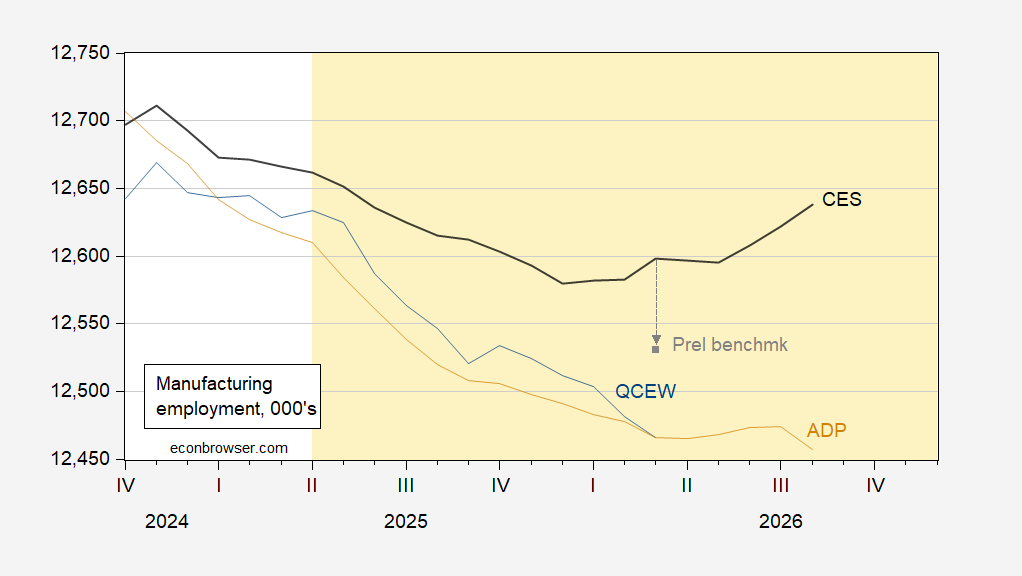
Figure 1: Manufacturing employment from CES (black), implied preliminary benchmark for March (gray square), ADP (brown), and QCEW seasonally adjusted by author (blue), in 000’s, s.a. Seasonal adjustment using X-13 in logs. Source: BLS, ADP via FRED, BLS, and author’s calculations.
dnyuz.com/2026/08/05/crocs-has-a-trick-for-dodging-taxes-a-tiny-office-in-malta
Crocs designs its shoes here but has them made in places like Vietnam which is pretty standard. What’s new here is the ways it evades US taxes by opening a tiny office in Malta. And yes MAGA tax policy enables this blatant tax evasion.
“several measures of manufacturing employment”
We know what measure Antoni and Hassett will abuse.
People are always obsessing about manufacturing jobs but it really should stop. Manufacturing jobs are dirty, dangerous and backbreaking. But at one time they were unionized, paid above average wages and provided a upward path for families to the middle class. None of that is true anymore. They broke the unions with “right to work” laws and manufacturing jobs now pay less than the median wage. There is no longer any reason to prioritize manufacturing jobs.
That is a very good point.
The yearning is for the old days when a man could be a man, and even if he was not that much of a “brainiac” his muscle and endurance could give him a high paying job. So they talk about bringing back manufacturing when what they actually want is “no-brain” physical labor with a high salary. The sad part is that, for obvious reasons, it is easy to fool that group of people – but they are generally good people who deserve better.
Lots of misunderstanding of the modern manufactoring process (guess we have none, how would we know how it is done nowdays) and speculation. Plus office work has its health risks as well (metabolic and heart disease, lack of physical activity, ergonomic Issues, eye strain, air quality issues and asthma, etc). Somehow, we have little manufactoring, yet our health care expances are the highest in the world. Some argue the latter is because of an inefficient health care system. My view is that the people are so sick that the best health care in the world can barely keep them alive. My hypothesis is that walking through a factory floor would do wonders to our health and wellbeing. The data out there are consistent with this hypothesis. And of course, since we don’t make nice things for ourselves, we have to consume the rubbish made for us in Asia…
“The data out there are consistent with this hypothesis.”
Normally, a claim of that sort is accompanied by a reference or link to a data source. Otherwise, it’s just soapbox stuff.
The data are there, don’t know about the references…
If manufacturing were so bad for us health-wise (the hypothesis), this would show up in all-cause mortality and hence life expectancy—more manufacturing would be associated with lower life expectancy (the prediction). Looking at a couple of countries:
South Korea — % GDP from manufacturing ~27%, life expectancy 83.4
Taiwan — % GDP from manufacturing ~36%, life expectancy 81.5
USA — % GDP from manufacturing ~8%, life expectancy 78.9
(the data are from Tranding Economics and microtrends for 2025/2026)
The hypothesis is falsified.
If manual labor (aka walk on the factory floor) were good for us health-wise (hypothesis), then socio-economic groups engaging preferentially in manual labor would have a higher life expectancy than the groups that prefer office work (prediction). The US Hispanics have lower educational attainment and disproportionately engage in manual labor relative to the US white population (a well-established fact, bls.gov/blog/2024/employment-trends-of-hispanics-in-the-us-labor-force.htm).
US Hispanic life expectancy — 81.8
White non-Hispanic population life expectancy — 78.9
(from cdc.gov/nchs/data/nvsr/nvsr75/nvsr75-05.pdf for 2024, the latest data available)
The hypothesis is not falsified.
It is probably more about the working conditions than the occupation itself. One reads titles like “Goldman Sachs junior bankers describe ‘inhumane’ working conditions where they don’t have time to eat or shower in a brutal internal survey” and “The Drugs Young Bankers Use to Get Through the Day—and Night Many on Wall Street see Adderall and Vyvanse as tools to plow through long hours of tedious work amid high-pressure competition”.
I further hazard to opine that our current predicament with manufacturing is psycho-cultural. We want to look buff on the international stage but don’t want to work for it. There is somewhere in the back of our heads that a more industrialized country will win a military conflict with a less industrialized country. This was an easy truth not long ago. It is ridiculous to buy hardware for our military from our stated adversary. So we yearn for the days of manufacturing. But work has undertones of slavery for men and prostitution for women, and the ideal is to escape the need to sell our labor in the labor market into the unearned income of investment and trust funds. We probably have >$84 trillion in trust funds. I will stop here.
The part that carries well outside macro is that the fastest series and the most confirmed series disagree about the same months, and QCEW is the slow one. We publish construction market intelligence, so we hit a smaller version of this constantly: a company gets named on a project early and fast, and the slower confirmation either agrees or quietly doesn’t. What we’ve settled on is publishing the fast read and the confirmed read as separate claims with different labels rather than averaging them into one number nobody can interrogate, which is roughly what you’re doing by plotting all four instead of picking one. The temptation in both directions is to let the timely series stand in for the true one because it’s the only one available yet. We laid out why a fast number and a confirmed number are not the same claim if it’s of interest.