Analysis of current economic conditions and policy
Policy Uncertainty: Economic and Trade
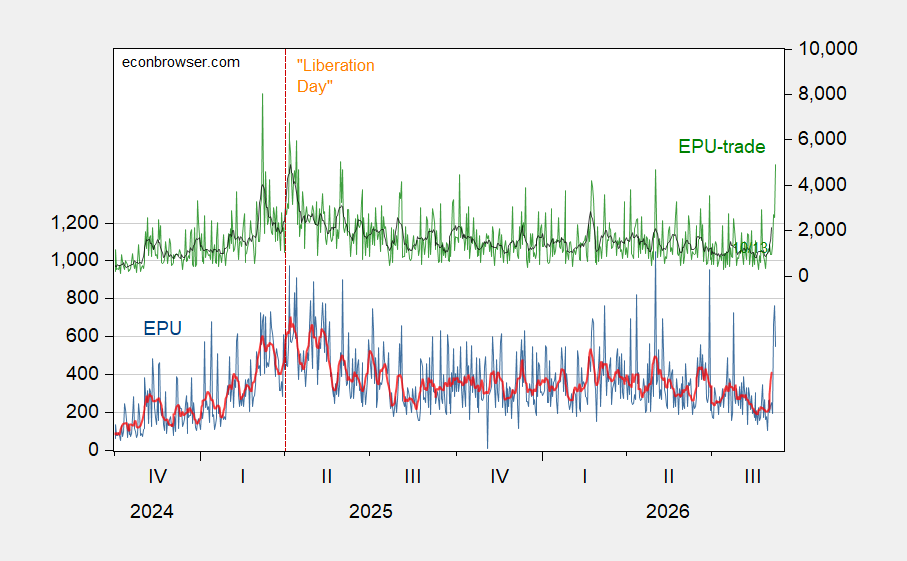
Through yesterday:
Figure 1: EPU (blue, left scale), 7 day centered moving average (red, left scale), EPU-trade policy (green, right scale), 7 day centered moving average (black, right scale), Source: policyuncertainty.com.
2 thoughts on “Policy Uncertainty: Economic and Trade”
James
As a Wisconsinite – I find Trump’s senseless trade war with Canada to be very harmful to my favorite food product – Wisconsin cheese. As of today, September 8, 2026, Canada has imposed a 25% tariff on U.S. cheese and other targeted U.S. agricultural products, in retaliation for the Trump administration’s tariffs on Canadian goods. The Canadian 25% tariff gets inserted between the exporter and Canadian buyer. Suppose a Wisconsin cheese producer sells $100 of cheese into Canada.
With the tariff: $100 Wisconsin cheese + $25 Canadian tariff = $125. The Canadian buyer now has several choices: Pay the $125. Demand that the Wisconsin producer cut its price. Substitute Canadian cheese. Substitute European cheese. Buy less cheese. The most likely outcome is some combination of all five.
Also please remember that Wisconsin is It is America’s dominant cheese-producing state, with an enormous processing infrastructure built around converting milk into: cheddar, mozzarella, parmesan, cheese curds, and other dairy ingredients. That infrastructure depends on large and reliable markets.
I’ve seen several interviews of Canadian political leaders that say Canada is looking elsewhere for reliable suppliers – China, EU, Asia. etc.
Why does Trump and the GOP want to hurt American farmers?
Ivan
As always with Carney this is very well designed. Trumps trade war will hit a remarkably well-targetted demographic, that could help turn the house. Even though our experience with tariffs has been that they are paid by the consumers in the country imposing them, this situation is more – cheesy. It is likely that consumers and importers will substitute away from a product with that level of price increase. A 10% tariff would have been split and eaten by all involved, but 25% is just a little too much to swallow.
As a Wisconsinite – I find Trump’s senseless trade war with Canada to be very harmful to my favorite food product – Wisconsin cheese. As of today, September 8, 2026, Canada has imposed a 25% tariff on U.S. cheese and other targeted U.S. agricultural products, in retaliation for the Trump administration’s tariffs on Canadian goods. The Canadian 25% tariff gets inserted between the exporter and Canadian buyer. Suppose a Wisconsin cheese producer sells $100 of cheese into Canada.
With the tariff: $100 Wisconsin cheese + $25 Canadian tariff = $125. The Canadian buyer now has several choices: Pay the $125. Demand that the Wisconsin producer cut its price. Substitute Canadian cheese. Substitute European cheese. Buy less cheese. The most likely outcome is some combination of all five.
Also please remember that Wisconsin is It is America’s dominant cheese-producing state, with an enormous processing infrastructure built around converting milk into: cheddar, mozzarella, parmesan, cheese curds, and other dairy ingredients. That infrastructure depends on large and reliable markets.
I’ve seen several interviews of Canadian political leaders that say Canada is looking elsewhere for reliable suppliers – China, EU, Asia. etc.
Why does Trump and the GOP want to hurt American farmers?
As always with Carney this is very well designed. Trumps trade war will hit a remarkably well-targetted demographic, that could help turn the house. Even though our experience with tariffs has been that they are paid by the consumers in the country imposing them, this situation is more – cheesy. It is likely that consumers and importers will substitute away from a product with that level of price increase. A 10% tariff would have been split and eaten by all involved, but 25% is just a little too much to swallow.