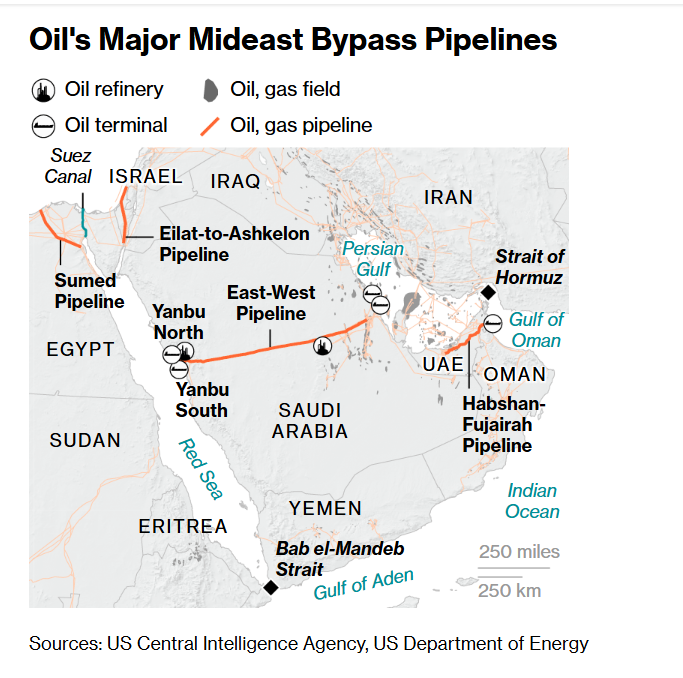
The Houthis expand control of the Red Sea side of Yemen, threatening remaining Saudi oil exports — and yet prices fall.
Source: Bloomberg.
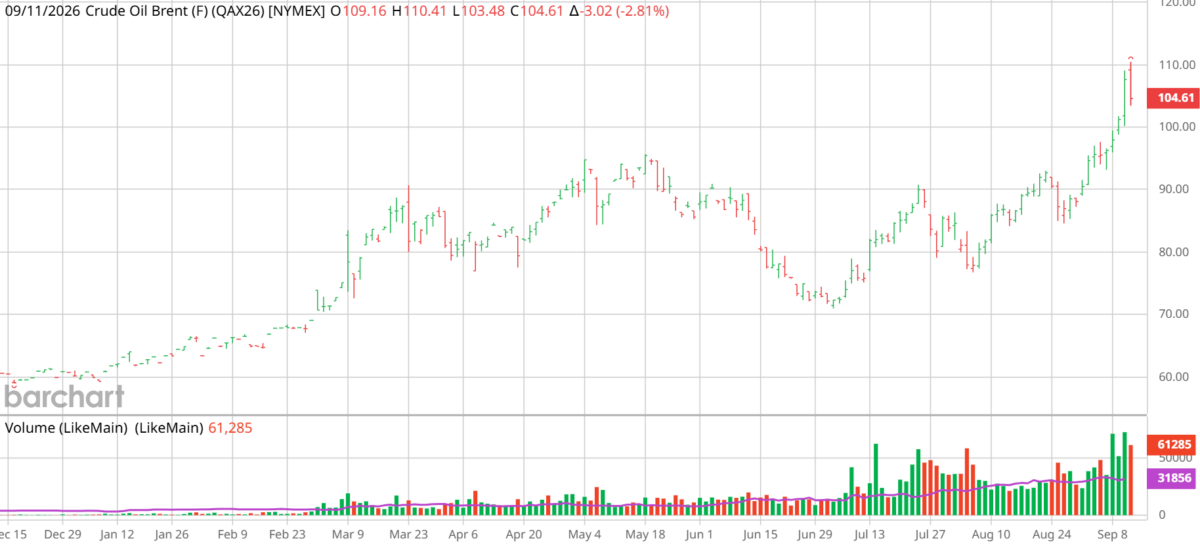
One explanation might be news regarding demand destruction, as reported by the International Energy Agency. From Bloomberg:
The agency said the hit to 2026 oil demand looks set to be on a comparable scale to the four largest shocks of the last 60 years, with the biggest impact falling on middle distillates like diesel, and feedstocks for petrochemicals plants in Asia.
…
… the market is heading for a deeper supply shortfall than previously estimated because the war is having an even bigger impact on the flow of oil than on consumption, according to the IEA.
The agency’s latest data indicate an average global oil deficit of about 1.7 million barrels a day this year, compared with a shortfall of 1.3 million a day in last month’s report. It shows stockpiles continuing to draw in the fourth quarter, instead of a marginal increase that it previously forecast. The agency’s August report said the market would return to surplus toward the end of this year.
Not a definitive answer, but a possible resolution to the puzzle (market commentary). As the extent of the closure becomes clearer, perhaps we’ll see a revision to prices.
Uh-oh, someone at the CIA or EIA is in trouble. The map refers to the “Persian Gulf” rather than King Donald’s preferred “Arabian Gulf.”
head will roll for not having the trump strait on the map. what the heck is hormuz anyway?
Another possible explanation for Friday’s price drop is that it was Friday. Crude prices were sharply higher on the week through Thursday, and over the weekend, no trade is possible. Why risk adverse news over the weekend when you can bank profits on Friday?
He who fights and runs away… Bulls make money, bears make money, pigs get slaughtered. Don’t push your luck. And so on.
Here’s a bit of related international affairs gossip:
“Saudi Crown Prince Mohammed bin Salman … called President Trump twice Thursday, urging him to launch strikes against the Houthis…, two U.S. officials told Axios.
“Trump declined, and U.S. officials stressed the administration has no plans to intervene directly against the Houthis for now.”
https://www.axios.com/2026/09/11/houthis-yemen-saudi-trump-mbs-strikes
Looks like Admiral Cooper, head of Central Command, is headed for Saudi Arabia. The current U.S. position is that we handle the Persian Gulf, while our regional allies deal with other problems. Since Saudi Arabia caused the Houthi problem, it seems fair they should deal with it, with the U.S. providing weapons and intelligence. Cooper will probably be carrying that message to the Saudis, but more than that. Cooper is not the brightest bulb, but he’s in charge locally and will want to coordinate actions to the extent possible, while maintaining our preferred division of responsibilities.
Funny…all of a sudden, we like having allies.
The Houthis’ gains and continued attack on Saudi Arabia, and the felon-in-chief’s refusal to help, may account for Iran’s new attempt to reach a deal with other Gulf states, excluding the U.S.:
https://www.nytimes.com/2026/09/13/world/middleeast/iran-meeting-gulf-arab-states.html
Cooper’s trip to Saudi Arabia takes on a new significance.
We’ll hear details tomorrow. Till now, Iran has insisted that Israel be reined in as a condition for opening Hormuz. Not sure how that’s going to fit in.
A major Saudi crude pipeline has been closed in response to aerial attacks originating in Iraq.
“It has been moving 4 million to 5 million barrels per day, amounting to 4% to 5% of global supply, sparing Saudi Arabia the brunt of the disruption that has crippled other Gulf oil and gas exporters.”
https://www.msn.com/en-us/news/other/saudis-shut-down-oil-pipeline-as-houthis-tighten-grip-on-red-sea-shipping/ar-AA2c5QnZ
BBC Newshour reports that Iraq has denied involvement and closed border crossings with Iran, presumably in an effort to capture those involved in the pipeline attack.
The BBC also observes what seems obvious, that the attack is an effort to keep oil in short supply as leverage to end the war. The problem there is the same as it has been all along; one old narcissist, suffering increasing mental decline and with no personal stake in lowering oil prices, is the person Iran need to persuade to end the war.
I’m curious as to whether this attack on the Saudi pipeline and Houthis’ taking of territory along the Red Sea is merely an effort to force an end to the war, or if part of the motivation is Shia resentment toward Saudi Arabia’s Wahabist Sunni rulers. Not that it matters much for oil prices.
If my guess about precautionary profit-taking being the cause of Friday’s oil price drop is right, well “oops” for those who sold, but it would still be the conventional right thing to do; it’s never wrong to take profits.
The U.S. has just “celebrated” the 25th anniversary of highjacked aircraft crashing into the World Trade Center, the Pentagon and a field in Pennsylvania. We, as a nation, have rarely been good at thinking about the rest of the world, but our response to the 9/11 attacks have profoundly affected people outside the U.S. In many cases, and in many countries, our actions have had effects far greater than those felt here at home. Brown University’s Cost of War project has tallied up some of the consequences. Here’s Al Jezzeera reporting in the Cost of War numbers:
“According to the Cost of War project at Brown University’s Watson Institute for International and Public Affairs estimates that US-led wars since 2001 have directly or indirectly killed an estimated 4.5 to 4.7 million people – including approximately 940,000 direct deaths and 3.6 to 3.8 million indirect deaths from disease, malnutrition and health complications.”
https://www.aljazeera.com/news/longform/2026/9/11/everything-changed-the-human-cost-of-25-years-of-us-wars
Four and a half million people dead because of our political leaders choices, and we’re at it again.
This does not count the deaths which the U.S. paid for and refused to prevent, mostly due to Bibi’s wars. Polling suggest Bibi will be out of power after next month’s elections. Whether that will bring Israeli violence in Gaza, the West Bank, Lebanon and elsewhere to an end, or make and end to the war on Iran easier, remains to be seen.