From FT yesterday:
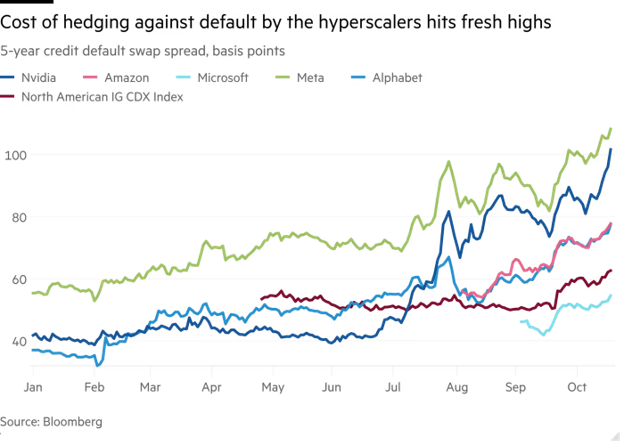
These are the large players in the AI boom; consider smaller players also involved in the AI boom. From the Economist:
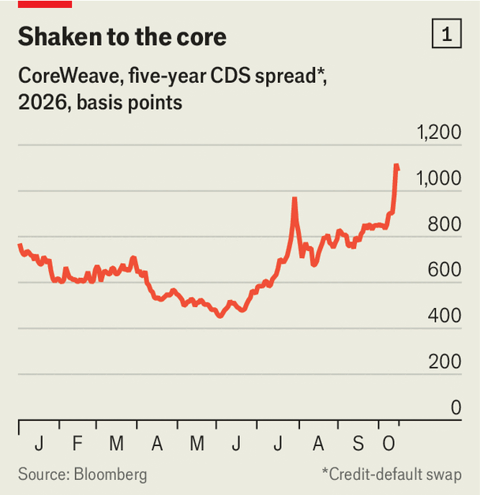
Credit markets are coming for CoreWeave. The price of a five-year bond issued by the “neocloud”, which rents out data-centre capacity for artificial-intelligence models, has fallen by 16% since July. The bond’s yield is now 15%—a level associated with companies in financial distress—up from 10% in July. The price of credit-default swaps offering insurance against a CoreWeave default implies that the probability of the company being unable to service its debts in the next five years has risen above 60% (see chart 1).
Investors increasingly worry that the companies at the heart of the AI boom will be unable to generate the cashflows necessary to service their vast debts. These concerns have spilled over from credit markets to cause a wobble in the stock market, too: having fallen sharply, the tech-heavy NASDAQ index is now back to where it was in mid-May. Investors are pricing in a debt stock that is getting bigger, more opaque—and increasingly risky.
This all leads to the $5.5 trn (by 2030) question – can borrowing really outstrip cash flow as much as required to hit planned capex spending?
The fog of violated ceasefire is thick these days. No MOABs have hit Iran’s Pickaxe Mountain yet, but there has been a small U.S. attack on Iran – a couple of Hellfire missiles, apparently – for the first time in nearly 2 months. There is unsubstabtiate internet chatter about the U.S. urgently seeking a deal, while Iran keeps pointing out that it has a 7-day plan for opening Hormuz, to which the U.S. hasn’t responded. Perhaps the U.S. is asking for the wrong deal – who’d have guessed? Both the U.S. and Iran are making loud noises about buddying up to Russia, as if Russia is the key to getting a leg up in the Persian Gulf. No other country has benefited from the U.S. war on Iran more than Russia, which makes Russia a poor choice as peacemaker.
There’s reason to see Iran as having the greater interest in dragging out the current situation, as long as the U.S. isn’t bombing, but most analysis which takes that view ignores what’s going on in and around Baluchistan:
https://www.aol.com/articles/iran-regime-under-pressure-rebel-115148000.html
Disparate groups of independence-seeking movements are busy exploiting Iran’s lack of an airforce. Some are joining forces, others not. Seems like a mess, whatever happens next.
Things we do know are that Iran has been tightening up on traffick through Hormuz and that the Houthis have been successful in maintaining their hold in western Yemen, and even expanding a bit. The UK has joined the party, sending planes to defend Saudi Arabia. It’s tempting to say that’s a bad sign for Saudi Arabia, but that’s probably too glib.
http://www.spglobal.com/ratings/en/regulatory/article/-/view/type/HTML/id/3579354
Nvidia got upgraded to AA by S&P a few months ago. I hope this is not Enron redux.
Krugman linked to Stijn Van Nieuwerburgh
http://www.brookings.edu/wp-content/uploads/2026/09/4c_Van-Nieuwerburgh.pdf
Definitely a must read.
Van Nieuwerburgh estimates AI investment will amount to 3.6% of GDP every year through 2036. With potential GDP growth put at between 1.8% and 2.1% through that period, net imports are gonna continue to climb – with an extra cost burden from tariffs – while investment outside of AI continues to be crowded out. It’s just math. If potential GDP ends up higher than forecast, that’s good, but 1.5% higher, every year? Not likely, and that means more imports and less non-AI investment.
Krugman may has said all of this already. I couldn’t find the article.
Everybody get their Medicare bribe from the grifter-in-chief?
It’s only $90. That’s barely one tank of gas. Where’s my $500? And when this bribe pays off and Republicans sweep the election, where’s my $5,000?
The CoreWeave CDS move above a 60% five-year default probability is a stark signal that credit markets are finally pricing AI infrastructure risk, not just equity hype. Insurance for hyperscaler-linked debt only helps if the underlying utilization and contract quality hold up. Do you see the stress concentrated in neoclouds, or is it starting to show up in the larger hyperscaler paper too?