Recent releases:
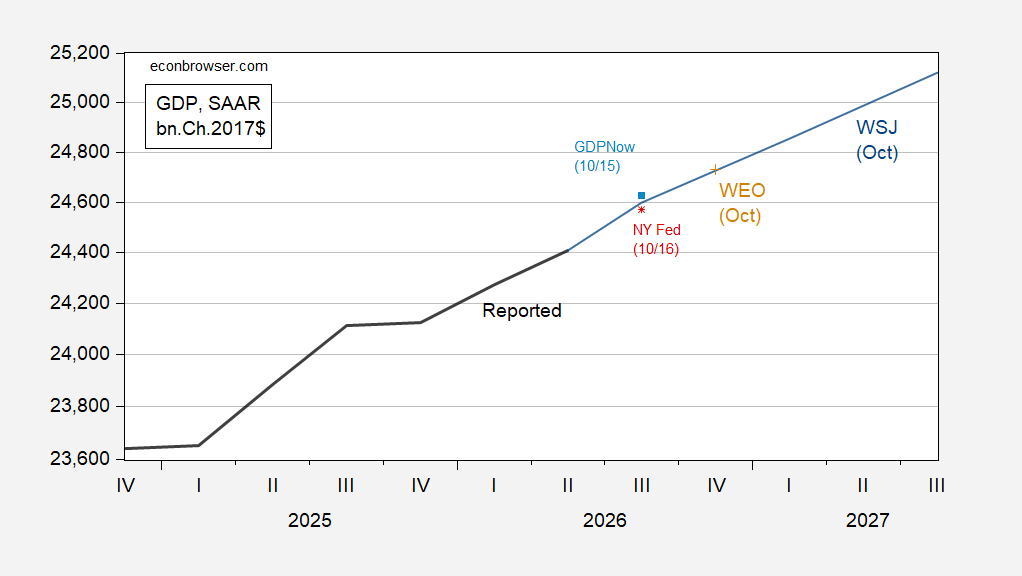
Figure 1: Reported GDP (bold black), October WSJ mean forecast (blue), GDPNow (light blue square), NY Fed nowcast (red *), October WEO (tan +). Source: BEA 2026Q2 3rd release, WSJ, Atlanta Fed, NY Fed, IMF, and author’s calculations.
My experience with these metrics shows a significant discrepancy during periods of high inflation.
If you don’t provide detail, your comment doesn’t do much good. What “experience” do you have in mind.
Off topic – Y’all remember the Arab Spring? It was a youth-led, peaceful uprising that temporarily changed politics in much of North Africa and the Middle East, permanently in some countries. That uprising came during a persistent drought that worsened economic conditions in the region, with young adults naturally suffering disproportionately. The current doings in France, at least according to Inside Climate News, are also partly inspired by climate troubles:
https://insideclimatenews.org/news/17102026/climate-crisis-fueled-paris-youth-protests/
Spain’s election is mostly focused on housing, but climate activism is on the rise there, too, and with reason:
https://www.weavenews.org/stories/2023/9/17/climate-justice-now-spaniards-demand-decarbonization-at-madrid-march
I’m willing to guess that the empty river beds have helped Nazi-adjacent AfD in Germany.
Just sayin’, there’s a pattern; if governments don’t start putting more effort into dealing with climate change, we may get us some new governments.
I neglected to mention India’s Cockroaches:
https://www.scmp.com/news/asia/south-asia/article/3371244/modi-under-pressure-indias-youth-protests-rise-highest-level-decade
The Cockroaches are mostly demanding a return to real democracy, which is slipping away under Modi. It is a youth movement, India is suffering from big climate issues, and despite some impressive headline growth figures, Indian youth are having a tough time finding work:
https://www.wsj.com/world/india/500-000-applicants-583-jobs-the-frantic-scramble-for-work-in-india-0fefa2b3
Can’t say the Cockroaches are motivated by the consequences of climate change, but where there’s smoke…
It’s looking like the SPR has become irrelevant to the North American oil market. That puts the SPR in the same category as the grifter-in-chief’s announcement that the U.S. would betray Ukraine in order to get a few measly barrels of Russian diesel.
There have been repeated releases of oil from the SPR since the U.S. attacked Iran, starting in March. In March, only about half the 40 million barrels offered from the SPR were taken. In June, only 1% of the 86 million barrels offered were taken. At the end of September, the SPR announced that another 40 million barrels would be made available:
https://www.yahoo.com/news/politics/articles/u-draining-oil-again-nobody-182515931.html
On Friday, 17 million of that new 40 million barrels was made available. WTI climbed about 11% last week, with a 3.5% gain Friday, the day the SPR offer was made. Doesn’t seem to mean diddly.
There are a at least three reasons for the irrelevance of SPR releases in North America. One is that refinery use is very high, leaving little need for more barrels. The latest reported refinery use rat is 93.5%, which is high, but not compared to mid-summer when the use rate hit as high as 98%. However, this is refinery maintenance season, and over the prior 4 years, usage never reached above 89.9% in a comparable week.
Another reason is that there is a good bit of crude trapped in the Americas because of record-high tanker rates, as high as $40/bbl. Lastly, the terms at which SPR oil is offered are unattractive. Barrels aren’t being sold, there offered in return for future barrels. For every hundred barrels taken now, 124 barrels have to be returned. Seems like a bad deal when the Americas have a heavy crude glut and refineries are don’t lack crude.
So we can watch SPR “releases” as market information and as political theater, but don’t think they do anything to ease market conditions.