Jared Bernstein, along with others, calculates the revenues needed to rationalize the AI capital investment in place and planned.
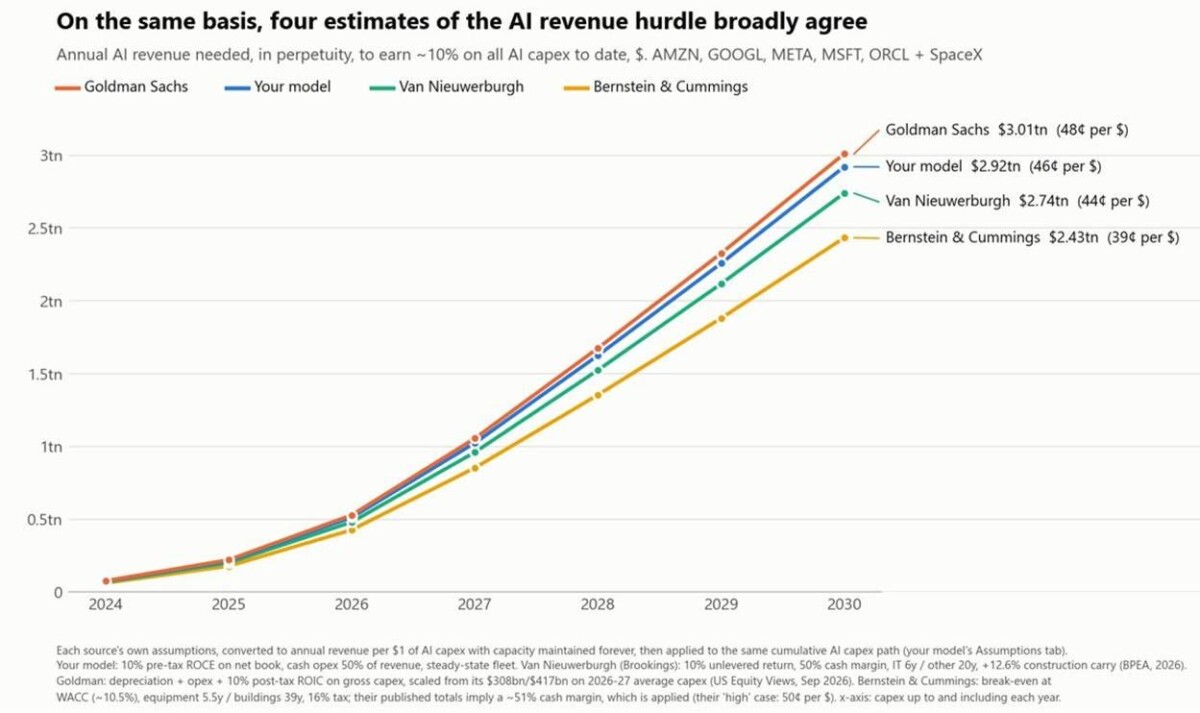
Source: Callum Williams via J. Bernstein.
As Bernstein recounts, this amount of revenue is unlikely to occur within a time frame financial markets are likely to tolerate (i.e., soon). A BPEA paper by Stijn Van Nieuwerburgh on the subject is here. And has been pointed out, financing for these expenditures has been migrating out to more exotic, less transparent, areas of the financial system.
I can’t remember where, but if you believe the revenues are coming, you have to also ask from whence they are coming. Surveys of planned spending on AI services (highly speculative I know) are much smaller.
I don’t doubt there can be a big payoff to the firm or firms that come first in the race to market AI services; however, a big mess can arise from the aftermath for the firms that come in last, or next to last…
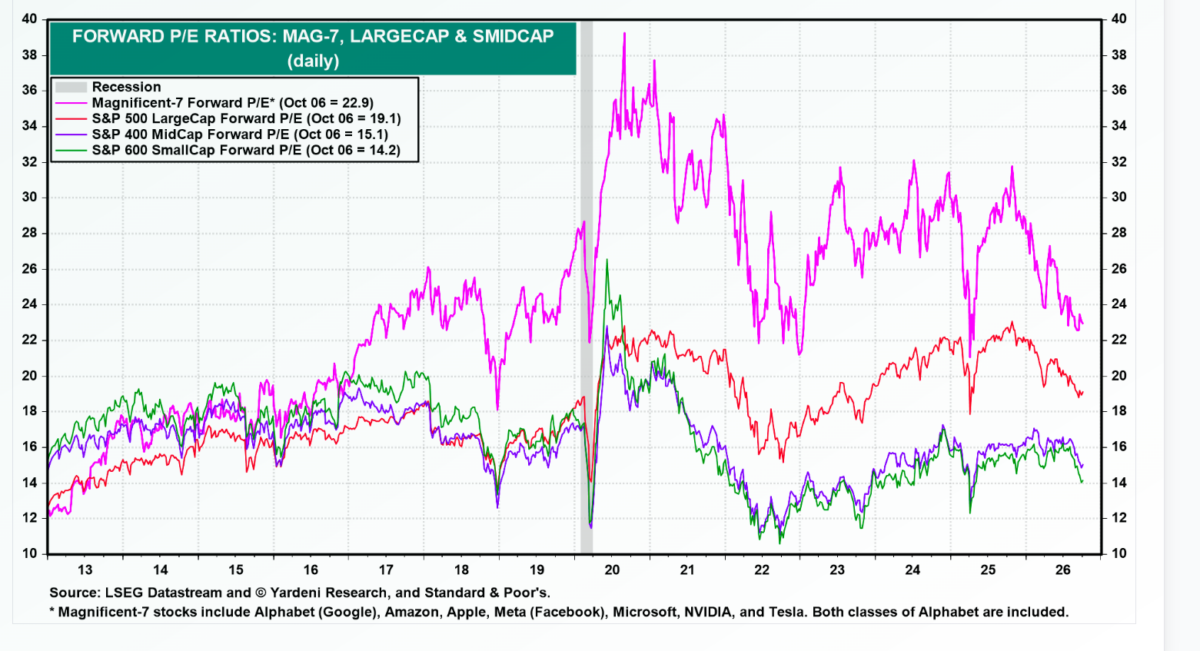
One interesting aspect of monitoring the sector: price to (forward) earnings for the Mag-7 (not exactly the AI labs; Mag-7 have revenues coming in from other streams) are pretty low, historically speaking. But then, one has to remember, these are forward earnings, which are analysts “guesses”
Thus the pretend/extend overall. Its when debt servicing becomes too large they have to liquidate assets the “panic” occurs. After 83 the big banks had been building big leverage. The first real leveraged boom since the economic change in the 70’s. The housing bubble finally blew it it up too far.
Considering how concentrated this is. It will be fast.
“This time is different.”
Said mortgage optimists.
Said tech optimists.
Said Japanese real estate optimists.
Said Fischer just ahead of the 1929 Crash.
Said Tulip optimists.
Human beings seem to make the same mistakes, just with different props throughout time.
Is it too cynical, jaded, sadistic to say, “Grab your bucket of buttered popcorn for the entertainment to start”??
The only way this may be different is if AI has created an integrated trading network that creates an Irving Fischer permanently high plateau of a pyramiding Ponzi via round robins, wash sales, matched orders and probably a multitude of transactional scams that I don’t have the math skills to imagine; but AI does and no doubt integrates all the new money flowing into retirement accounts into the web. Add in the dark web trading platforms that supposedly report into the the public systems and it becomes a feast for the overlords. As someone who did these cases in the eighties (and those were complicated beyond belief) not to mention no one wanted the burst the bubble (which really pisses off the investor marks) my money is on the scam not just in the debt markets but the as yet to be revealed stock/options/futures markets. Mike Milken charted the way with debt/equities/options nexus combined with fictious transactions and computerized trading and now it’s exponential. Imagine then if like with LIBOR, all of the major players are in because the profits are huge and with AI there is no “intent” to defraud (that will be the defense) as “no one knew” the programs could do that !
Still invested though but have taken sufficient profits hoping to weather the next big bang. (Not investment advice).
Small and mid caps look pretty cheap by historical standards. Ratios are all declining since Trump took office.
Well high interest rates would do that. If you think this means they are undervalued might we suggest you take freshman finance.
There are a number of ways to value stocks, or anything else, for that matter. However, by the metric of forward P/E ratios back to 2013, yes, they look a bit undervalued.
Yet another sign of credit market stress – Bloomberg on leveraged loans:
“…strategists at JPMorgan Chase & Co.,… on Tuesday wrote that the value of loans trading below 60 cents on the dollar, or deeply distressed levels, rose to $65 billion from $40 billion a year ago, to the highest since March 2020.”
https://finance.yahoo.com/markets/stocks/articles/deeply-distressed-us-loans-rise-181049683.html
If only there were a simple policy decision which could improve the outlook for the credit market…
My little joke in these days of a quickly- developing credit-market disaster is “If only there were a simple policy change which could ease credit-market stress…”
There is such a policy: end the war on Iran. Why is there no discussion of that solution in the halls of power? One way of understanding the war-criminal-in-chief’s refusal to end the war is “other people’s money”. The losses being inflicted on everyday people are not a concern for the mostly-rich members of the war criminal’s administration, and certainly not for him. Oh, and you can substitute “other people’s children” for “other people’s money” and still be right about how this thinking works.
The war criminal has long been cavalier about paying his obligations, and generally about the consequences of his decisions. He has always lived on other people’s money. It shows in his governance. So what if interest rates are rising? He doesn’t pay the price. Oil prices and general inflation? A “small price to pay” for whatever-the-hell his excuse for the Iran war is today. All these problems are “other people’s money”. He’s the King of Debt, after all.
This attitude is not unique to the war criminal. One bit of advice I’ve heard from small business owners all my life is never to use one’s own money to start a busienss. The finance sector, construction, real estate development, stock buy-backs and all kinds of other “enterprises” are all about getting rich on other people’s money. AI investing is now largely paid for with other people’s money, and the top guys are making a fortune.
Congress is, of course, in the business of spending other people’s money, so huge deficits are just dandy. Tax cuts for the already-rich, at the expense of piling up debt to the point of disaster, looks a lot like the war criminal loading businesses up with debt while paying himself handsomely. The same is true for private equity vultures.
Brad Delong once described working in finance as little more than smearing oneself with glue and stepping into a stream of money – other people’s money, naturally. Delong is smart and well-intentioned, but sometimes naive; finance is only one of a range of endeavors which amount to getting sticky with of other people’s money.
If there is a lesson here, it’s that our political leaders need to be subject to the same consequences as the rest of us. Thinking about unintended consequences is a big part of good decision-making. Rich celebrities, left-over Kennedys, bond-market billionaires, partisan warriors – none of them fully share the consequences of their actions with regular folk. That makes them likely to make “other people’s money” decisions.
White House mocked for absurd claim Donald Trump is stopping hurricanes forming
http://www.themirror.com/news/us-news/white-house-trump-stopping-hurricanes-2022353
Trump did it with his sharpie!
Treasury’s 10-year auction went really well – we’ve stepped over a banana peel today. Dealers got a very small share of the auction, which is good for market stability in the near term.
https://www.apollo.com/insights-news/insights/daily-spark/europe-is-financing-the-us-ai-buildout
From your link:
“Hyperscalers account for 7% of euro issuance with maturities of 10 years or more, compared with 3% across all maturities.”
Longer duration reduces near-term roll-over risk and matches returns that are expected to come in later years, so the decision to issue long is reasonable. However, it also means greater interest-rate sensitivity. With rates rising, that’s not good.
this is what I have been saying on this blog recently. I just don’t see how you can justify the amount of investment going into these AI datacenters. where is the money going to come from to pay for all of this, on a recurring basis? the purpose of AI is supposed to make the business more efficient. but if the business needs to pay large sums for AI access to be efficient, it defeats the purpose. I am not sure I really see how the AI companies continue to maintain a revenue stream over large time frames, which is required to pay off these debts. this really relies on some sort of growing the pie feature that is much larger than anything we have seen in the past, at least that is my impression. and who is going to pay for the mistakes that AI makes in this work? my experience with AI is that it makes plenty of mistakes that need correction, with time or money. sure it can hit home runs and solve millenium problems. but you see the cost involved in those solutions? lots of money spent to produce accurate mathematical proofs that are essentially useless, because it is not so much the proof as the new mathematical advances that are of value. it seems very good at providing proofs through technicalities, not creativity. imo.
In the normal run of investment, the cost of keeping things running becomes very large relative to the cost of new investment. There are big doubts about the ability of this first round of build-out to pay for itself. How the heck is depreciation going to be paid for? Extraordinary returns will be needed, year after year, even when most new investment is replacement of worn-out capital.
Little economic anecdote. Larry Lindsey was one if the supply-side guys who claimed that investment would flourish, so that growth would accelerate and all would be grand under the right set of policies. Lindsey’s PhD thesis was largely about how depreciation eventually eats up any new increment of investment as a share of GDP, so any acceleration in growth from that new increment of investment has a limited life. Lindsey earned his spurs by showing that the benefits of supply-side policies are quite limited, and then became a supply-side cheerleader. And Lindsey was one of the honest ones. I mean that in all sincerity. Lindsey was a good economist and mostly honest. He just happened to fall in with a bad crowd.
an interesting side note, not aligned with my comment though. I have a friend who is a great business man, entrepreneur type. he has a business that recycles old electronics (think gpu boards, etc). business is growing into a monster it appears. at any rate, he surprised me with the comment that multi year old gpu’s and other devices can be recycled at significant value even though their performance is a fraction of the new devices. it appears the depreciation of these data center “junk” is not nearly as great as I had believed. not sure if this really affects ongoing funding issues, but the hardware does not become as worthless as I expected. at least according to my friend in that business. just an interesting observation.
Great point. It’s sort of like with old car batteries. Even if the capacity is down to half they can still be useful for energy storage – just not in cars. For a battery farm on a big plot of land energy density is not a critical parameter. That is one of the reasons recycling of batteries has not picked up much.
the FT reported a while back that OpenAI had annual revenues in the neighborhood of $70 billion, based on info analysts could dig up-not reported by OpenAI but with data reported by them. apparently the company has now reported its own annual revenue, and it is substantially less at $50 billion. one advantage investors get from a public company is that they can no longer lie about their numbers without repercussions. my guess is this clarifying update is in anticipation of a presumed IPO. big trouble if you lie about your revenue prior to going public. over the past year people have struck deals and bought bond debt with perhaps inaccurate revenue numbers related to AI and compute. this update is not catastrophic, but it plays into the narrative on whether there is enough revenue by these companies to cover costs.
First, given that data center projects are behind schedule and over budget, that a big quantity of delivered chips are gathering dust, will there be AI “capacity” of any volume for LLM to produce value (if themselves they could) worth more than the few billion OpenAI and Anthropic are generating this year?
Second, to do/replace such human work, can a senior VP be expected to “manage” LLMs, burning GW of compute, measured in trillions of tokens billed, without an army of experts….Checking the inferences, looking for hallucinations .?
https://www.yahoo.com/news/politics/articles/t-eat-road-salt-susan-140922754.html
“We Can’t Eat Road Salt”: Susan Collins Crashes and Burns in Debate
BTW imports of rock salt are important during the winter. I once did a report on the transfer pricing for a company called the North American Salt Company so I can appreciate what she did. But come on – how does this bring down the cost of groceries
Oil is frisky today. Brent up over 4% today on news of more Iranian attacks on tankers. The war-criminal-in-chief has said the U.S. won’t attack Iran again until after the election – making the Iran war all about U.S. politics, I guess? Or maybe he’s lying.
Meanwhile, refineries are shutting down to prepare for a hurricane to make landfall. Seasonally, that’s not odd and in fact, El Niño is reducing the number of Atlantic storms, but still, not goid for the crack spread.
Iran really is annoyed at all the reporting about Persian Gulf oil shipments nearing pre-war levels:
https://www.reuters.com/world/middle-east/iranian-official-says-illegal-routes-strait-hormuz-soon-be-blocked-2026-10-07/
An Iranian Revolutionary Guard guy says illegal routes near Oman will be closed down.
just as a reminder, the republican controlled presidency, senate and house have run another $2 trillion budget deficit. conservative fiscal policy gives us huge deficits. careful what you vote for in November folks.
Krugman take on AI investing from another perspective:
https://paulkrugman.substack.com/p/ai-versus-everything-else
He plainly says that AI investment is crowding out other forms of private investment. His post includes a chart from Steve Rattner showing data center investment up by $51 billion from January 2024 to July 2026, while all other forms of private construction spending have fallen by $120 billion.
There is, of course, the usual problem of attribution, of causality. Is a $51 billion increase in data center investment enough, all by itself, to account for crowding out $120 billion of other investment? The math doesn’t work. It’s not that crowding out isn’t happening, just that other problems are piling on. Tariffs have caused uncertainty. Government deficit spending has raised interest rates, as has the inflation caused by tariffs and the Iran war. Krugman knows about these other factors, obviously, but has chosen to focus on data centers.
Here’s the thing – when private investment is boosting GDP, when output is above potential, increasing the deficit is bad policy. Do we want all thise data centers? In a market economy, that’s up to investors to decide. Economists (and others) are right to be concerned that investors are screwing up, because they often screw up, but the investment decision is still up to investors.
Government, meanwhile, ought to be taking steps to assure stability, to induce private interests to internalize externalities, and to balance public interests. Stoking AI investment through government intervention, while ignoring crowding out, is a mistake right now. Stoking growth with fiscal deficits is a mistake right now. It’s a full-employment thing, a systemic risk thing, a crowding out thing.