The term spread is positive in Canada through September. But the term spread signaled recession for 2024 (which some had predicted). What can we take from this, regarding recession probabilities?
In part, the answer depends on what recessions have been identified. That in turn depends on the interpreter. For Canada, there are at least three: CD Howe, ECRi, and Philip Cross as updated. Here are 10yr-3mo spreads and the respective recession dates (peak-to-trough).
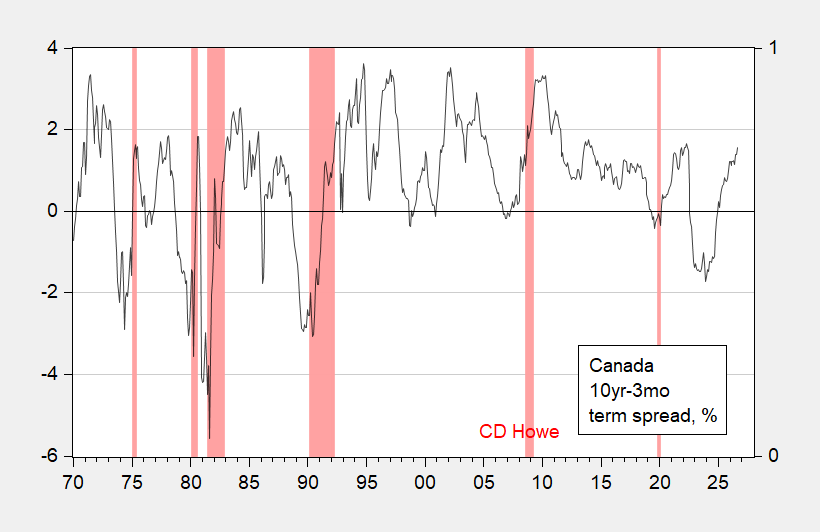
Figure 1: Canadian 10yr-3mo spread, % (black line), and CD Howe peak-to-trough recession dates (pink shading). Source: OECD, CD Howe.
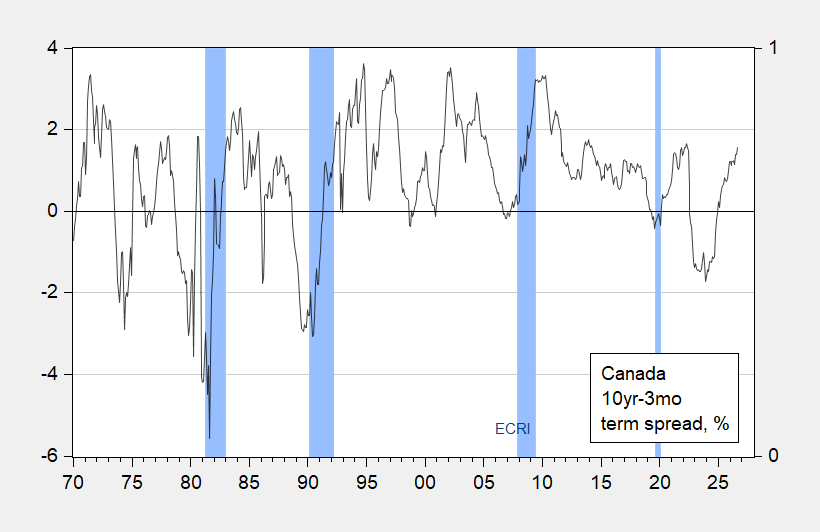
Figure 2: Canadian 10yr-3mo spread, % (black line), and ECRI peak-to-trough recession dates (pink shading). Source: OECD, ECRI.
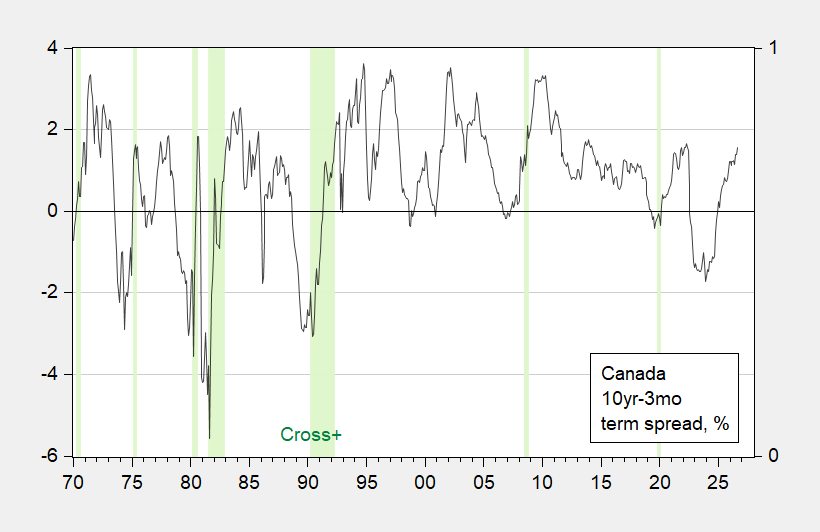
Figure 3: Canadian 10yr-3mo spread, % (black line), and Cross peak-to-trough recession dates (pink shading). 2020 recession set equal to ECRI dates. Source: OECD, Cross (1996) as updated by Hao and Ng (2011).
As noted in Chinn and Ferrara (2026), the 10yr-3mo term spread model — estimated on pre-pandemic data — would have predicted a 2024 recession (using a 40% threshold), but would’ve missed the 2008 recession (as well as the 2020 recession). Using the entire sample, a recession would’ve been predicted using a 35% threshold.
Using some of the same specifications reported in Chinn and Ferrara (2026) for the US (blogpost here), we find the debt service augmented regression would’ve also predicted a recession, using the 40% threshold. The term premium augmented specification would not have (although this is estimated on a much shorter sample).
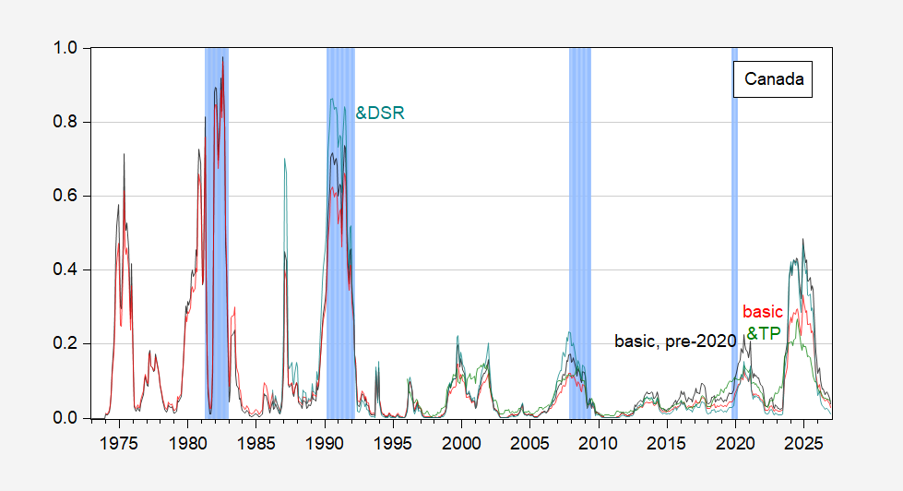
Figure 6 from Chinn and Ferrara (2026): Canadian recession probabilities. Light blue denotes ECRI defined peak-to-trough recession dates. Notes: Estimated recession probabilities pertain to predicted date, not to date of prediction. Assumes no recession through April 2026.
On the other hand, the term spread has never been so positive and then subsequently followed by a recession (at least since 1970 onward). Hence, the indicator based evidence for an incipient recession is not strong (and was not strong, based on historical correlations, for a recession in 2026). Of course, a 12 month ahead indicator can’t take into account “surprises” like a drastically escalated trade war.
Given the number of false positives for just any old inversion, and the oddity if the Covid recession, what would happen if we picked a deeper inversion? There are no false positives for -200 basis points. Only the Covid recession is missed.
Looks like peace efforts are underway between Iran and the Mecca Accord bunch. No U.S., no Israel.
https://www.aljazeera.com/news/liveblog/2026/10/26/iran-war-live-trump-rules-out-strikes-today-israeli-forces-raid-hebron
Muslim states will have to create their own peace and just kick US out of their countries. They have no other choice.
The US no longer have any strategic interest in the area, so a normal US government would actually be happy to leave. It would even be a classic US isolationist move if we packed up and left both the Middle East and Europe – which would be fine with those regions since we have given up on being the benign hegemon.
The bigger problem is that China is more than ready to fill the void when US give up on being the worlds only super power.