Here are several price indicators for consumers:
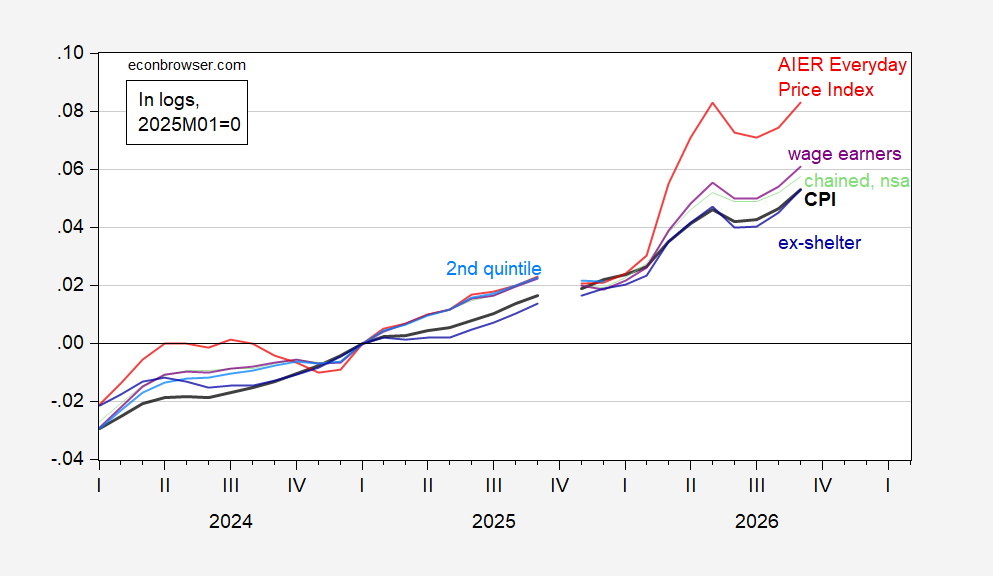
Figure 1: CPI – all urban (black), CPI wage earners and clerical workers (purple), chained CPI (light green), CPI ex-shelter (blue), AIER Everyday Price Index (red), all in logs 2025M01=0. Source: BLS, AIER, ad author’s calculations.
If you feel like everyday expenses are rising faster than the CPI since February, the AIER’s EPI confirms this impression.
Real hourly earnings deflated accordingly.
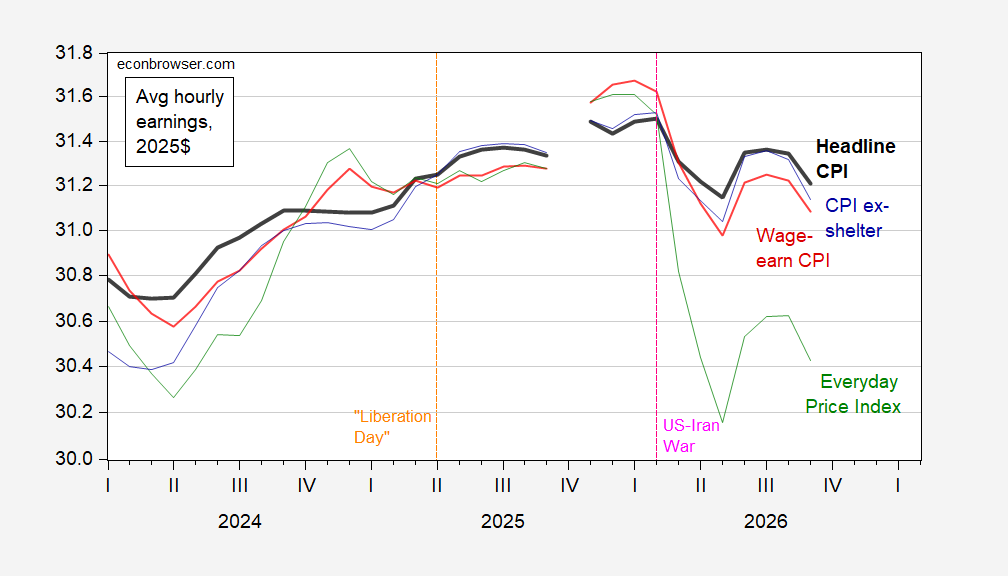
Figure 2: Average hourly earnings for production and nonsupervisory workers deflated by CPI – all urban (black), CPI wage earners and clerical workers (purple), chained CPI (light green), CPI ex-shelter (blue), AIER Everyday Price Index (red), all in 2025$. Source: BLS, AIER, ad author’s calculations.
As for final demand PPI, this picture shows that it’s rising much faster than the CPI.
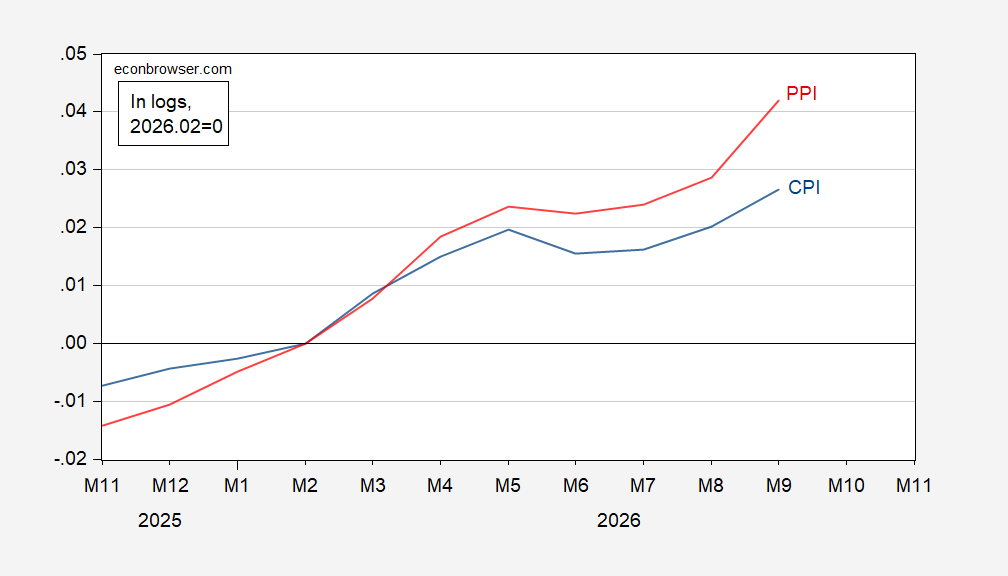
Figure 3: CPI (blue), final demand PPI (red), both in logs, 2026M02=0. Source: BLS.
With “fuels and related products” leading the upward movement, I think we can be relatively assured that PPI will be leading CPI (see this post).
I found Torsten Slok’s Daily Spark from October 15, 2026 interesting: “Higher interest rates have not slowed the data center buildout. Over the past year, 10-year yields are up 125 bps, yet consensus forecasts for 2027 capex growth have only been revised higher. The reason is that many AI investors expect AI investments to return more than 10%, well above the 4% Fed funds rate. With borrowing costs far below expected returns, the AI spending boom is not sensitive to interest rates, and tighter policy is losing its bite on the economy. The implication for investors is that upward pressure on rates persists until either the Fed raises rates above expected AI returns, or expected AI returns fall below the Fed funds rate. With the consensus still very bullish on AI, investors should expect continued upward pressure on rates.”
To me – this indicates that we have two different U.S. economies – the tech bro oligarch economy and the rest of us. Also check out some of the reports on direct and indirect water use by the data centers – good luck with El Nino induced drought.
Slok is looking at historical data, which is a very good thing to do. However, that approach inevitably misses canaries in the coal mine. We’ve just seen evidence that some canaries aren’t feeling well. Repeating a link:
https://startupfortune.com/banks-are-now-trying-to-offload-the-ai-data-center-debt-they-just-underwrote/
If investors are expecting a 10% return that begins in the future, the calculation is more complicated than ROI vs cost of capital, because the ROI has to reimburse investors for thenperiod in which no return, or modest returns, are earned. That makes the longer-term cost of capital a better starting point. BBB corporate debt is going at % these days:
https://fred.stlouisfed.org/series/BAMLC0A4CBBBEY/
Data centers aren’t all as healthy as generic BBB; Coreweave is trading around 15%:
https://247wallst.com/investing/2026/10/16/whos-really-paying-for-the-ai-boom-the-bond-market-is-starting-to-ask/
Slok’s observation is valuable, but there’s more going on than the point he made. And if borrowing costs continue to rise…
First I have heard of the AIER Everyday Price Index. Essentially, as I understand it, it focuses on consumables and largely excludes durables. I think this one — but not the only — measure of the impact of inflation on the average consumer. Not a bad metric, though, for short term, middle class inflationary pressures. (My bag of coffee has risen from $14.99 pre-Trump to $19.49 most recently, and immediately jumped to $19.99 under Trump’s tariffs. I certainly noticed.)
One should not minimize, however, durable purchases on short-term consumer sentiment. About 40% of households acquire a new or used car yearly, and about 25% of households do so using debt or leases. Thus, a substantial share of households will be sensitive to both car prices and interests rates, even in the short term.
In addition, 13% of households are exposed to either property price inflation or interest rate increases (via purchase or refinancing) in a given year.
Also, roughly 35–45% of all US households carry an interest-bearing credit card balance at any given time, which are exposed to short term variations in interest rates.
So figure 50-60% of households are exposed to either durables inflation or interest rate rises in any given year. It’s not just consumables by any means.
https://aier.org/research/what-is-the-everyday-price-index/
‘‘God, I Sound Like Marx’: Jim Cramer Shocks Himself With Analysis of Who’s Cashing In on the Economy.”
https://www.mediaite.com/media/god-i-sound-like-marx-jim-cramer-shocks-himself-with-analysis-of-whos-cashing-in-on-the-economy/
Time for mainstream macroeconomists to start acknowledging how bad inequality has gotten?
I’m waiting…
Its not inequality. Its paper leverage. Crash it and watch inequality measures crash.
If you’re waiting, it’s because you doknow what mainstream economists are writing, saying or thinking. You’re still walliwing in ignorance. Sad little man.
Is Johnny banned for violating the comments policy of the blog?
As I recall, he disparaged someone by name. In this case, he’s disparaging a group of people – same offense, just scatter-shot.
I asked the Duck-Duck-Go search assistant “which macroeconomists are warning about inequality?” Answer: “Economists including Thomas Piketty, Joseph Stiglitz, Jayati Ghosh, and IMF researchers have warned that rising economic inequality threatens growth and stability.”
It’s interesting that the list is so short and that only one American made it.
You might also be interested in typing “inequality” into the search box on this page and see what it comes back within the past eight years.
Your reliance on, and trust in, AI to represent what economists are saying speaks volumes. So does you biased spin.
In the AI algorithm, how many answers are required? Four were returned. If four is what the algorithm is programmed to return, you don’t know whether lots of economists or few are interested in inequality. And you surely don’t know what’s in the algorithm.
We know that Menzie Chinn, Brad Delong, Justine Wolfers, Paul Krugman and Claudia Golden write about inequality, but the AI didn’t return their names. We also know that David Schieferdecker, Susanne Reinhardt, Jonathan Mijs, Graziella Moraes Silva, Chana Teeger, Flavio Carvalhaes and Jeremy Seekings write about inequality, but the AI didn’t return their names:
https://compass.onlinelibrary.wiley.com/doi/10.1111/soc4.70001
Your reliance on a single stab at AI is laughable.
The U.S. has about 5% of the world’s population and in recent years produces less than 25% of journal publications. So the fact that the AI response named three people and one is from the U.S. means the U.S. is over-represented among economists writing about inequality.
Johnny has a long record of making scurrilous claims, and he’s at it again. He doesn’t know enough about economics to know what economists have to say. Never has. When called out, he falls back on AI and then misrepresents the AI response.
Johnny was banned from commenting for insulting an individual. Now, he’s slandering a group. He should remain banned.
“Why So Few American Economists Are Studying Inequality
In recent years, it’s been European scholars who have written the blockbuster papers on the topic.”
https://www.theatlantic.com/business/archive/2016/09/why-so-few-american-economists-are-studying-inequality/499253/
Leave it to Macroduck to wax self-righteous when caught in fragrante delito. Instead of providing proof of macroeconomists gripping attention to what Obama has identified as the defining challenge of our time., he prefers to simply smear the person raising the issue.
Where’s the beef?
Here’s an economist (French-American) who actually puts his money where his mouth is…instead of closely following the aggregates and the markets and occasionally noting inequality and chattering about it, like Krugman.
“On the campaign trail with Gabriel Zucman, the economist who wants to tax California’s billionaires”
https://www.lemonde.fr/en/m-le-mag/article/2026/10/18/on-the-campaign-trail-with-gabriel-zucman-the-economist-who-wants-to-tax-california-s-billionaires_6758722_117.html
I mean, has anybody here even mentioned California Proposition 40? Does anyone know what it is?
JohnH: I do. And 41, 42, too.
Johnny, you linked to an article in The Atlantic that is nearly a decade old. and it is a newsrag, not a research paper.
and let me point something out to you Johnny. academic researchers do not choose their topics based upon pop culture and blog requests. in fact, if you start to see alot of researchers working on the same topic, you can bet the rigor in that work will begin to diminish. expertise is important, moreso that quantity. progress depends on quality, to quantity.
Funny, funny. There no chance Krugman has any idea what Johnny, a gnat, has to say. Nevertheless, here’s Krugman writing about inequality, today:
https://paulkrugman.substack.com/p/ai-rising-inequality-and-rising-oligarchy
Johnny’s silly AI poke didn’t turn up Krugman, so in Johnny world, Krugman doesn’t care about inequality. That’s the level at which Johnny thinks.
I see that Krugman signed a letter supporting California Proposition 40, but I don’t see that he’s ever written anything about it. Curious… I mean, it’s not like it’s a seminal attempt to directly counter inequality or anything…
Did MacroDuck deign to look up what it is?
She lasted less than a scaramucci on the job. The press secretary, that is. Didn’t even catch her name. Brash hiring based on looks does that sometimes.
A Clinton guy has said she was set up to fail. He doesn’t discuss whether it was intentional. Either way, it’s a huge failure. It’s like, say, picking a heavy-drinking TV talking head for a cabinet post. Or a blogger to run a law-enforcement agency.
Or a felon to be president.
Deflating the production and nonsupervisory series is the right call here, since that’s the paycheck most trades workers actually live on. We run a job board for traveling trades workers, and for people on the road the everyday index matters even more than for most, because fuel, food and a motel room are the whole cost of getting to work. A flat per diem doesn’t move when those prices do, so the squeeze shows up first in what’s left at the end of the week. The workers who come out ahead are the ones who keep a running log of fuel, food and motel receipts and know exactly what the job cost them.
One thing the index debate leaves out: the same item sits at very different prices across sellers. The CPI tracks how the average moves, not that spread. For a household, that spread can be bigger than the yearly inflation rate, so who you buy from is part of your personal cost of living. Seeing real prices is the one part of inflation you can actually act on.