The Bureau of Economic Analysis announced today that seasonally adjusted U.S. real GDP grew at a 3.4% annual rate in the third quarter. That is a little above the historical average growth of 3.1% and better than the numbers we’d been seeing over the last three quarters.
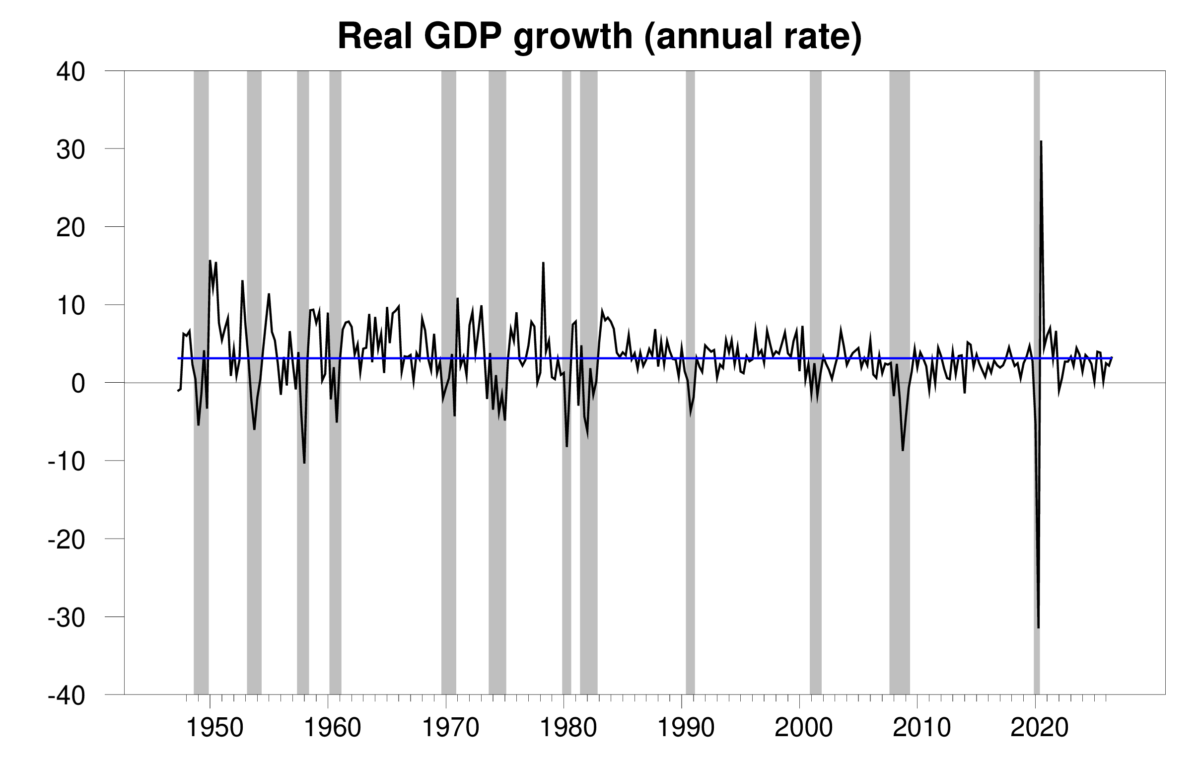
Quarterly real GDP growth at an annual rate, 1947:Q2-2026:Q3, with the historical average since 1947 (3.1%) in blue. Calculated as 400 times the difference in the natural log of real GDP from the previous quarter.
Today’s GDP report brings the Econbrowser recession indicator index down to 3.5%, a little more favorable reading than the previous two quarters.
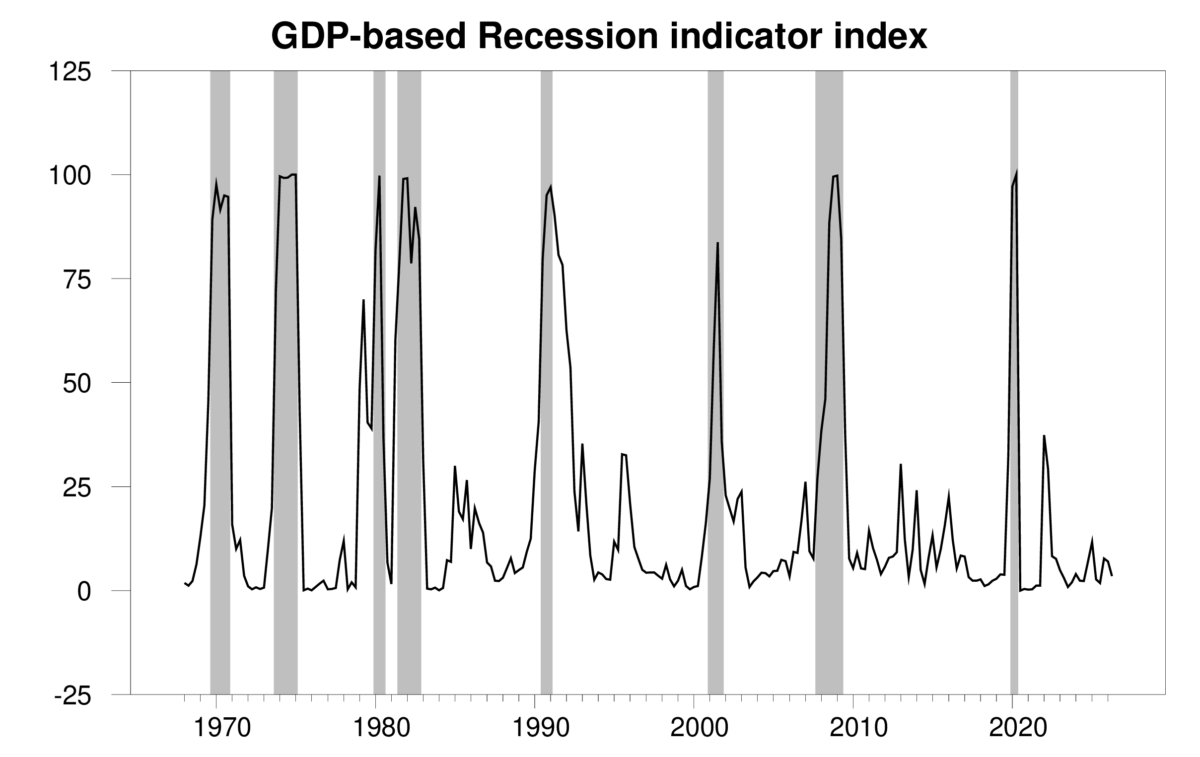
GDP-based recession indicator index. The plotted value for each date is based solely on the GDP numbers that were publicly available as of one quarter after the indicated date, with 2026:Q2 the last date shown on the graph. Shaded regions represent the NBER’s dates for recessions, which dates were not used in any way in constructing the index.
Gangbuster AI investment keeps making a big contribution. But since much of that spending was on imported goods, the net contribution to GDP was more modest. Residential fixed investment, which will bear the brunt of any Fed tightening, continues to look weak. The big difference from the previous quarter came from increases in inventories, which represent newly produced goods that were not sold.
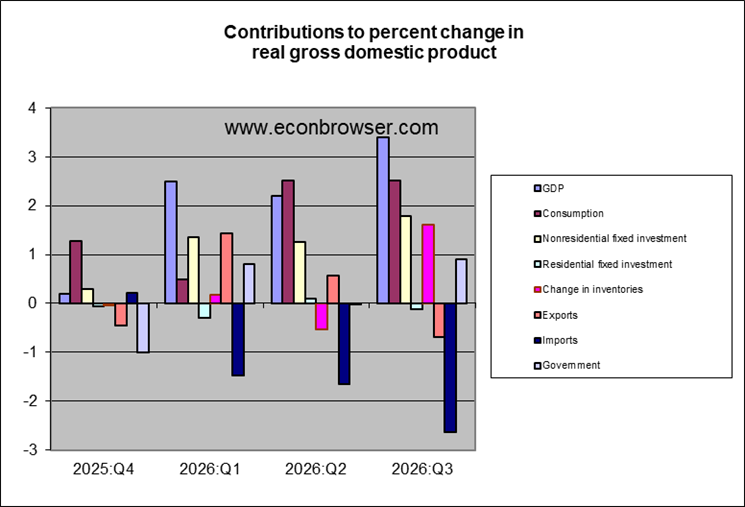
Imports grew a lot. Guess those tariffs are not working out as planned.
“U.S. real GDP grew at a 3.4% annual rate in the third quarter. That is a little above the historical average growth of 3.1% and better than the numbers we’d been seeing over the last three quarters.”
And yest Kevin Hassett was telling us that the numbers over the past 3 quarters showed strong economic growth. I bet he touts this report as saying Trump’s Golden Age is flourishing. I just hope he brushes his teeth before all those smiles.
My regional data shows a different pattern for this specific metric. That difference highlights how localized economic forces impact national figures.
Links? Data? Evidence?
Bruce Hall loves to cite the BS from Tyler Cowan. Tyler’s latest thinks AI is smarter than Gabriel Zucman. Zucman’s reply is perfect:
x.com/gabriel_zucman/status/2115853568276132148?s=20
Isn’t Cowan supposed to be able to do that sort of peer review himself? Smeering Clark medal winner Zucman and Clark medal/MacArthur Fellowship winner Saez? Cowan does restaurant reviews to keep his blog going, for glibness sake!
Telling AI to do a hit job for you is troll-level behavior. Just ask Johnny.
I see from fred real GDP growth is running at 2.1% at an annual rate. not strong at all. It has been falling since the 1st quarter of 2024.
Is it possible a large part of the change in inventories in Q3 are unused GPUs caused by data centers construction delays?
“Microsoft Is Warehousing An Estimated $50 Billion to $100 Billion In GPUs ”
https://www.wheresyoured.at/wherere-all-the-ai-chips/#microsoft-is-warehousing-an-estimated-50-billion-to-100-billion-in-gpus
Companies are telling the same story on their own calls. An economy-wide recession came up on just 2 of 477 S&P 500 earnings calls in July to September 2026, the lowest since January 2024. What executives talk about instead is price: “affordable” or “affordability” came up on 25.6% of calls, the most since early 2024, including every utility call and 19 of 30 consumer staples calls. The count is here: https://equibles.com/research/recession-talk-has-vanished-from-earnings-calls
Data: S&P 500 earnings call transcripts, processed by Equibles.
Earnings calls point the same way as the 3.5% indicator reading. Reading every recession mention on S&P 500 calls, an executive or analyst discussed the chance of an economy-wide recession on 2 of 477 calls in July to September 2026 (0.42%, Paychex and Morgan Stanley), the lowest share since at least January 2024. It was 8.2% in early 2024 and 22.2% in April to June 2025, after the tariff announcements, and analysts raised it on none of last quarter’s calls. The freight recession came up more often than an economy-wide one, and “affordable” or “affordability” was on 25.6% of calls, including every utility call. Quarterly table and method: https://equibles.com/research/recession-talk-has-vanished-from-earnings-calls
Data: S&P 500 earnings call transcripts, processed by Equibles.