Today, we present a guest post written by Jeffrey Frankel, Harpel Professor at Harvard’s Kennedy School of Government, and formerly a member of the White House Council of Economic Advisers. A shorter version was published in Project Syndicate. Thanks are due Sohaib Nasim for excellent research assistance.
Oct. 29, 2026 — Paul Krugman gave a talk last month at an ECB research conference where the subject was Geoeconomics, the weaponization of economic power for geopolitical ends. China’s ability to cut trading partners off from its exports of rare earth minerals is an example.
Krugman’s talk, titled “Economic Size and Economic Power,” rightly emphasized that country size matters for geoeconomics. Canada, for example, has more to lose from a rupture of trade with its larger neighbor, the United States, which can be expected to use its size to coerce the former. But I don’t buy Krugman’s way of comparing economic power across countries.
The governments of the US and China measure their quarterly GDP in, respectively, dollars and yuan. To compare economic sizes requires a decision on how to translate them into a common currency standard. The conversion factor most often used is the obvious one, the exchange rate. If China and the US compete to put a naval base in a South Pacific island country, it is dollars versus yuan at the current exchange rate. But an alternative approach is a PPP measure of the real exchange rate that takes into account that prices of goods and services are lower in China. The PPP price data on baskets of goods are collected at multi-year intervals, by the International Comparison Program (ICP) at the World Bank.
The choice of conversion factor sounds like a small, very technical detail. But it makes a huge difference. “Who’s #1?” Using the PPP conversion factors leads to the result that China surpassed the US in economic size in 2017. Krugman, among others, argues that PPP rates are the right way to compare GDPs for geo strategic purposes and thus concludes that China is now the world’s largest economy.
China’s surpassing of the US has been heralded repeatedly. But using the exchange rate conversion factor, which I favor, implies that US remains ahead by a whopping 47% . In light of the recent peaking of China’s population and the slowdown in its productivity growth, it now seems possible that China won’t pass the US for many decades, if ever. This is all the more true if one thinks that Chinese growth statistics are overstated.
While the comparison between the US and the EU doesn’t carry quite the same geopolitical weight, Krugman considers it important when determining whether American productivity growth has exceeded European productivity performance, as many believe. By standard measures, productivity has risen much more in the US than in the EU since 2000. Many interpret this as evidence that Europe’s more robust social-safety nets and regulations, coupled with its failure to compete at the technological frontier, have impaired its economic growth. The answer changes when comparing them on a PPP basis, rather than using nominal exchange rates. Adjusting for PPP, Krugman finds productivity performance in the EU to be much stronger than it first appears, challenging the conclusion that the US offers a superior economic model.
The ICP collects data on absolute price levels, allowing comparison of countries’ incomes, only once every three to six years, typically released with a three-year lag. The most recent pertains to 2021. Earlier surveys produced data for 1990, 2000, 2005, 2011, and 2017. In the years following each benchmark, the World Bank extrapolates by means of national governments’ GDP statistics to produce annual estimates. The most recent available benchmark survey pertains to 2021. The ICP has extrapolated the annual estimates up to 2023.
There is no question that PPP rates are the right approach, if one is comparing income per capita to get at the country’s standard of living. But computing economic power is a different matter. Consider such examples of weaponized interdependence as efficacy of trade sanctions, financial sanctions, leverage in international trade negotiations, weight in international bodies, or the influence to put a naval base in a small Pacific island country. Doesn’t it seem that what matters is what dollars and yuan can buy on the world stage, not their purchasing powers at home in their respective domestic economies?
In maintaining the superiority of the PPP comparison, Krugman relies on the observation that nominal exchange rates are highly volatile. “So, one of the ways we can compare economies is purchasing power of their GDP. Now you might say why not just use dollar values. And the answer mostly is just instability. … So, you would basically use something like purchasing power parity to smooth it out” [from his presentation of September 2026].
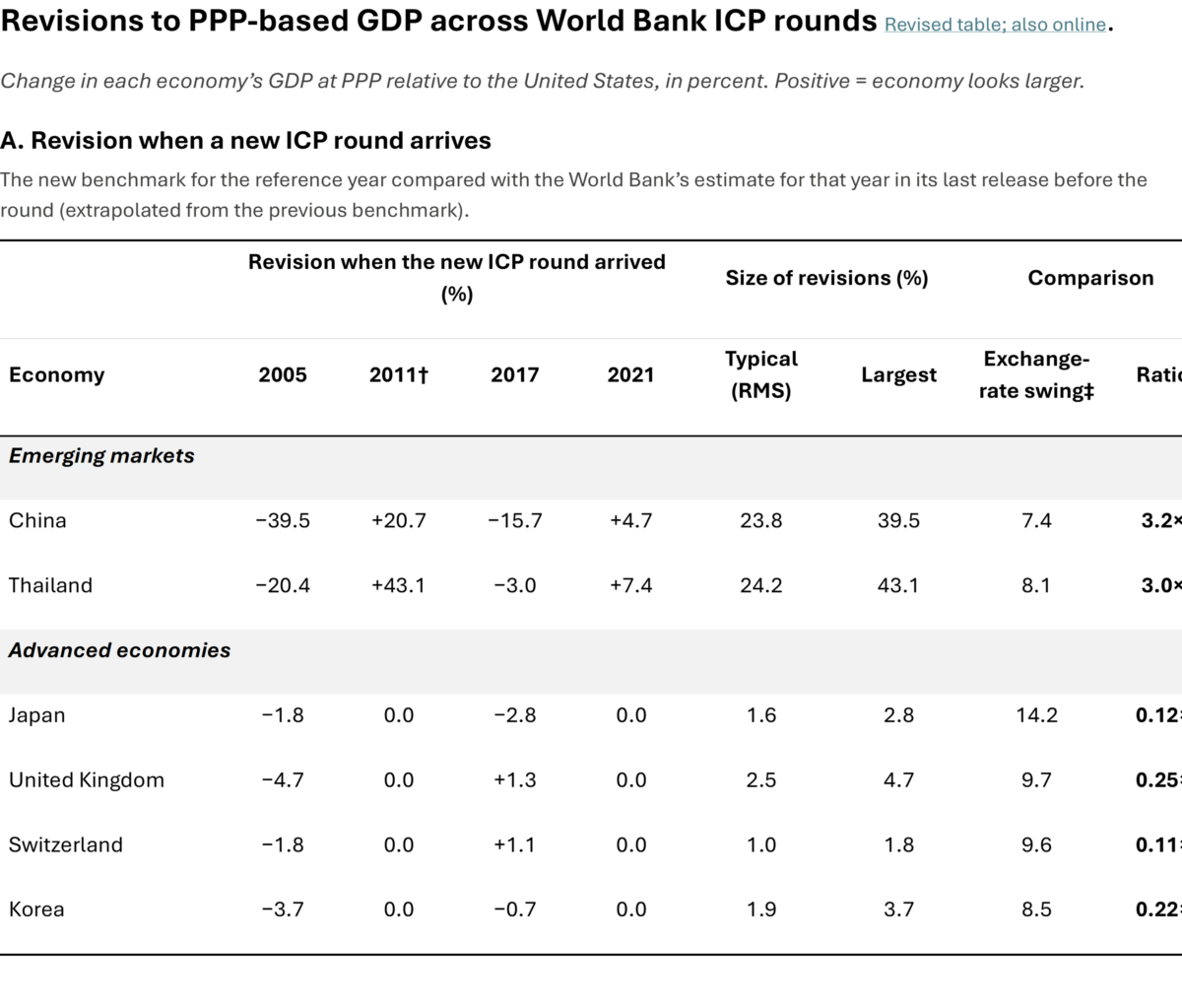
It is true that the volatility of exchange rates complicates their use in comparing GDPs. It seems wrong for country size comparisons to fluctuate year by year. But if that is the grounds for the decision, one must recognize that a parallel critique applies to the PPP-based rankings as well: The ICP comparisons often change radically when revised in light of subsequent data.
The ICP data for 2005 showed rapid growth in China, as did the official extrapolation of the initial report by means of national GDP statistics; but real GDP was revised downward by 40% in the subsequent survey, in 2011. Next, the extrapolations of the 2011-benchmarked data were revised upward by 21%, between first release and the time of the subsequent survey. Then, the 2017 data were revised downward by 16%. Finally, the 2021 data, upward by 5%. These revisions are substantially larger than the annual fluctuations in the nominal exchange rate or in the GDP comparisons that use it. If one had relied on the ICP numbers just before the 2011 data were released, one would have been jolted when the new figures came in, to find that the number needed to be revised upward by 40%. The statistics are reported in the table below (online version):
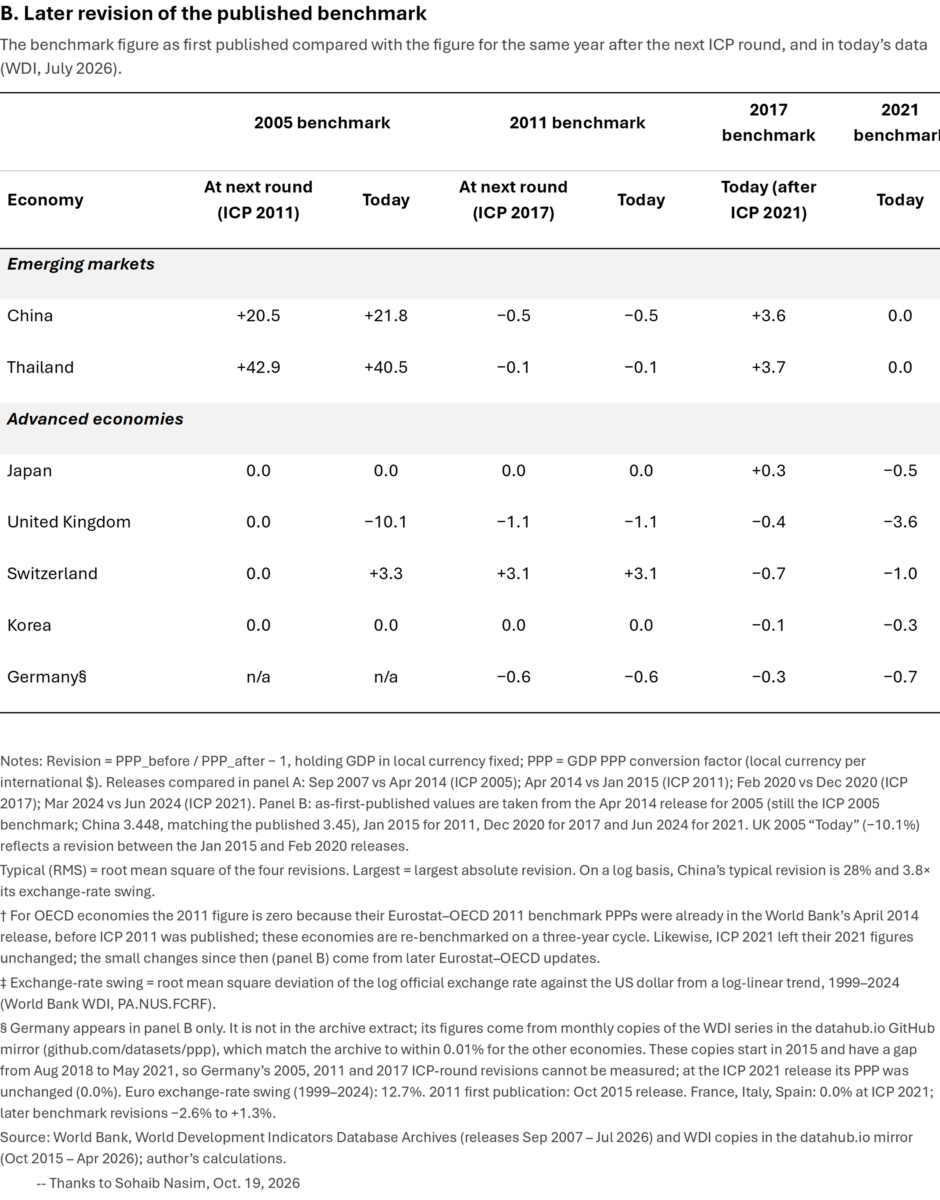
Worse, sometimes the benchmark numbers are themselves subsequently revised. China’s 2005 PPP rate was published as 3.45 yuan per dollar. When ICP 2011 came out, it was revised to 2.86, raising China’s 2005 PPP GDP by 20.5%. It stands 21.8% above the original according to today’s data). So, the 2005 figure was first cut 40% and then raised back about 20%.
Similar findings apply to other Emerging Market countries. The revisions in Thailand’s ICP GDP, for example, were down 20 % in 2005, up 43 % in 2011, down 3 % in 2017, and up 7% in 2021. Revisions to ICP estimates for advanced economies have been more reasonable. (In the case of EU members, Eurostat and the OECD now conduct new surveys every three years, so revisions are smaller.)
The bottom line is that, for comparing national GDP, one cannot use volatility to justify dispensing with exchange rate data in favor of the less obvious choice of PPP data from the ICP. Two implications apparently follow. The US economy is still considerably larger than China’s and US productivity growth is still ahead of Europe’s. Domestic political malpractice has apparently not yet been sufficient to fully overcome the natural advantages that the US has long enjoyed.
This post written by Jeffrey Frankel.
It is said that the US is just as obsessed about their GDP appearing to be the largest in the world as China is obsessed about their GDP not appearing to be larger than the US.
http://www.thedailybeast.com/nate-silver-lays-out-case-for-landslide-that-buries-trump?via=newsletter&source=DDMorning&user_emailA=5501c3c07a38261cf593e089ac6b6c31&user_emailB=766b6f0787e5dac1fd30dcd6129c21dd711338487313fd2a78eab63a1e0ff829&lctg=696297437e86e6be55113d94&utm_source=Sailthru&utm_medium=email&utm_campaign=261029-AMDIGEST&utm_term=F%20List%20Daily%20Beast%20Newsletter%20AM
Nate Silver is predicting a Dem landslide. Hope he’s right.
I think what he’s doing is raising the possibility of a landslide. He and other numbers-driven forecasters run thousands of simulations to come up with forecasts. A bunch of those simulations – too many to ignore – now show a Democratic landslide. His base case is hidden behind a paywall, but apparently still gives Democrats 52 Senate seats. That’s enough to make a Fetterman defection irrelevant, but not a landslide.
Silver and his fellow forecasters are making hay while the sun of this election still shines. Landslide stories make good copy, but I have been disappointed to often to believe them now.
That said, let’s hope. In Hungary’s recent case, an authoritarian goon who had co-oped the courts and diddled with voting rules was unable to stay in office because the vote was so strongly against him. We need that.
Nate Silver has done very similar in the past and been dead wrong 2-3 times. For a “member of the tribe” the man is pretty dumb sometimes. He’s gotten at least 2 large elections wrong, and was telling us Hillary was a slam dunk when she couldn’t even walk the sidewalk without two lugheads hauling her mid-air by the fanny. You may or may not recall, she was probably worse than trump was, about having an open question presser OR personal interview. She had Donna “I got my honorary doctorate from LSU but can’t speak proper grammar” Brazile spoon-feeding her questions before a big CNN event. But Silver thought she was on a sleigh ride to victory. Spare me any thoughts from Silver on close elections. His standard lame excuse after being wrong on national elections?? “Oh yeah, I forgot rural people exist in this country”. Talk about sh*t for brains,
Wow, the stupid, it burns. WRT to 2016: “He [Nate Silver] gave Donald Trump, the eventual winner, a 28.6% chance of victory in the 2016 presidential election, a higher estimate than other major scientific forecasts.” – Wikipedia. 71.4% is not, by any measure, a “slam dunk”. It is less than the probability of seeing one or more heads in two coin flips. If you would like to establish your “slam dunk” odds more precisely, say 95%? I would be happy to wager a lot of money with you in repeated coin flip bets, right up until you go bankrupt. FWIW, Hillary won the popular vote by a full 2.1 percentage points more than Trump, so she couldn’t have been as pathetic a candidate as you make out – unless you are willing to concede that Trump was as pathetic or more.
I could go on, but I’ve fed the troll enough for one day.
If you were in the sole business of making predictions, and gave the eventual loser a >70% chance to win, and that was your day job, you would be happy with that?? This is why Republicans create words like “libtards”. Because you actually think that is a defendable spot.
I didn’t specifically call Hillary pathetic, but if you watch a midwestern raised woman, who graduated from Yale with a law degree, fake a southern accent on state-wide TV while her husband runs for Arkansas governor, that could easily be labeled pathetic. Not to mention landing in East Europe and being greeted by a child upon landing and telling the world you were “under military fire” as you landed.
https://www.npr.org/2008/03/25/89064837/clinton-backtracks-on-bosnian-trip-danger
Right, because a sample size of one is clearly definitive of lifetime performance. Why not look at results in aggregate?
“Silver’s final 2008 presidential election forecast accurately predicted the winner of 49 of the 50 states and the District of Columbia, missing only the prediction for Indiana. As his model predicted, the races in Missouri and North Carolina were particularly close. He also correctly predicted the winners of every U.S. Senate race. ”
For 2010: ” He correctly predicted the winner in 34 of the 37 contested Senate races.”… Of the 37 gubernatorial races, FiveThirtyEight correctly predicted the winner of 36.”
2012: “On the morning of the November 6, 2012, presidential election, the final update of Silver’s model at 10:10 A.M. gave President Barack Obama a 90.9% chance of winning a majority of the 538 electoral votes. Both in summary tables and in an electoral map, Silver forecast the winner of each state. At the conclusion of that day, when Mitt Romney had conceded to Barack Obama, Silver’s model had correctly predicted the winner of every one of the 50 states and the District of Columbia.”
2016: ” Their final prediction on November 8, 2016, gave Clinton a 71% chance to win the 2016 United States presidential election,[6][88] while other major forecasters had predicted Clinton to win with at least an 85% to 99% probability.[89][90] Donald Trump won the election. FiveThirtyEight argued it projected a much higher chance (29%) of Donald Trump winning the presidency than other modelers,[89] a projection which was criticized days before the election by Ryan Grim of The Huffington Post as “unskewing” too much in favor of Trump.”
— so in 2016 he way outperformed pretty much everybody else.
2020: “In their final prediction of the 2020 United States presidential election, FiveThirtyEight predicted that Joe Biden had an 89% chance of winning the election;[92] Biden won both the Electoral College and the popular vote. FiveThirtyEight only missed Florida, North Carolina, and Maine’s 2nd congressional district in their projections.”
2024: “Silver’s final forecast for the election gave Trump and Harris almost an exactly even chance of winning the Electoral College (50.015% for Harris, 49.985% for Trump). His model also forecast that a Trump victory in all seven swing states was the single most likely outcome (at over 20% likelihood), [This is what actually happened.] Silver’s final forecast also gave the advantage (i.e. greater than 50% odds of winning) to the eventual winner in 48 out of the 50 states,”
Overall, an impressive track record, you really ought to agree.
70% is not much of a margin, if you ask me. 50% is a coin flip. you are closer to a coin flip than 100% certainty in that case. it is just not a strong case.
my kid had a 99% chance of winning his fantasy league matchup a couple weeks ago, and it came down to the rams-bills game. as time was expiring, he had multiple paths to win, no matter whether the bills or rams won that game. 99% chance as time expired. then it got extended into overtime, where he still had an opportunity to win, and he was winning with his points. but a fumble by cook subtracted his points, and he lost the game. with a greater than 99% chance of winning as regulation expired. so be careful how you act on these probabilities of winning.
case in point, if your house is at the 100 year flood plain, you have a better than coin flip odds of flooding over your lifetime ownership of that house. think about that next time you buy a house.
As a Wisconsinite – I find this interesting – personally – I have had sport bikes and always disdained HD as a throwback appeal to aging baby boomers with their heavy cruisers- over the years – I’ve watched HD try to appeal to a younger generation with Buell and LiveWire and smaller sportster bikes. But, I appreciated HD as an ionic Wisconsin manufacturer.
Now it looks like LiveWire has failed: https://www.axios.com/2026/10/29/harley-davidson-livewire-electric-motorcycles and Harley’s core motorcycle business experienced a sharp contraction in 2025. Will Trump’s tariffs/trade wars put the final nail in coffin to HD’s business?
(Also – way to go Brewers! small market baseball teams can win the World Series – thanks to Dave Crowley for getting a deal to keep Brewers in Milwaukee.)
Unrelated to HD, some, I guess, interesting research done at some university I had never heard of before?? What an obscure and remote name for a school.
https://www.kosu.org/2026-10-27/conservation-practices-cost-effective-research
Menzie, do you know who these people are?? NOTE to Menzie: No insulting remarks about goofball degerates who comment on blogs and graduated from small state college.
*degenerates even. Damn, that remedial class I took my freshman year was supposed to help with that.
Isn’t it great that all that Dodger Blue money would not buy them much in the NL championship? Here is quiz – when was the great Henry Aaron a Brewer?
Hank Aaron played the final two seasons of his Major League Baseball career with the Milwaukee Brewers from 1975 to 1976. Fun fact: Hank Aaron made his professional minor league baseball debut with the Eau Claire (WI) Bears in 1952. If you visit Eau Claire – I recommend stopping by Carson Park – where there is a statue of Hank Aaron in front of the baseball stadium.
as a pirate fan, I find your small market comments insulting!
Relative economic size matters, but there has to be more to relative power than relative size. The fact that China’s economic output is of the same order of magnitude as that if the U.S. is probably most of what we need to know about size.
After that, the dollar’s role in trade and finance relative to that of the yuan is a huge deal; China’s effort to create a non-dollar financial system hughlights a serious weakness for China. Strategic interdependence is also a huge deal. China produces a lot of critical minerals. Tiny Taiwan may be safer against Chinese bombardment and blockade because of its massive share of advanced microchip output. Little Canada could put out the lights in a number of U.S. cities.
So, yes, let’s measure output correctly for the purpose at hand. Let’s not, however, overstate the importance of rank-by-size in economic power.
Speaking of China’s GDP, the government is having another crack at getting growth to target at year end:
https://archive.is/1ammN
An extra 2.2 trillion yuan in bond sales has been announced, addded to 11.15 billion issued so far this year. Apparently, the cash raised will go to infrastructure spending.
Whether this is a good use of resources is an open question. One thing in China’s favor, though, is China’s 10-year borrowing rate is 1.63%. Yes, all of that low-cost debt will roll over some day, quite possibility at higher rates, but for now, China can spend like a nautical inebriant.
China’s borrowing does, however, add to global demand for credit, so adds to upward pressure on borrowing costs outside of China.
The first question is who cares?
So it’s about whether US can proudly declare “we have the biggest”. But the population is still forked – they don’t have stable lives with guaranteed healthcare, cheep higher education, 5-weeks annual vacation, social safety net, etc. So we have the biggest funny number of “productivity” but the smallest of anything that really matters for real people. Congratulations bubba, you won the stupid price.
The foreign policy folk really care.
Remember, the first reason for developing GDP accounting was to assess relative economic strength as source of military strength. “My industrial base is bigger than your industrial base” is why we measure GDP.
And that was certainly a valid measure and concern in the old day when warfare was maneuver warfare. Who can build the most heavy duty tanks and Howitzers with huge numbers of shells to arm them. But now it’s all about cheep drones. Sure a GDP has some kind of monetary quality, but industrial base is more of a disadvantage. You are better off building your drones in a thousand garages than in one big central site that is easy to target.
A hard-to-target bunch if drone factories is surely important in Ukraine and Iran. The U.S. still has two oceans and a huge continent as a buffer against attack. What we lack is the imagination to realize that giant aircraft carriers and pilot-in-aircraft bombers and fighters are growing obsolete. We’re too profit-driven to pay for air-gapped computer networks for every vital service. Too many entrenched interests to think clearly.
Completely agree. Our military should have seen and responded to the shift more than a decade ago.
There is no excuse for the absurdly expensive piloted aircrafts they have now, when you can take the man out and get more capable aircrafts for a fraction of the cost. The same goes for the aircraft carriers. Sure you need a defended drone carrier vessel to credibly project massive military power all over the world – but you don’t need thousands of men and a dozen support ships for such a craft to be mission capable. Make such platforms cheep enough and you can have thousands, with little worry if a few hundreds get incapacitated.
The big problem is our politics and military industrial complex has made it impossible to make changes based on rational thinking.
Ukraine has had a huge advantage of starting from very little and being pushed by existential threats. They have had no choice but to respond immediately with the most effective approaches possible. Everything has to be made decentralized. Their energy grid will be next. Gone is the big central electricity production (bombed to pieces), replaced by local production and decentralized micro-grids.
Years back I saw old apartment buildings in China where there were a lot of solar water heaters on the roof, with tubes down the buildings to individual windows. Even in apartment buildings people had set up their own solar power.
If our AI data-center boom could go bust, there would be a lot of used container sized NG power plants that could be shipped to Ukraine and do something important.
I believe China is in a depression. We see collapsing investment, residential real estate continuing to fall off a cliff, and now vehicle sales down 22% this year. They fell 40% in the US during the Great Recession.
A depression in China is what we might expect, pro forma. As I have stated, a recession is an income statement even, a recession is a balance sheet event. Repairing a balance sheet — typically resulting from falling home prices — usually takes seven years or so. The trick in China is establishing the beginning of the downturn. Call it 2021 with the Evergrande crisis. Probably another 2-3 years to bottom, given government intervention dragging the process out.