A statement by the French Business Cycle Dating Committee (CDCEF) of the French Economic Association (AFSE) on 10/29/2026 (original communique in French), by way of Laurent Ferrara (Chair), and secretariatafse@gmail.com.
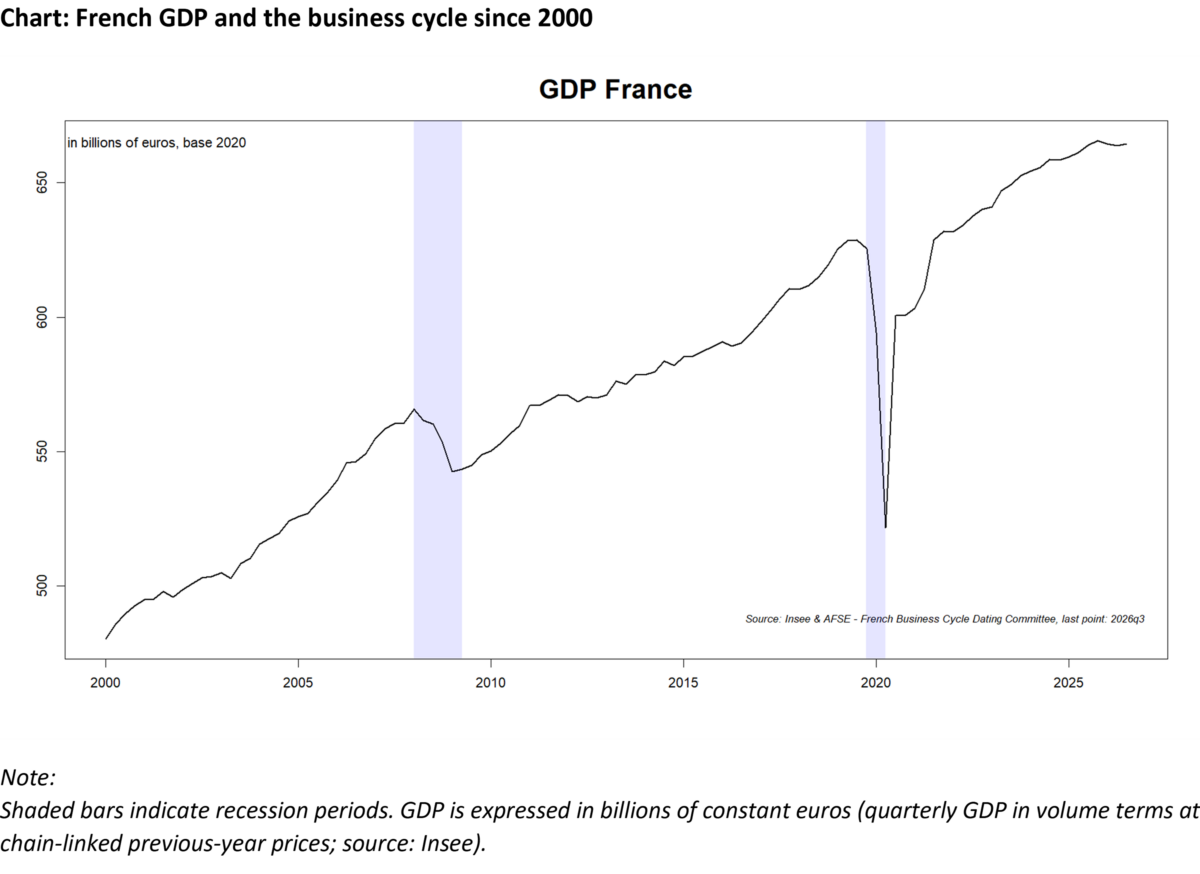
- The quarterly growth rate of French GDP just released by the National Statistical Institute (Insee) for the third quarter of 2026 stands at −0.1%. This follows a contraction of 0.2% in the first quarter of 2026 and stagnation in the second quarter. According to some economic commentators, this sequence of figures would imply a “technical recession” in the French economy over the first three quarters of 2026.
- The French Business Cycle Dating Committee (CDCEF) of the French Economic Association (AFSE) urges the utmost caution before declaring an economic recession. Based on the information currently available, the CDCEF considers that the evidence required to identify a recession in the French economy is not present at this stage.
- First, the GDP data provided by Insee are subject to revision. They could be revised substantially in the coming months, potentially turning a negative figure into a positive one, as the GDP growth figures for the first three quarters of 2026 are very close to zero. This is one reason why the CDCEF generally waits a few months before reaching a reliable assessment.
- More fundamentally, identifying a recession cannot be reduced to observing two consecutive quarters of negative GDP growth. The CDCEF bases its assessment on a joint evaluation of three dimensions: the duration, depth and diffusion of the decline in economic activity (the 3D’s rule). This approach draws on several indicators to distinguish a genuine recession from a mere economic slowdown.
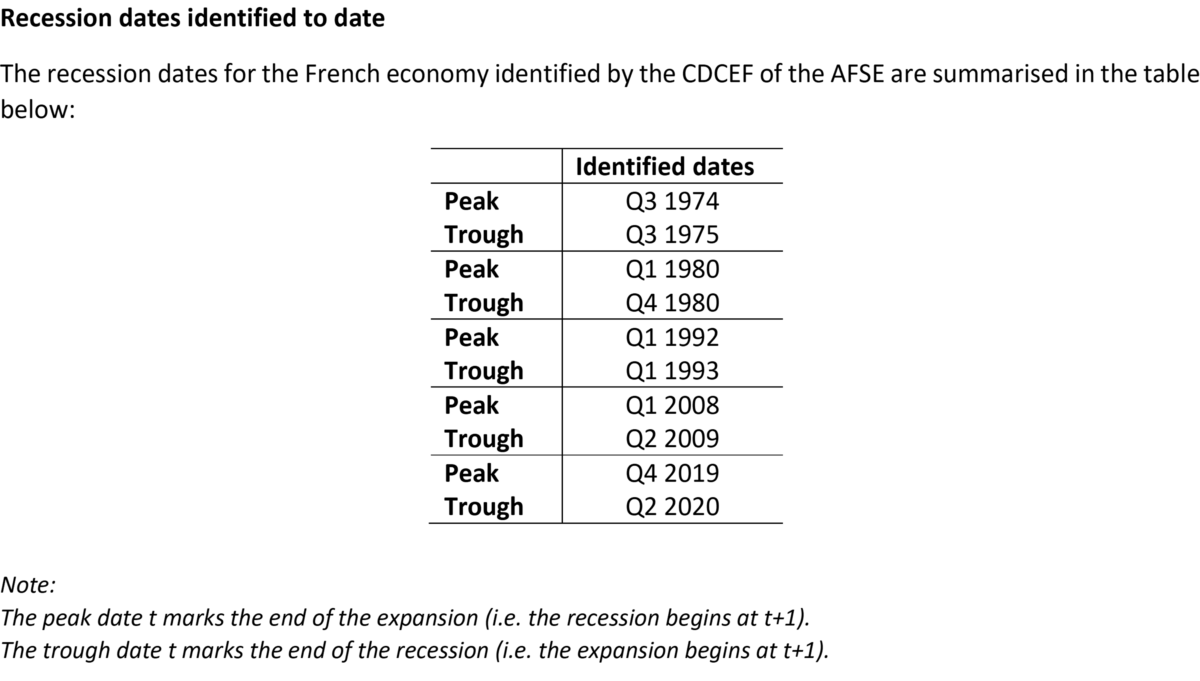
- Regarding depth, the cumulative decline in GDP since the fourth quarter of 2025 remains very limited, at around 0.3% according to the data currently available. By comparison, economic activity contracted by approximately 3% during the recession following the first oil shock of 1973 and by 4% during the 2007–2008 financial crisis. Although these differences in depth do not in themselves constitute a dating criterion, they help put the current weakness in activity into perspective. At this stage, it is more suggestive of stagnation or a prolonged slowdown than of a clear-cut recession.
- Regarding diffusion, among the variables considered by the Committee when assessing recessions, total employment is stable at a very high level (30.5 million), investment by non-financial corporations has been on a plateau since 2023q3, and the capacity utilisation rate remains stable at around 81%. Only hours worked have declined slightly, by 0.6% since their peak in 2024q3.
- The weakness of French economic activity in 2026 can be partly explained by sector-specific effects, notably a sharp decline in agricultural value added following the exceptional summer drought. Insee records agricultural output throughout the production cycle, rather than solely in the quarter in which harvesting takes place. As a result, substantial crop losses, particularly maize, led to downward revisions to the estimates of agricultural output for the first and second quarters of 2026. This sectoral shock helps explain the observed current slowdown.
- Overall, the data available to date do not support identifying a recession in the French economy over the first three quarters of 2026. They nevertheless point to particularly sluggish activity, whose evolution warrants close monitoring. The CDCEF reiterates that its mission is to identify and date business cycle turning points through a rigorous examination of the available information, rather than to forecast them. Should the decline in activity persist, deepen and spread to more sectors, the Committee would reassess the situation.
About the French Business Cycle Dating Committee (CDCEF)
Established in October 2020 under the umbrella of the French Economic Association (AFSE), the French Business Cycle Dating Committee (CDCEF) aims to establish and maintain a historical chronology of business cycle turning points for the French economy.
The Committee uses the same definition of the business cycle as the NBER for the United States and the CEPR for the euro area as a whole. The business cycle is defined as a succession of periods of declining economic activity, i.e. negative economic growth (recessions), and periods of rising activity, i.e. positive growth (expansions). These periods are bounded by peaks (the highest level of activity) and troughs (the lowest level of activity), which constitute the turning points of the cycle.
The methodology used by the CDCEF of the AFSE to establish the historical chronology of business cycle turning points is described in detail in a working paper available on the AFSE website and published in French in the journal Revue Economique. The Committee assesses the duration, depth and diffusion of each phase of the cycle (the “3D’s” rule) and relies on two pillars: a quantitative pillar based on econometric approaches and a qualitative pillar based on expert judgement.
Members of the French Business Cycle Dating Committee
Laurent Ferrara, Chair of the French Business Cycle Dating Committee, Professor at SKEMA Business School, Member of the AFSE Executive Committee
Frédérique Bec, Professor at CY Cergy Paris Université, Research Affiliate at Thema and CREST-ENSAE
Guillaume Cléaud, Deputy Director for Economic Analysis and Forecasting, French Treasury
Claude Diebolt, CNRS Research Director at BETA Research Center, Former President of the AFSE
Catherine Doz, Professor at Université Paris 1 Panthéon-Sorbonne and the Paris School of Economics
Denis Ferrand, Director General of Rexecode, Vice-President of the Société d’Economie Politique
Eric Heyer, Director of the Analysis and Forecasting Department, OFCE – French Institute of Economics
Valérie Mignon, Professor at Université Paris Nanterre, Researcher at EconomiX-CNRS, Scientific Adviser at CEPII, Former President of the AFSE
Pierre-Alain Pionnier, Economist, OECD
Off topic – Thinking about election consequences.
Odds are, Democrats will insist on funding Ukraine’s defense. In the normal budget cycle, that would mean U.S. money and arms to Ukraine a year from now. There has been lots of talk lately of movement toward peace, but no offers of concessions.
Inability to win territory has led Russia to increase attacks on civilians, while loosing over 100 troops a day. There has just been an announcement of a 15% cut to social spending, while spending increases go to the military and debt service. The war is not going Russia’s way.
Unless there is a decisive change on one side or the other, it looks like Ukraine has reason to hold on for another year. Putin has created a fiction in which failure to grab Ukrainian land amounts to betrayal of Russia, thereby boxing himself into more war.
So, another year, shot to hell. If Republicans hadn’t betrayed Ukraine, they’d have had more weapons all along. Think where we might be.
Russias casualty rate was 45,000 in October with no gain but a minimal LOSS of land. They have been struggling to recruit even 30,000 new soldiers per month. I had expected some kind of mobilization after their election 6 weeks ago, but Putin seems to have a mental block on that. It’s possible that the people around Putin know how much he hates mobilization, so they don’t dare to tell him that it is inevitable, and urgent. Ukraines success with operation Vivaldi suggests that Russia will face a new strategy that will make it even harder for them at the front line.
Ukraine has been negotiating with Turkey about getting massive numbers of generators; so they are getting ready to deal with Russias attacks on their infrastructure. We have to remember that in many poor countries in Africa there is no grid and people find ways to live without. Putin’s fantasy that he can make life so hard that Ukraine would rather surrender and submit, is remarkably out of touch – maybe before the “Rape of Bucha”, but not now.
I find it very interesting that Melania forced a short term cease fire at a local area where civilians were trapped and starving to death (as a deliberate Russian strategy). She must have some very scary (for Russia) information, to be able to dictate that way to Putin and force him to “make it happen”.
Off topic – final voter preference polls:
https://www.nytimes.com/2026/11/01/upshot/poll-times-siena-senate-midterms.html
Y’all have probably seen the NYT poll results; big shift toward Democrats. Doesn’t mean a thing after actual votes are counted…except…
Part of the “stolen election” lie is often that polls and election results don’t match up. The widespread expectation that Democrats will win big helps put a lid on that lie for low-information types.
It’s going to be interesting to see how news organizations call results based on exit polling, what with a substantial share of votes already cast. I suppose exit polling may have been underway during early voting.
With Democrats over-represented during early voting, one result might be what looks like an early lead for Democrats in competitive races, with the gap closing as election day progresses.