From the October WSJ survey:
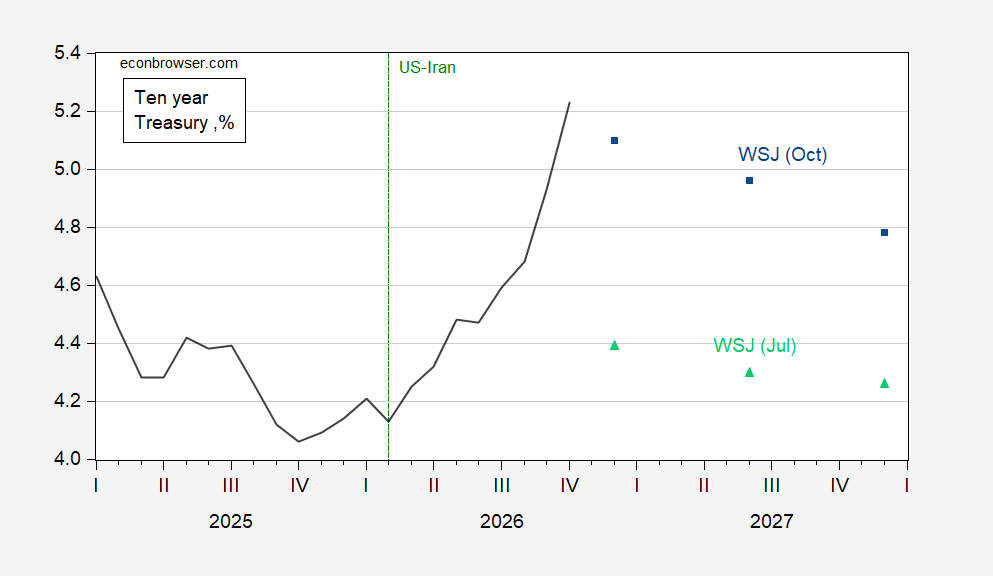
Figure 1: Ten year Treasury yields (black), October WSJ survey mean (blue square), July WSJ survey mean (light green triangles), all in %. Source: Treasury via FRED, WSJ.
A mix of improving growth, new inflationary pressures and concerns about the U.S. fiscal trajectory have pushed bond yields higher since the start of the summer. Many economists said the cocktail has forced them to re-evaluate their assumptions about investors’ demand for Treasurys, whose yields rise when their prices fall.
The low prediction for December 2027 is 3.95%, high is 5.63% (the indomitable James Smith, and Allen Sinai, respectively).
I don’t think there is any doubt that future rates will be heavily impacted by inflation, which is high and ongoing, without a coherent plan from the administration to fix the problem. that definitely pushes rates up over the next year or two. the question is what could push rates down? a recession and unemployment would be the primary driver. and right now that risk is not severe. and I see a more likely scenario of stagflation with high rates, than a recession driving rates down in the near term. and the big risk everybody talks about is AI. I do not know how to anticipate this affect. if AI causes large scale unemployment, but productivity and profits remain high, what is the net effect on interest rates? unknown to me. I am not certain AI will affect unemployment to that scale, but that is a big unknown.
The wild card is the demand for AI related bonds. I think current treasury yields is almost exclusively driven up by crowding out from the AI boom.
The felon-in-chief lover to punch down. Most of his actikns can be understood as punching down. Gonna do it some more after the election:
https://www.washingtonsun.com/economy/trump-aides-plan-penalize-defaulting-student-loan-borrowers
Biden tried to offer student loan relief. The felon and the Republicans fought doing so. Now the felon is going to sic the dogs on student loan borrowers. But not unntil there are no consquences for the felon.
Speaking of punching down, the felon-in-chief is now trying to free up seized Russian assets as a step toward a peace deal. That’s utterly stupid. You don’t deliver the bribe BEFORE you get the pay-off. Once Russia has its money, it doesn’t have to agree to peace, and certaunly not on terms favorable to Ukraine. In fact, giving Russia money bails out Russia’s flagging economy, allowing more vigorous attacks on Ukraine.
The felon is just choosing the aggressor over the victim, because that’s how he thinks.
I’m not up on the whole corporate structure of the dat-center build-out, so I don’t know how much trouble Nvidia offspring are really in. Coreweave lost over 25% of its market value last week. Coreweave execs blamed trouble at Australian Nvidea puppie Firmus for slopping onto investor perception of Coreweave. Firmus, recent beneficiary of Australia’s largest-ever IPO, had just been through a 30% slide – not supposed to happen that way. Part of the problem, though clear only part, was that there was no lock-up period for IPO shares. No wonder Coreweave is pointing fingers.
These are both firms that take financing from Nvidea and buy Nvidea chips. Circular financing of this sort is one of the issues market-watchers have been worried about. Nvidea is still outperforming the broader stock market on a year-to-date basis, but is down over 3% in the past month.
China’s Q3 GDP growth amounted to 4.5%, with exports and AI investment once again the main sources of growth. Property investment continues to slide and consumer demand remains soft. Growth in Q3 was up slightly from Q2, down slightly from Q1, and at the bottom of the government’s target range. Anything at the bottom of the target range has to be suspected of a bit of padding by government statisticians.
So no change in the big China picture. With exports headed for a new annual record, it’s reasonable to expect that the EU won’t be satisfied for long with recent trade discussions with China. The appointment of Judy Shelton as a (China) trade and currency advisor at Treasury says the U.S. may be ready for another round of trade troubles with China.