The release of Q1 GDP pushed growth to a very slight negative number (-0.1% vs Bloomberg consensus +1.5% q/q AR), after a downwardly revised Q4 print. Lots of skeptical commentary regarding an imminent recession call based on this number, from professional economists (BN Bloomberg). Here’s GDP:
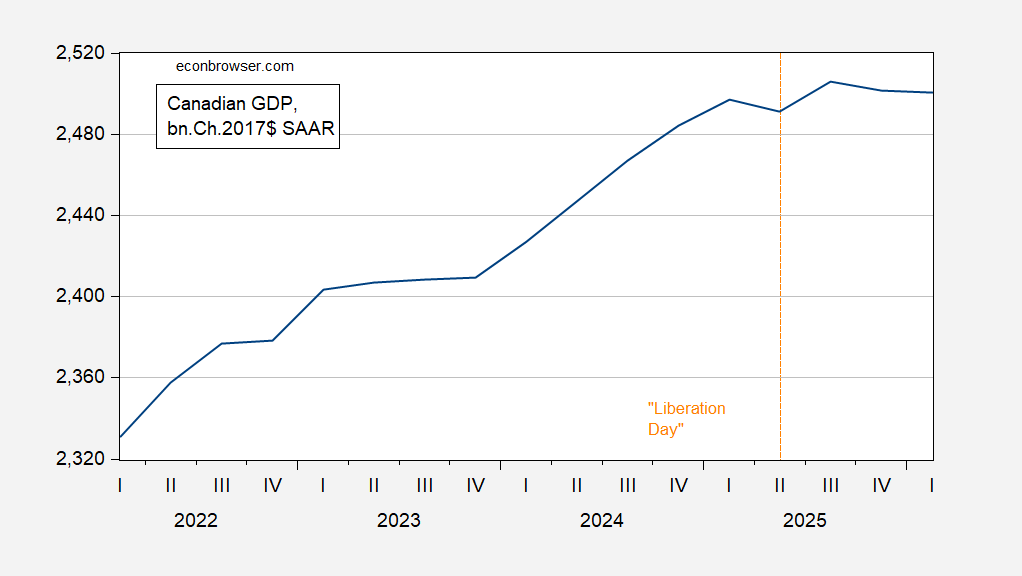
FIgure 1: Expenditure side Canadian GDP, bn.Ch.2017$ SAAR (blue, log scale). Source: StatCan.
As in the case of the NBER’s BCDC, the Business Cycle Council (BCC) at the CD Howe Institute does not rely solely on GDP, in part because it’s subject to lagging and potentially large benchmark revisions.
Employment and monthly GDP are plotted in Figure 2.
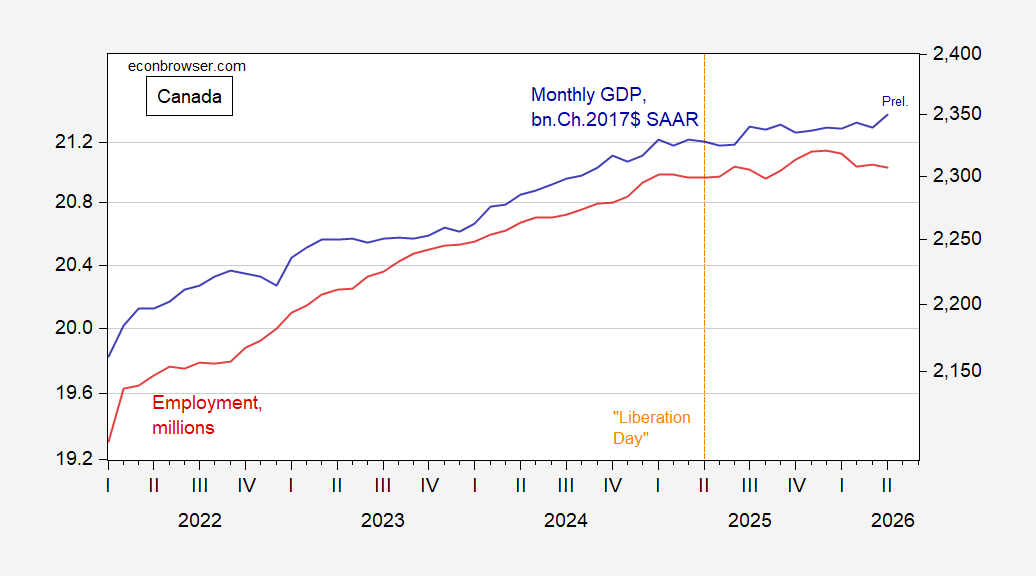
Figure 2: Employment, in millions, s.a. (red, left log scale), value added side monthly GDP, bn.Ch.2017$ SAAR (blue, left log scale). Source: StatCan.
It’s not at all clear that monthly GDP has peaked, with the preliminary April suggesting acceleration. Employment does seem to have peaked, but the Canadian population shrank slightly in 2025, so interpretation of this decline is complicated.
In assessing the US case, one would typically look to industrial production. There’s no index directly comparable to that compiled by the Fed; however, StatCan does compile value added by by sector (which sums to monthly GDP shown in Figure 2). I plot industry sector value added in Figure 3.
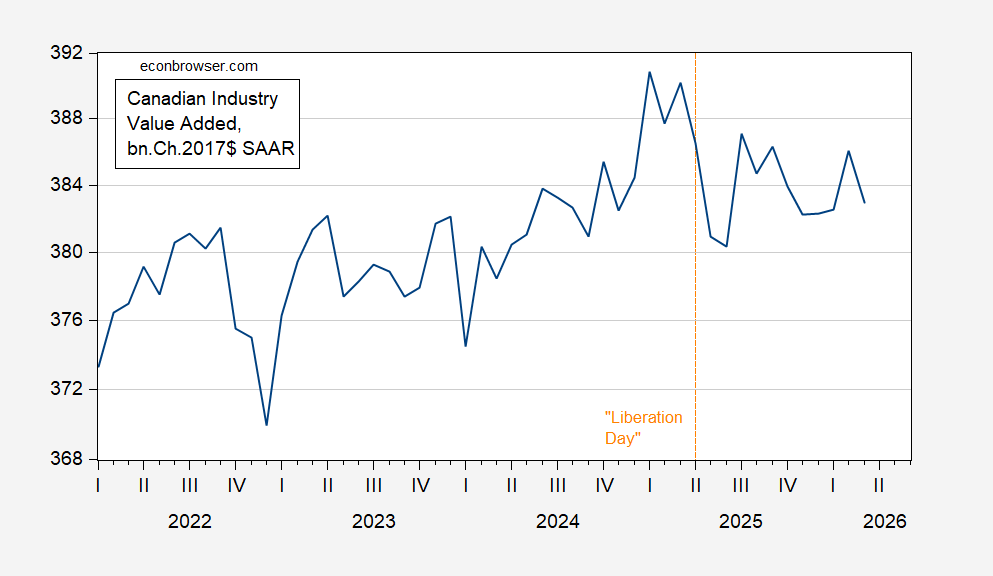
Figure 3: Value added in industry, bn.Ch.2017$ SAAR (blue, left log scale). Source: StatCan.
March industry value added is 2% below peak. Since the standard deviation of a m/m change (ex pandemic) is about 1%, this is not a terribly large decrease relative to peak.
Here’s a link to BCC’s toolkit of metrics for business cycle diagnostics. Unfortunately, they don’t publish their data on an ongoing basis. One series of particular interest would be their diffusion index (see methodology here).
Addendum:
To highlight the difference between betting and economic definitions of recession, see the Polymarket outcome for the Canada recession bet, and how the punters can be surprised:
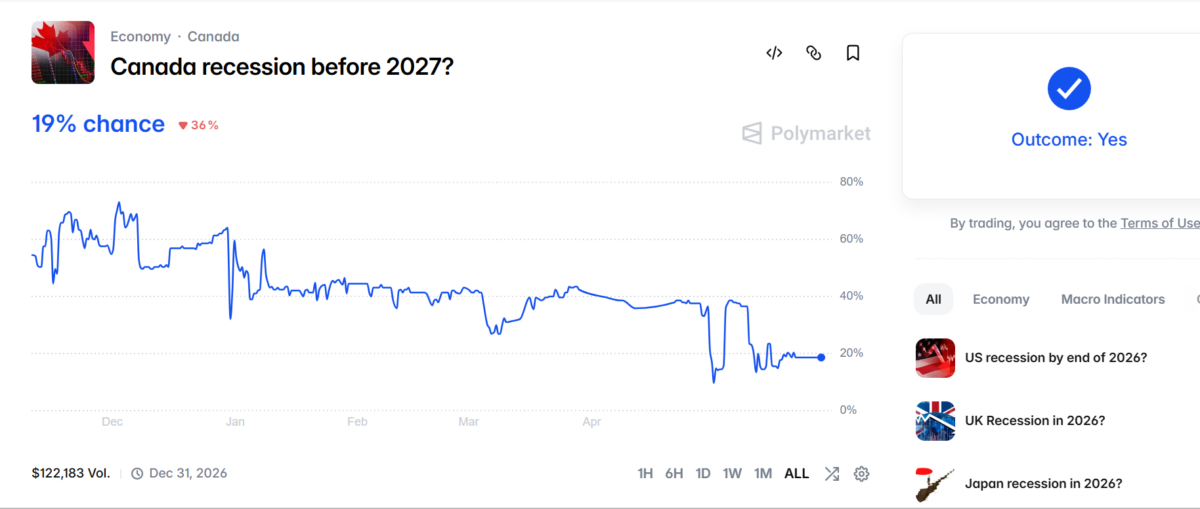
The odds for a recession call (either 2 quarters negative growth or CD Howe declaration) was only 19%. Somebody made some money.
Further demonstrating the differene between the determination using the 2 quarter rule and a judgmental decision based on various criteria, note that there were two consecutive quarters of negative GDP growth in 2015; yet CD Howe’s BCC declined to declare a recession since the contractions were concentrated in certain sectors.
Addendum 2, 6/1/2026:
To my surprise, the CD Howe Institute does post the business cycle indicators it constructs (I should have looked harder), including the diffusion index (+50 indicates more than half of the industries are growing).
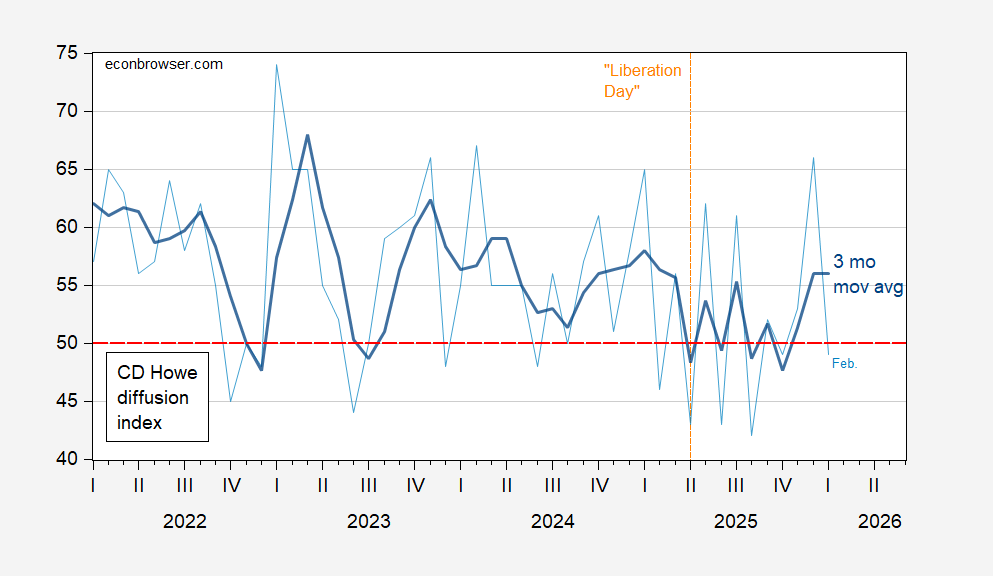
Source: CD Howe Institute, accessed 6/1/2026.
Unfortuately, the latest update is as of 4/2/2026, with the last observation at February 2026.
Nice commentary on GDP release, from ScotiaBank today.
Here are year-over-year percentsge changes for U.S. and Canadian employment:
https://youtu.be/LwRTRHm3VOI?si=BjKSa_IoFZHwkYRJ
Canada had been doing considerably better than the U.S., from mid-2023 until February of this year. Since February, the gap has narrowed, but hasn’t closed. Canada has not had a sudden change to its immigration policy to slow employment growth.
In the very short term, for which revisions are still to come, the recent acceleration in U.S. hiring has coincided with a slowdown in Canadian hiring. Like the U.S., Canada is a petroleum exporter. Other than a few tanker loads of Venezuelan sour crude to the U.S., the recent period should be good for Canada’s oil sector shouldn’t it?
Canada should get a boost from oil, potash, and metal exports in Q2. Anyone has an analysis on its impact on Canada’s GDP?
Optimistic but sceptic: Yes. “Economists pour cold water on recession talk after Canada’s economy stalls in Q1”
May 29, 202610:50 AM The Canadian Press.
“StatCan mainly blamed weakness in Canada’s resource extraction industries and in construction activity for a 0.1 per cent decline in real GDP in March.
The last two quarterly contractions are mostly due to real GDP declines in October and March. Growth was either flat or modestly positive for the four months in between.
Bradley Saunders, North America economist at Capital Economics, said in a note that the “trade-induced” technical recession was likely already over as rising oil and gas activity mean the second quarter of 2026 is tracking for a solid rebound.
…
Ercolao said that, on net, rising oil prices tied to the ongoing war in Iran generally support Canada’s economic growth and current price levels should offer a lift to GDP results in the coming months.”
Off topic – Iran is getting feisty:
https://www.aljazeera.com/news/2026/5/30/iran-reasserts-control-over-hormuz-strait-as-deal-with-us-remains-elusive
Meanwhile, the war-criminal-in-chief has made more demands of Iran, maybe in an effort to get them to accept the previous terms:
https://www.nytimes.com/2026/05/30/us/politics/trump-iran-peace-framework.html
Anyhow, it siggests that the U.S. has decided, for now, not to accept the ceasefire extension deal. Not sure that’s gonna buffalo Iran, especially if you tell ’em that’s why you’re doing it. Art of the deal.
There are no live prices right now for oil or stocks, but Kalshi says odds of Hormuz opening any time soon are falling:
https://kalshi.com/markets/kxhormuznorm/when-will-traffic-at-the-strait-of-hormuz-return-to-normal/kxhormuznorm-26mar17
Now in his latest chapter of “The Art of the Kindergarten Deal” Trump has decided “brilliantly” to make an offer that is even tougher than the one Iran previously rejected. He apparently think that if he offers something a lot worse, then Iran will come back and accept the deal they previously rejected. The Orange Clown did not know what Bibi was getting him into and he has no clue how to get out of it. The only good news is that at the cost of a mild recession the world will be sprinting out of hydrocarbon based energy and transition to green energy.
The Big Picture pointed to this graph:
https://ourworldindata.org/data-insights/global-sales-of-combustion-engine-cars-have-peaked
showing how fast the rest of the world is moving away from combustion engine cars. US will be left behind, but we are only about 15 million out of 80 million new cars sold every year. So in the big picture US is a small potatoe.