Jeffrey Frankel and Hélène Rey organized a great conference for the NBER’s International Seminar on Macroeconomics, hosted by the Sveriges Riksbank; topics covered were wide and diverse. The program is here:
Welcome address: Anna Seim, Deputy Governor, Sveriges Riksbank
Chair: Hélène Rey, London Business School and NBER
Discussants:
Michael McMahon, University of Oxford
Robert J. Richmond, New York University and NBER
Chair: Kenneth D. West, University of Wisconsin – Madison and NBER
Discussants:
Veronica De Falco, Imperial Business School
Stephen A. O’Connell, Swarthmore College
Chair: Ulf Söderström, Sveriges Riksbank
Discussants:
Kristin Forbes, Massachusetts Institute of Technology and NBER
Loriana Pelizzon, Goethe University Frankfurt
Discussants:
Ozge Akinci, Federal Reserve Bank of New York
Gianluca Benigno, University of Lausanne
Chair: Ricardo Reis, London School of Economics
Discussants:
Matthew Ferranti, Bitcoin Policy Institute
Fernando Broner, Center for Research on International Economics
Thursday, June 25
Chair: Jordi Gali, Center for Research in International Economics and NBER
Discussants:
Nuno Coimbra, Banque de France
Zhengyang Jiang, Northwestern University and NBER
10:30 am
Discussants:
Kenza Benhima, University of Lausanne
Menzie D. Chinn, University of Wisconsin – Madison and NBER
Chair: Jeffrey A. Frankel, Harvard University and NBER
Discussants:
Michael D. Bordo, Rutgers University and NBER
Catherine R. Schenk, University of Oxford
For me, this was a chance to catch up on a lot of open economy macro work that I’ve missed (focused as I have been on US macro policy debacles developments over the past year and half). I was a discussant for the UIP paper, on which I’ll do a separate post.
The hyperlinks to the papers allow you to read the abstracts for more details. I’ll just make a few remarks.
The first paper, presented by Anton Korineck, described how LLMs can condense IMF fiscal advice as represented in Article IV reports, and how the content has evolved over time. For those of us will little familiarity about how LLMs summarize text, this was extremely
informative.
The second paper, presented by Toni Iko, showed how exchange rate pass through into Nigerian CPI depended more on the parallel rate than the official. Anusha Chari discussed “Capital flows in risky times”, which demonstrates that passive fund behavior induces a feedback mechanism that amplifies exogenous shocks; at the same time, she and her coauthors develop a “risk-on/risk-off” index, which is now available on FRED. This is an impressive data compilation,using EPFR mutual fund data.
Gernot Muller’s coauthored paper (Dollar Trinity) delivers a model based on dollar dominance in safe assets, corss border asset trade, and trade invoicing, which explains the existence of a global business cycle, asset price cycle, and trade cycle. The discussion highlighted the fact that the dollar invoicing componnent was not central to the existence of the global business and asset price cycles, but did rationalize the trade cycle.
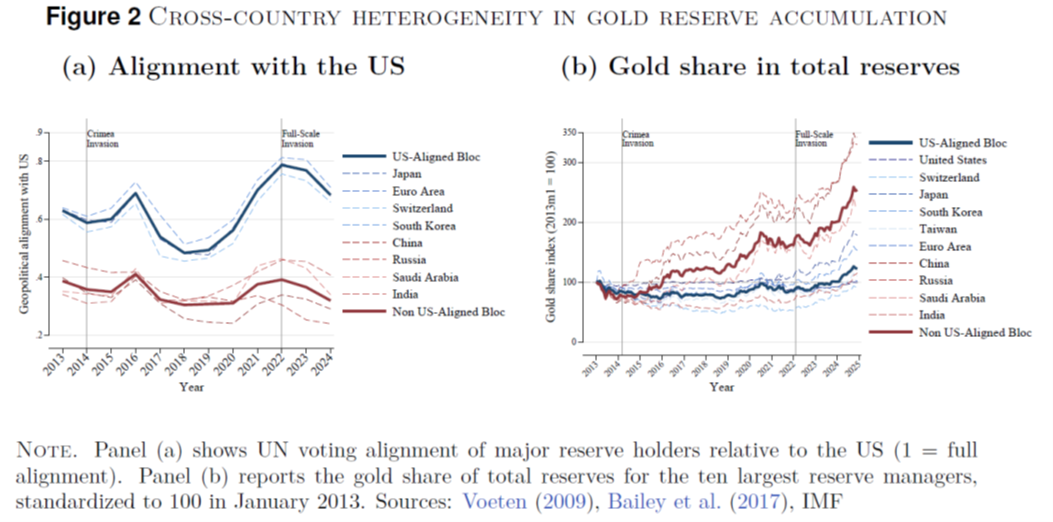
The last paper of the first day (Fool’s Gold), presented by Kai Arvai, modeled the rise of central bank gold demand as a function of greater geopolitical risk, and documented empirically the rise of such holdings. (For a slightly different perspective, see Chinn, Frankel and ito (2026), or this post).
The second day’s starting paper, “Loanly governments” documented a little known (to me!) fact that loans constitute a noticeable and persistent share of total borrowing by OECD governments. Using credit rating changes as shocks, Lucas Hack showed that loans increased as a share of total borrowing in the wake of such shocks.
Eric Monnet’s paper documented the creation of a new (Fed discount rate) measure over the period in which the (offshore) eurodollar market grew (before the breakdown of the Bretton Woods regime). Using this new measure, he and his coauthors showed that such shocks induced changes in foreign policy rates in the wake of convertability, but had on measurable impact on foreign output and prices. The discussant, Michael Bordo, commented on the fact that the discount rate is an insufficient measure of Fed policy during this period, while Catherine Schenk observed that in reality, what we typically refer to the Bretton Woods era, in some senses ended much earlier (1947, if not earlier).
All the papers were really illuminating, in terms of empirical findings, or even in describing phenomena that were not well-known. Since all papers are linked (unfortunately not the discussion slides), there’s no excuse to skip any of them. More on Sebnem Kalemli-Ozcan’s paper and my discussio next post.