Approximately, as we don’t have direct observations on items solely related to AI.
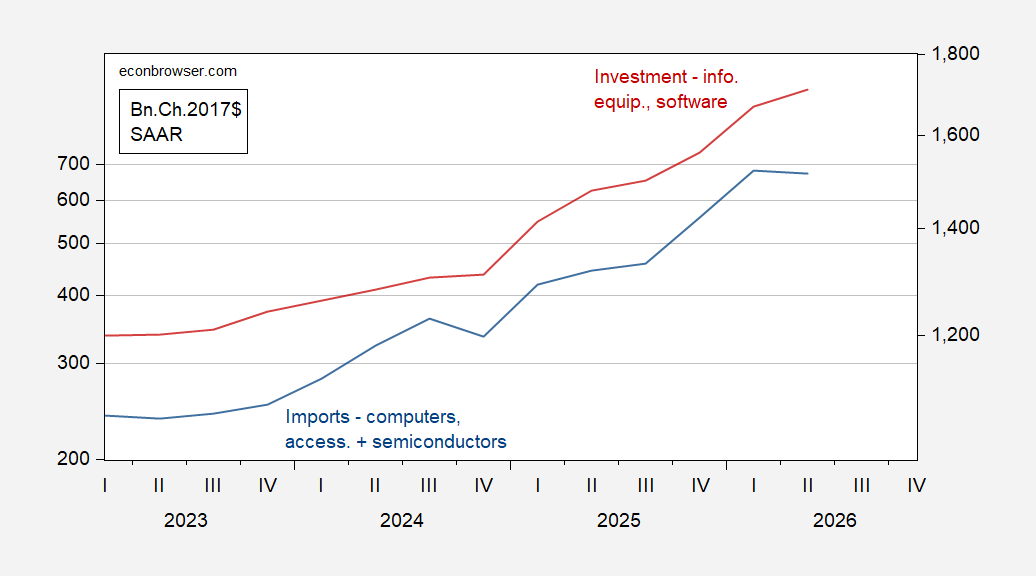
Figure 1: Imports of computers, computer peripherals, plus semiconductors (blue, left log scale), investment in information equipment, and software (red, right log scale), both in billions Ch.2017$ SAAR. Source: BEA 2026Q2 advance release.
The sums of components are simple arithmetic; this is not appropriate if the relative price of the series have channged. To be more accurate, one should use a Tvornquist approximation. In the last year, computer and peripherals import prices have risen about 15% faster than software, while information equipment prices have risen about 8% faster than software. Over a longer span, simple addition would distort the picture somewhat, maybe less in the short term. There is an additional question about the accuracy of the deflators.
Further note the increase in summed imports masks a sharp divergence between equipment and semiconductors; the latter jumped enormously, while equipment dropped slightly.
My estimate of nominal imports was about$700 billion (SAAR) for Q2, based on April and May imports. The advance estimates is $730 billion, suggesting the BEA’s internal estimate for June was slightly higher than the preliminary May figure. June figures out August 4.
Off topic – yen intervention:
https://asia.nikkei.com/business/markets/currencies/japan-carries-out-yen-buying-intervention-as-us-executes-rate-check
South Korea joined in, with suspicion running high that the Fed would join. So far, there’s no evidence of intervention during U.S. hours. There was also suspicion of intervention the day before, with no confirmation. Looks like the BoJ may have been waiting for yen short covering and then piled on. South Korea’s incentive to join in may have been the rout in shares; the Kospi closed 10% higher on the day.
Not to be a doomster, but Japan has apparently suffered a fiscal regime change. The new government has backed away from its fiscal policy plans in response to rising rates and a weakening yen. That hasn’t happened in decades. Again, oil is part of the problem, so thanks, Bibi, Vlad and Donny.
Low Japanese rates are a very large part of the financial world we live in. Low OECD rates, though not as low as Japan’s, have also been the norm. A hedge fund failing, Japan intervening, could be mere ripples. Could be the first round of greater trouble.