Nominal consumption beats expectations ( +0.2% m/m vs +0.1% Bbg consensus), but real personal income ex-transfers remains below recent peak.
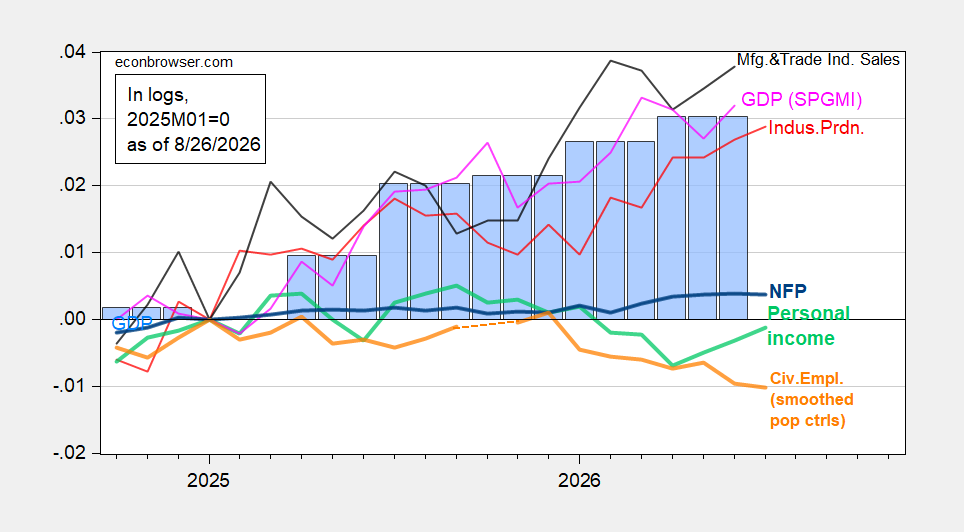
Figure 1: NFP employment (bold blue), civilian employment with smoothed population controls (bold orange), industrial production (red), personal income excluding current transfers in Ch.2017$ (bold light green), manufacturing and trade sales in Ch.2017$ (black), and monthly GDP in Ch.2017$ (pink), GDP (blue bars), GDPNow nowcast of 7/10 (light blue box), all log normalized to 2025M01=0. Source: BLS via FRED, BLS, Federal Reserve, BEA 2026Q2 2nd release, S&P Global Market Insights (nee Macroeconomic Advisers, IHS Markit) (8/3/2026 release), and author’s calculations.
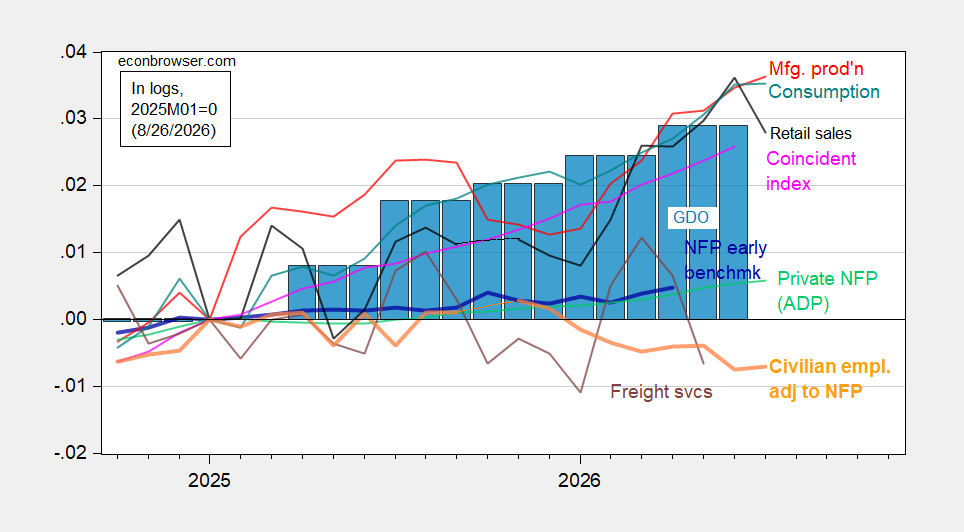
Figure 2: Civilian employment adjusted to NFP concept smoothed population controls, using experimental controls for 2025 (bold orange), manufacturing production (red), ADP private nonfarm payroll employment (light green), real retail sales, CPI deflated (black), freight services indexes (brown), and coincident index in Ch.2017$ (pink), GDO (blue bars), all log normalized to 2025M01=0. Source: BLS, ADP via FRED, Philadelphia Fed, Bureau of Transportation Statistics, Federal Reserve via FRED, BEA 2026Q2 2nd release, and author’s calculations.
The fact that consumption is flat in July is notable given rising personal income ex transfers. The SP500 was also (perhaps not coincidentally) flat as well. Here’s a detailed comparison of consumption, consumption durable expenditures, and real retail sales ex-gasoline stations.
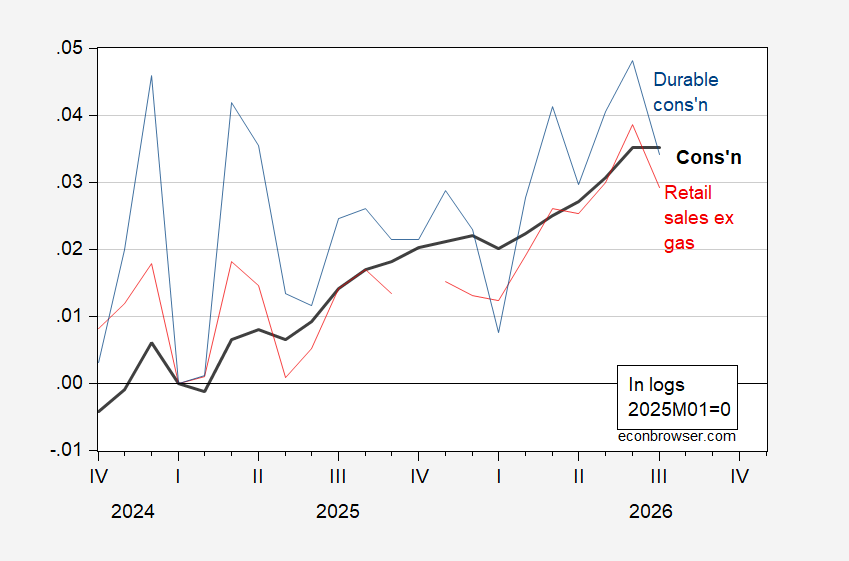
Figure 3: Consumption (bold black), durable consumption (blue), retail sales ex gasoline stations deflated using core CPI (red), all in real terms, in logs 2025M01=0. Source: BEA, Census, BLS and author’s calculations.
The fact that durables consumption has dropped might reflect forward looking behavior in terms of household wealth, rather than any specific tariff related issues … but who knows.
To my mind, the most interesting aspect of the graphs is the continued downward trend in household measures of employment, over a time when the population controls are unchanged.