Today we present a guest post written by Matías Scaglione and Romina Soria of Motio Research, an independent research firm focused on measuring and analyzing U.S. household income.
Household income is central to economic well-being, but it is largely absent from the set of indicators used to monitor the U.S. economy at monthly frequency. Official household-income estimates are annual and published with a substantial lag. At Motio Research, we have been publishing monthly estimates of U.S. household income since December 2023, using Current Population Survey (CPS) microdata and covering the period since March 2010.
On August 11, we announced a new household-income series that follows the same methodology as our public series but uses reported-only income data throughout, excluding Census-imputed income values. This allows the series to extend back to January 1994, providing a long historical record for evaluating household-income behavior across multiple business-cycle episodes.
The historical series reveals a pattern that motivated what we call the Motio Rule, a U.S. recession warning indicator based on deterioration in household-income momentum following a mature expansion.
Household-income momentum
The new series measures the year-over-year percentage change in the three-month moving average of real median household income. The underlying household-income estimates are not seasonally adjusted and are converted to real values using the not seasonally adjusted CPI-U. The CPS and CPI inputs are not subject to routine historical revision. We call this measure household-income momentum.
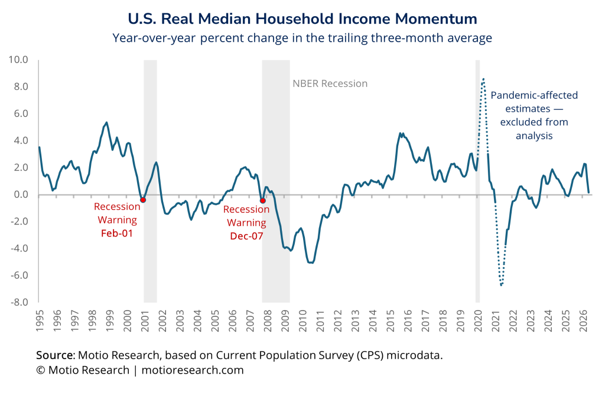
Across the longer historical record, the series shows a clear pattern: sustained positive momentum characterizes household-income expansions, while deterioration in momentum during and following mature expansions preceded the 2001 and 2007–09 U.S. recessions.
The pandemic recession did not follow a conventional business-cycle pattern. In addition, pandemic-related nonresponse bias affected CPS household-income estimates. The affected observations are shown for continuity but excluded from the analytical warning record.
An interactive version of the momentum chart is available here.
The household-income cycle
We distinguish between two confirmed phases—expansion and contraction—and two transitional phases—candidate expansion and candidate contraction.
Following a confirmed contraction, a candidate expansion begins with the first nonnegative momentum reading. It becomes a confirmed expansion when consecutive nonnegative readings sum to at least +2.5 percentage points. Following a confirmed expansion, a candidate contraction begins with the first negative reading. It becomes a confirmed contraction when consecutive negative readings reach a combined depth of at least 2.5 percentage points.
Candidate phases are provisional. If a candidate reaches its threshold, the confirmed phase is dated from the first month of the candidate phase. If momentum reverses sign before the threshold is reached, the candidate fails and the cycle returns to the preceding confirmed phase.
Beginning in its 24th month, a confirmed expansion becomes mature once at least 21 of the latest 24 readings are nonnegative.
The Motio Rule
Following a mature household-income expansion, a U.S. recession warning is triggered the first time household-income momentum is negative for at least two consecutive months and the negative readings have a combined depth of at least 0.5 percentage point.
A Motio Rule warning is a dated event, not an ongoing state. Only one warning may be issued following a given mature expansion.
If the warning conditions are met after the NBER has already declared a recession, the deterioration remains part of the household-income cycle, but no Motio Rule warning is issued.
2001
The first observable expansion began and was confirmed in March 1995 and became mature in February 1997. A candidate contraction began in January 2001. A second negative reading in February brought cumulative deterioration to 0.69 percentage point, triggering a recession warning.
The February 2001 warning occurred one month before the March business-cycle peak subsequently determined by the NBER. The NBER did not announce that peak until November 26, 2001.
The candidate contraction failed when momentum turned positive in April, and the cycle returned to the mature expansion. A new candidate contraction began in March 2002 and became a confirmed contraction in May, after a cumulative deterioration of 2.8 percentage points. Negative momentum ultimately persisted for 43 consecutive months.
2007
The next expansion began in October 2005, was confirmed in May 2006, and became mature in September 2007. A candidate contraction began in November. A second negative reading in December brought cumulative deterioration to 0.82 percentage point, triggering a recession warning.
The December 2007 warning coincided with the business-cycle peak subsequently determined by the NBER. The NBER did not announce that peak until December 1, 2008.
The candidate contraction failed when momentum turned positive in January 2008, and the cycle returned to the mature expansion. A new candidate contraction began in August 2008 and was confirmed in October, when cumulative deterioration reached 2.8 percentage points. Negative momentum ultimately persisted for 47 consecutive months.
The post-pandemic period
A candidate expansion began in July 2022 and became a confirmed expansion in December, when cumulative positive momentum reached 2.8 percentage points. A candidate contraction began in January 2023 and became a confirmed contraction in July, before the expansion had become mature. The episode therefore could not generate a Motio Rule warning.
A new candidate expansion began in October 2023 and became a confirmed expansion in December. A mild candidate contraction began in April 2025 but failed when momentum turned positive in June, after cumulative deterioration of only 0.14 percentage point. The cycle returned to the confirmed expansion, which became mature in September.
As of July 2026, household-income momentum stood at +0.17 percent, down from +1.1 percent in June and +2.3 percent in May. The May-to-July slowdown was unusually abrupt. After excluding pandemic-affected observations, June and July recorded the two largest one-month declines in the household-income momentum series. The deterioration was faster than immediately before either the 2001 or 2007 warning. Unlike in those episodes, however, momentum remained positive through July. The cycle therefore remained in a mature expansion: no candidate contraction began, and no Motio Rule warning was issued.
The evidence is limited. The series includes only two conventional recessions, and we used both to develop the Motio Rule. Still, both recessions were preceded by the same striking pattern: household-income momentum weakened steadily in a mature expansion and then turned negative near a business-cycle peak.
Household income is clearly central to economic well-being. The evidence presented here suggests that it should also occupy a central place in the assessment of the U.S. business cycle.
This post written by Matías Scaglione and Romina Soria.
Very useful. Along similar lines, New Deal democrat has pointed out the predictive power of a monthly BLS series – maybe the aggregate weekly payrolls index? Seems like that one is too short to be useful. Maybe he’ll stop by and comment.
My pleasure.
I put a lot of stock in real aggregate nonsupervisory payrolls. Here they are YoY:
https://fred.stlouisfed.org/graph/?g=1XVVX
This series has a much longer history, and the only arguable false negative or false positive is in 2002. And it appears to be much less volatile.
While I appreciate the work by Motio Research, I have a few quibbles. The requirement that an expansion be “mature,” the -0.5% threshold, and the administrative dismissal of 2021-22 strike me a “just-so” chart fitting. For example, why *shouldn’t* the year after a stimulus disappears give rise to a recession? How would this series handle 1966-67 with its “guns & butter” stimulus? And would it count the 1980 economy as “mature” going into 1981? (I know it can’t be tested because the history doesn’t go back that far.
Also, how would this series stack up against various YoY real income measures (e.g., per capita, disposable, or excluding government transfers)?
But I do praise Motio for their work. If there were one official measure the reporting of which I could change, it would be that real household income re reported quarterly, and with less of a lag.
Ģracias!
Thanks for the thoughtful comment.
We looked more closely at the payroll measure using the numbers available at the time, rather than the revised history shown today. That distinction matters because Motio’s published observations are *not subject to routine revisions*. The appropriate comparison is therefore what the payroll measure showed in real time.
Before the 2001 recession, the payroll measure slowed but did not turn negative. It fell from about +2.0 percent in September 2000 to +0.9 percent in February 2001, when the Motio Rule issued its warning, and remained positive through September. Its first negative point estimate came in October, at just −0.1 percent, and became available only ten days before the NBER formally declared the recession. November was also marginally negative, but the measure returned to positive growth in December.
The contraction beginning in April 2001 that appears in today’s chart was not visible at the time. Using the data available when the April observation was first released, our reconstructed estimate was +0.63 percent. It was still +0.34 percent immediately before a major historical revision in June 2003. The revised source data lowered the reconstructed estimate to −0.31 percent, more than two years after the fact.
Before the 2007–09 recession, the Motio Rule issued its warning in December 2007. The payroll measure turned slightly negative four months later, became clearly negative in May, and remained negative through early 2009.
The measures also cover different ground. The payroll measure captures the earnings of production and nonsupervisory employees. Motio measures household income more broadly, including earnings from self-employment and contract work, as well as pensions, investment income, and government transfers.
We agree that the Motio Rule rests on limited evidence: our series contains only two conventional recessions, and we used both to develop it. That is why the specification is now fixed and will be evaluated prospectively.
We treat 2020–22 separately because the recession arose from an extraordinary external public-health shock and was accompanied by exceptional fiscal transfers and disruptions to survey response and income measurement.
We are already working on a real-time comparison with other business-cycle measures. As the payroll example shows, the important comparison is what each measure showed at the time, not only what its revised history shows today.
Off topic – The Hill reports on debt-ceiling discussions between the White House and Congressional Republicans:
https://thehill.com/homenews/senate/6050623-trump-debt-limit-bond-market-republicans/
The felon-in-chief wants to use a budget reconciliation bill this year to raise the debt ceiling by $5 trillion while Republicans still have control of Congress, but given thin Republican majorities in both chambers, that may not be possible.
The article mentions in passing an end-of-year confrontation, suggesting the push for a debt-ceiling increase will happen during a lame duck session. I guess nobody wants to vote for a $5 trillion debt-limit increase ahead of an election.
The article also quotes a handful of Republican Senators moaning about spending, without one mention of tax increases. Here’s Krugman, pointing out that Bush and felon-in-chief tax cuts account for a very large part of the increase in federal debt:
https://paulkrugman.substack.com/p/debt-and-tax-cuts
Without those tax cuts, debt held by the public would now be around 60% of GDP, headed toward 48%, instead of 99% of GDP, headed for 188%.
Spend and spend and borrow and borrow!