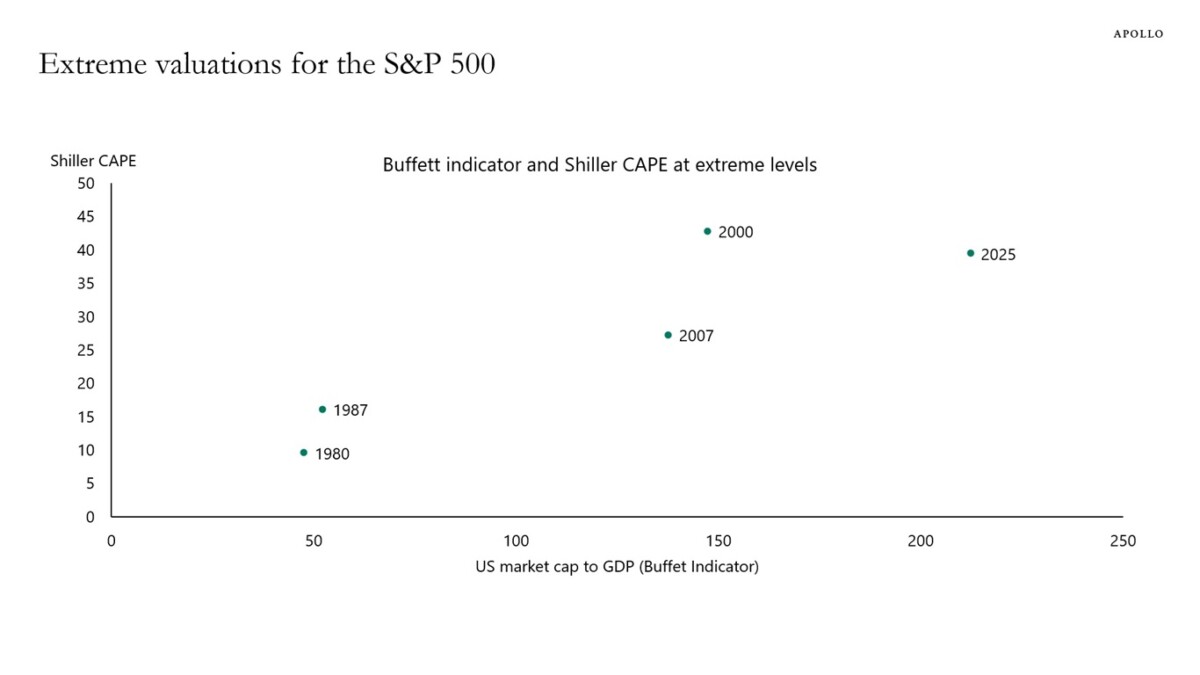
Source: Torsten Slok/Apollo.
Combine with Yardeni’s picture of Mag-7 forward PE ratios:
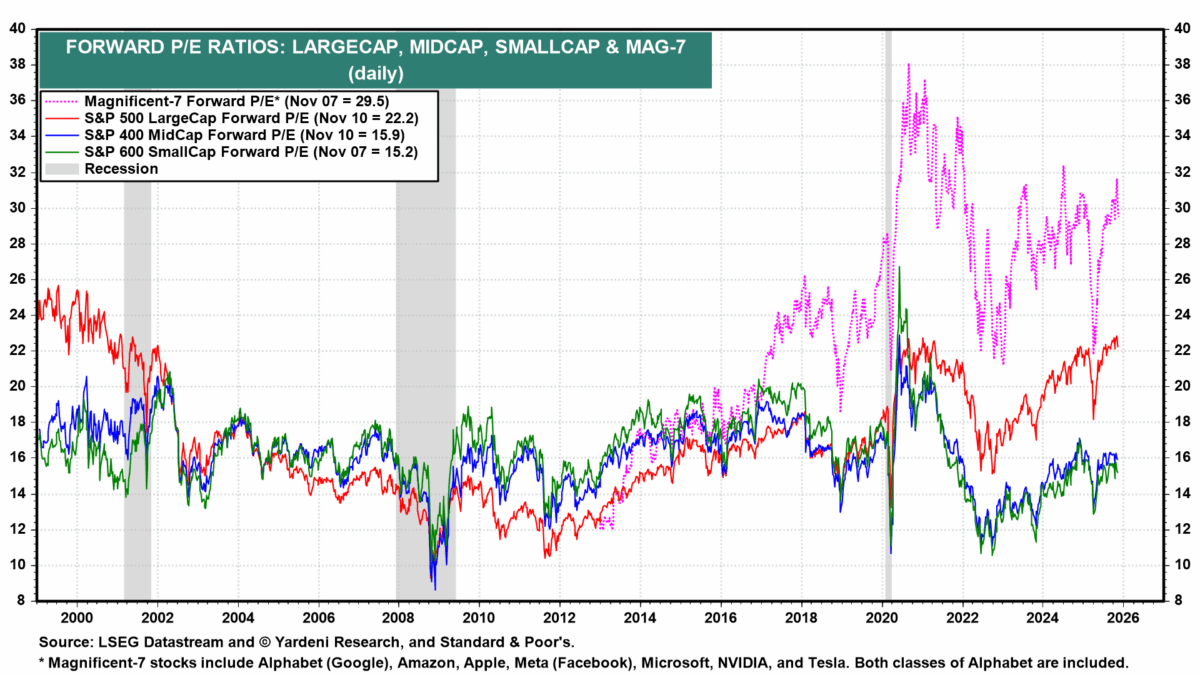
Source: Yardeni, accessed 11/11/2025.
We’d best hope for some tremendous upside earnings surprises going forward. More unsettling graphics and information at the Economist.
Off topic – still harping on Senate Democrats’ Obamacare betrayal:
The CBO has sliced up various outcomes of the health insurance subsidy battle:
https://www.cbo.gov/publication/61734
Using CBO’s analysis, I get something like a $30 billion subtraction from transfers to households in 2026. That’s about 0.1% of GDP, so not enough to induce recession all by itself. The harm falls mostly on the disadvantaged – what else is new? – but is likely to have the secondary effect of driving down health insurance participation and skewing insurance pools toward sicker participants. I can’t imagine that having a positive impact on the economy, but don’t have any good way of guessing how large the damage will be. That drag persists until new legislation changes it, so maybe for all time.
Senate Democrats caving on Obamacare subsidies isn’t in the same macroeconomic league as tariffs or letting Social Security turn PAYGO. But tariffs are also more harmful to poor households that to the rest. So harms from Republican policies are piling upon poorer households. After the mid-term elections, you can add cuts to Medicaid and Medicare. Medicare cuts, in particular, will hurt the rural poor by inducing the closure of non-urban hospitals and clinics. Then, in about 8 or 9 years’ time, cuts to Social Security benefits will hurt the elderly poor most.
The macroeconomic effect of ACA subsidy cuts pales next to some of these other policies. That’s probably not true for harm to individuals. For many, cutting ACA subsidies means the difference between having health insurance and not, between having medical care and not. And that’s on top of all the other harms being done to them by the policies of Republicans, and of a few Democrats.
Chuck Shumer: it’s a name…and a rallying cry.
There are some good takes on the cave-in, by bloggers I respect, that see the Senate deal as a product of reality and not just caving in. But the take that resonates most with me is one that Digby alerted her readers to in a post titled How to Lose Well.
https://digbysblog.net/2025/11/11/how-to-lose-well/
She directs readers to an episode of The Daily Blast podcast and quotes Brian Beutler from the transcript.
https://newrepublic.com/article/202994/trump-rage-shutdown-boils-rant-wake-dems
https://newrepublic.com/article/202998/transcript-trump-angry-new-tirade-shutdown-wake-dems
Beutler: It sounds a little bit contradictory, but there’s strong ways to cave and then there’s weak ways to cave. And what we’ve seen is Democrats say, essentially, we tried to fight Donald Trump and it didn’t work, so we give up. That was Angus King’s line, essentially.
But if they had reached the same decision but from a different posture, it might not have appeared to everyone like surrender, right? If Jeanne Shaheen or Angus King, or ideally just Chuck Schumer, went to the mics and said: We have tried everything we can to make Republicans give you back your health care. They refuse to do so. The only way you’re going to get your health care back is to elect Democrats.
In the meantime, Americans need their government to be working for them. The problem with that is that Donald Trump can’t be trusted with a full-year budget. So what we’re going to do is we’re going to give him one month of budget authority. And if he doesn’t break the law, we’ll give him another month. And we’re going to keep him on a very short leash to keep him in line with the law. And if he and Russell Vought break the budget law even one more time, there will be no more Democratic votes for even a month of budget, of budget runway.
Then at least you’re setting the terms—you’re saying, Look, like they are completely irrational about health care and you’re going to pay for it and we’re sorry about that, vote for us next time.
In the meantime, we have to do something about the lawlessness and this is the only way we can do it.
Yep.
The impression that Democratic leaders cannot think beyond the Beltway, that everything is about scoring points, has become pervasive. The idea that Democratic politicians are all in the pocket of big business is pervasive.
A month-to-month budget would keep uncertainty elevated, but predicating month-to-month budgets on compliance with the eule of law would reduce uncertainty. Fair enough.
My partner sent a message to our U.S. democratic senator who folded, calling her a “terrorist”. I was shocked.