From Atlanta Fed and Goldman Sachs, numbers that perhaps better represent the trajectory of aggregate demand.
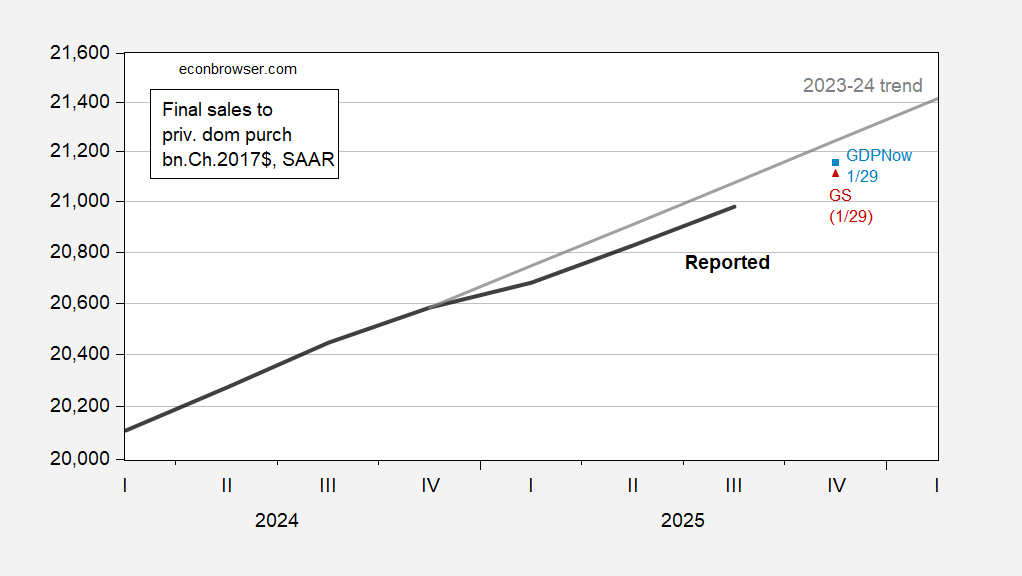
Figure 1: Final sales to private domestic purchasers (bold black), 2023-24 stochastic trend (gray), GDPNow of 1/29 (light blue square), Goldman Sachs of 1/29 (red triangle), all in bn.Ch.2017$ SAAR. Source: BEA 2025Q3 updated release, Atlanta Fed, Goldman Sachs, and author’s calculations.
Core GDP is tracked by Goldman Sachs as decelerating from 3.0% q/q AR to 2.5%, and accelerating to 3.4% by the Atlanta Fed. Either one is a respectable number, but neither gets “Core GDP” back to the 2023-24 trend.
I know I’m supposed to be dazzled by the productivity miracle of AI and highly dubious of potential GDP estimates, but this still gives me the willies:
https://fred.stlouisfed.org/graph/?g=1R8Uc
Where are the inputs to growth going to come from?
Yes, growth in Q4 (shutdown still seems a problem) and Q1 can come in above trend, but keeping growth going seems a tough proposition, what with all the stresses on the real economy and on finance and on confidence. It’s a miracle we’ve done as well as we have.
And we hear from Kevin DOW 36000 and his minions that Q4 growth is over 5%!
Off topic – Noah Smith is out with a piece on the possibility of “financial anarchy”. It’s educational:
https://asiatimes.com/2026/02/goodbye-dollar-dominance-hello-global-financial-anarchy/
Worth pointing out, I think, is that financial anarchy would be a reflection of breakdown in other areas – trade, security policy, respect for institutions and norms, the rule of law and, to a limited extent, democracy. When adherence to the rules breaks down in any of these areas, financial arrangements have to be reconsidered.
Under the Pax Romana, the Pax Mongolica, the Pax Britania and the Pax Americana, material welfare improved and war became less frequent. Yes, all dominant powers are big bullies, but Monty Python’s Palestinians were pretty clear-eyed about the benefits – roads, schools, peace. When a Pax breaks down, the transition is reliably a reduction in material welfare and a rise in violence. Alongside that emmiserating decline comes financial fragmentstion.