The Bureau of Economic Analysis announced today that seasonally adjusted U.S. real GDP grew at a 2% annual rate in the first quarter. That is below the historical average growth of 3.1% and also below some analysts’ expectations for the Q1 numbers. The new BEA report also revised down the estimate of the Q4 annual growth rate. The latter was originally reported to have been 1.4% but is now estimated to have only been 0.5%.
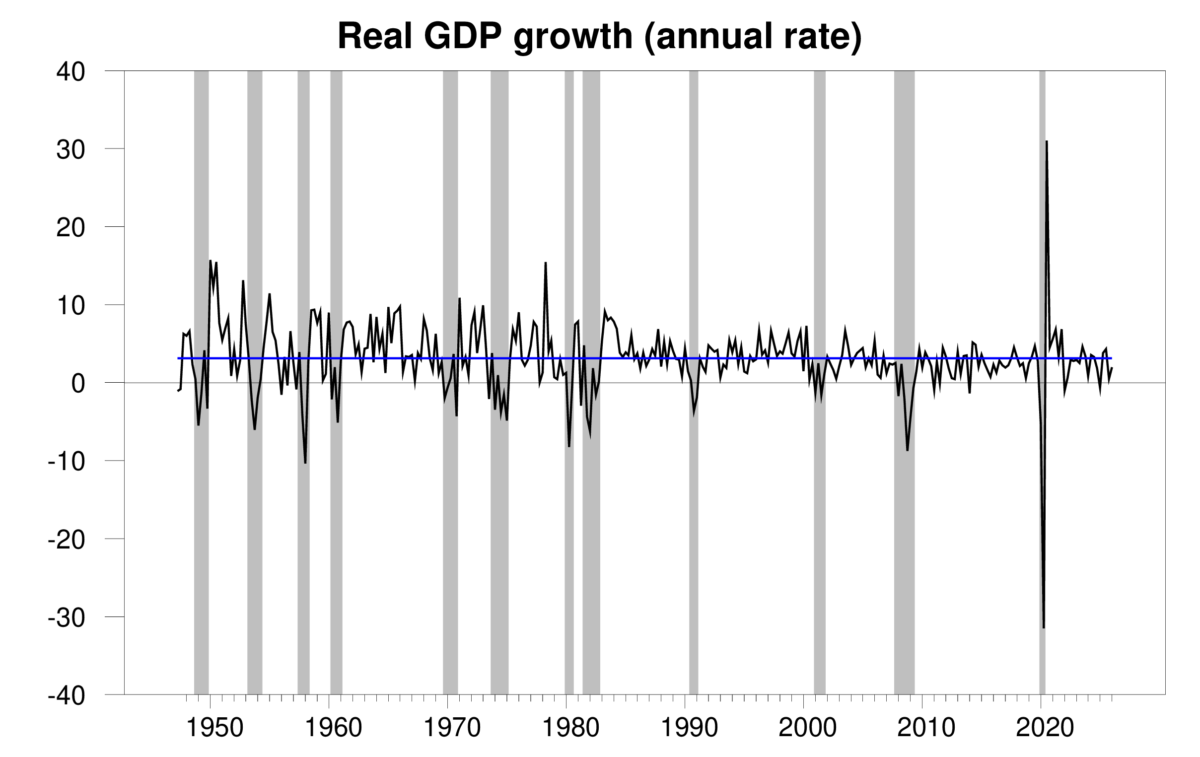
Quarterly real GDP growth at an annual rate, 1947:Q2-2026:Q1, with the historical average since 1947 (3.1%) in blue. Calculated as 400 times the difference in the natural log of real GDP from the previous quarter.
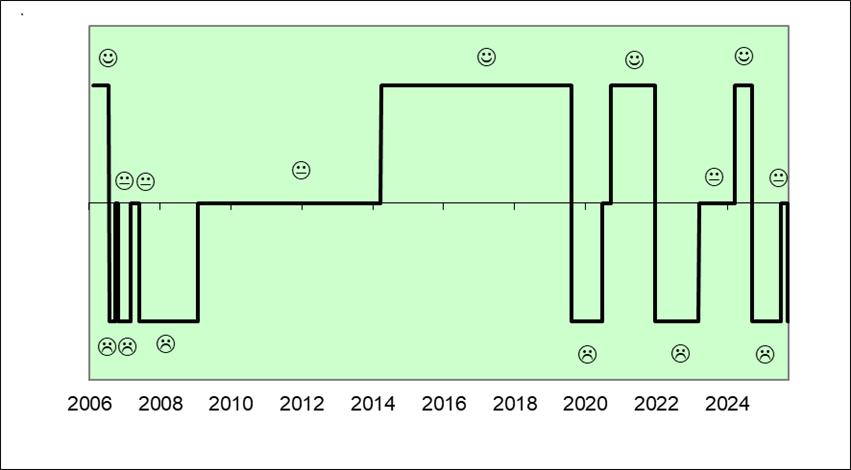
The new numbers bring the Econbrowser recession indicator index up to 7.7%. This uptick largely reflects the fact that Q4 is now reported to be rather weak. Our procedure has always been to wait one quarter for data revisions and better pattern recognition before announcing the index. The revisions to the Q4 GDP numbers illustrate one of the reasons this is desirable.
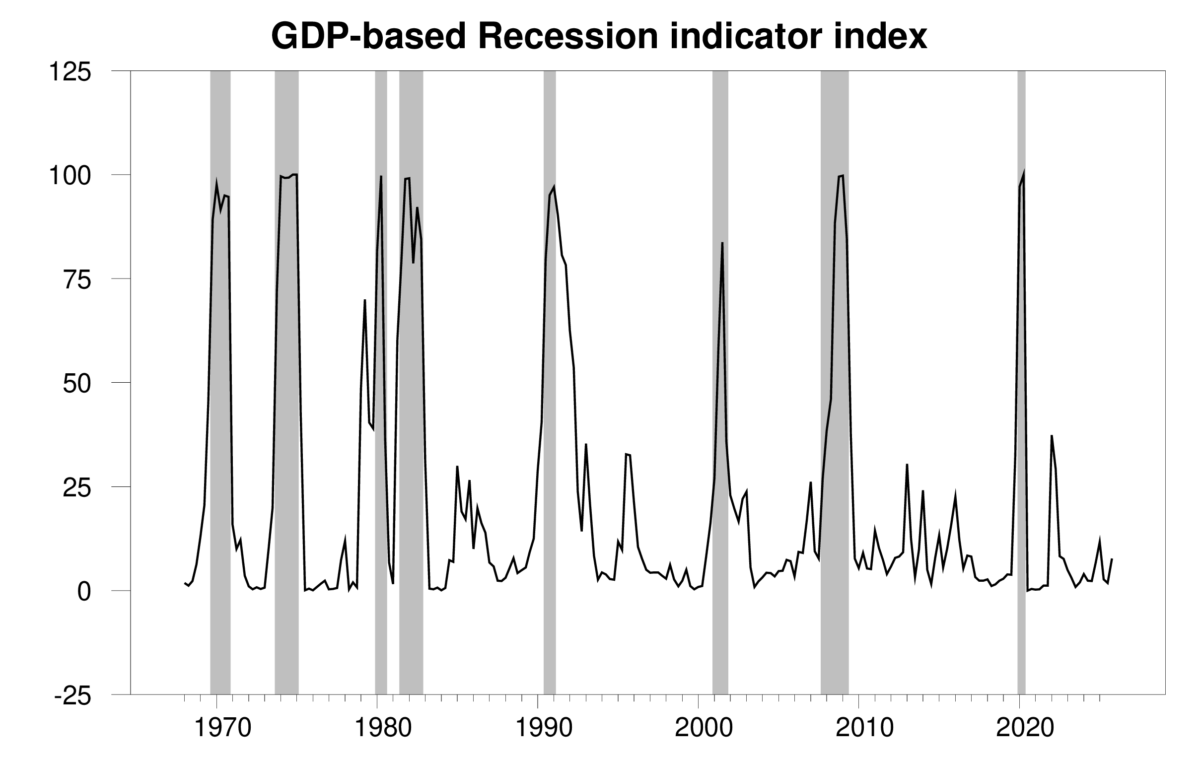
GDP-based recession indicator index. The plotted value for each date is based solely on the GDP numbers that were publicly available as of one quarter after the indicated date, with 2025:Q4 the last date shown on the graph. Shaded regions represent the NBER’s dates for recessions, which dates were not used in any way in constructing the index.
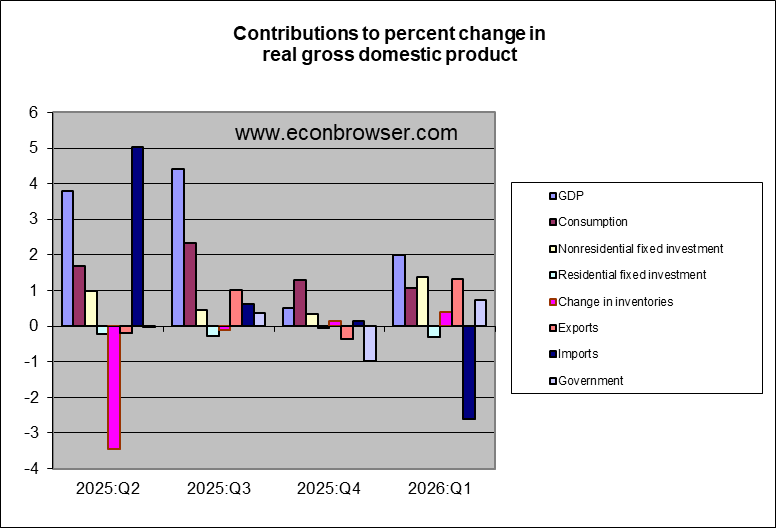
Nonresidential fixed investment, in part propelled by spending for AI infrastructure, seemed to contribute significantly to the Q1 growth. But many of these components were imported, so the net contribution to U.S. GDP — which measures production of new goods in the United States — was more muted. Consumption spending was weaker than it has been recently.
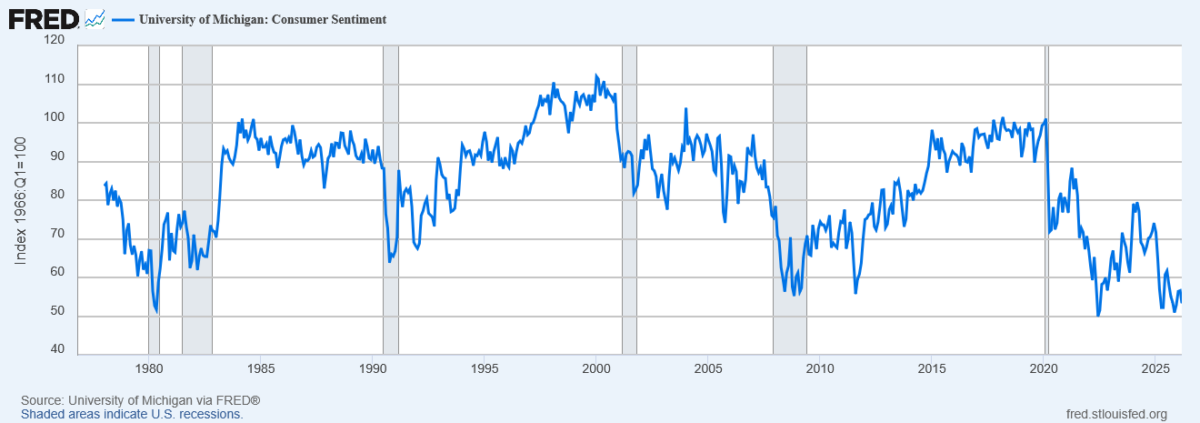
Some analysts have wondered whether the surge in oil prices could have played a role in the softness in consumption spending. Consumer sentiment, which often moves inversely with gasoline prices, has been pretty low, though this started before the recent oil price surge.
The drop in consumption spending following historical oil shocks has usually been led by the auto sector. Auto sales so far seem to have been holding up.
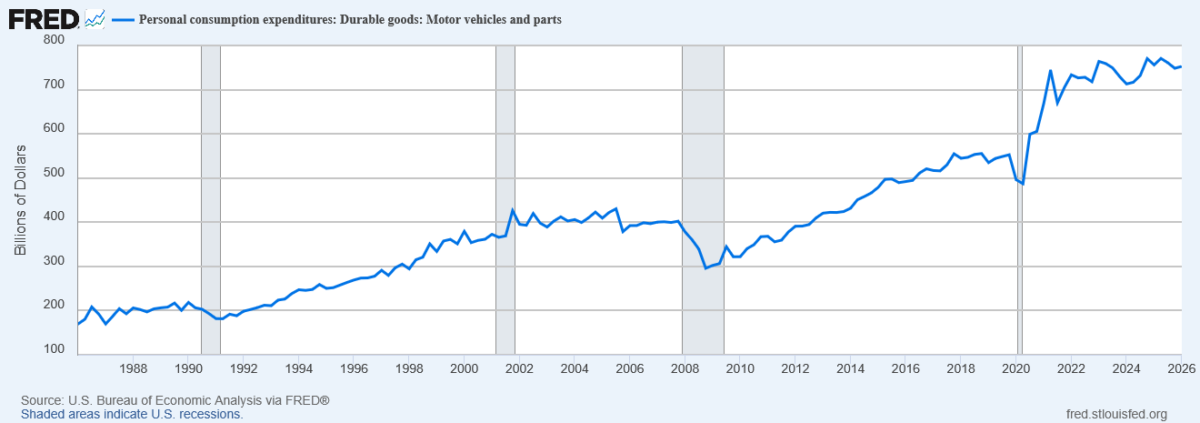
Nominal personal consumption expenditures on motor vehicles and parts, 1986:Q1-2026:Q1. Source: FRED.
The price of oil today is still below where it was four years ago. That may be part of why the recent oil price spike has not yet disrupted spending on autos and other goods more. But I am surprised that the price of oil right now isn’t higher. The IEA estimates that the conflict in Iran has cut world oil production by 10 million barrels per day, or about 10% of world production. We’ve seen nowhere near that big a drop in consumption of oil at this point. Consumers are being shielded from the full impact by sales out of inventories in the form of a drop in the amount of oil being stored on land and sea.
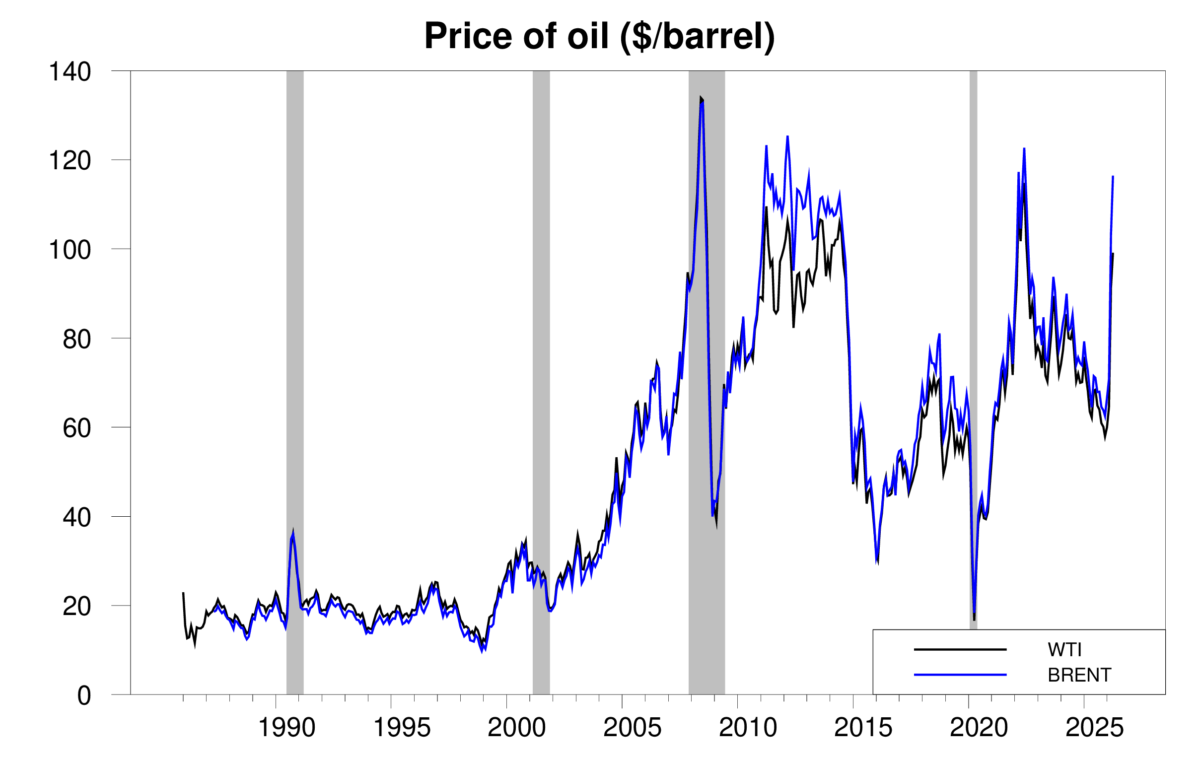
Selling out of inventories is the way markets are supposed to respond to temporary supply disruptions to cushion the economic impact. Wall Street seems to be counting on a quick resolution of this conflict. I hope the optimists are right. But I see a significant probability they are not. If the world needs to get by with 10% less oil for a prolongued period, we’re in for a much bigger drop in economic activity. The current sky-high stock market seems to be betting there’s not much danger of that. I think the market may be wrong.
I’m moving our Little Econ Watcher’s countenance back to worried until we get some better news out of the Middle East.
the world has a lot more EV’s on the road today than 4 years ago, with longer range and more charging stations. what kind of impact do you see that having on the price of oil and gas in the USA today? in particular, I think you see more two car families with one of them being electric. may be that households are shifting to more EV miles when possible?
I share your concern that oil seems to be priced lower than I would have expected, given the circumstances. the problem with oil drawdown of storage, is when you sell it cheap it draws down fast. and physical scarcity is a completely different animal from futures hedging. at some point, no matter how much you are willing to pay, there may be a lack of oil. that becomes a supply chain issue.
EVs today represent about 1.5% of passenger vehicles in the US. I doubt you could see any effect of that in gas prices. It would be lost in the noise.
The average age of vehicles is about 14 years and EVs currently replace a maybe 0.5% of those a year so its going to be a while before you see much of an impact, especially with the current administration doing everything it can to discourage EVs.
China is a different story. More than half of vehicles sold each year are EVs or plug-in hybrids.
And China count more than US because they sell more new cars per year than we do.
I think EVs will blunt the impact of oil disruptions for a while. Until oil physically becomes scarce, which will occur this summer. Interestingly, EV owners tend to be financially better off so that group of consumers may not cut back on expenditures quickly, which is a boost for the economy going forward. But once they begin to cut back, we have a recession.
Right. 1.5 million plug-in vehicles were sold in the US last year. China sold 13 million.
Along with solar and wind, China is well on its way into the 21st century while Trump’s US is stuck in the 19th with fossil fuels. China currently has half the solar panels of the entire world and is annually adding more than the rest of the world combined.
Meanwhile you have Trump paying wind turbine companies $2 billion to not build wind turbines. We’ve got at least three more years of this insanity and I doubt we will ever recover.
The 21st century is going to be the century of China.
The Hutchins Center estimates that the Q4 government shutdown cut GDP growth by 1% and that the reopening boosted growth by 1.3% in Q1:
https://www.brookings.edu/articles/hutchins-center-fiscal-impact-measure/
Correct for those effects and Q4 growth would have been 1.5%, Q1 growth 0.7%. So the 2-quarter average pace of growth is somewhere in the 1.1% to 1.3% range. The wobble between Q4 and Q1 isn’t all that large for this series and there are revisions yet to come, but the short-term trend appears to show a slowing, and now we’re in the middle of a substantial price shock and a physical supply shock overseas.
Blue Chip forecasts center around 1.4% growth for Q2, with the Atlanta Fed’s initial GDPNow tally at 3.7%. GDPNow doesn’t take account of the oil/fertilizer shock. If we were to make the iffy assumption that the gap between the Blue Chip median and GDPNow is entirely from the effect of the Iran-war shock, we’d get an estimated drag of 2.3% of GDP. That’s gotta be too big for now, but by the end of Q2, maybe not. If we take the Blue Chip median at face value, we’ll have a 3-quarter stretch of soft output growth; that’s consistent with weak job growth and multiple policy shocks.