Today, we’re pleased to present a guest contribution of Mufan Chen (University of Wisconsin).
An inverted yield curve is often seen as an early warning sign of recession. A large body of research suggests that the yield curve helps predict both GDP growth and downturns, especially in the United States and Europe. More recent experience, however, has raised doubts about how reliable that signal remains. In mid-2022, the yield curve inverted again in the United States and several major OECD economies, yet no immediate recession followed. That has led many observers to ask whether the yield curve still has the predictive power it once did.
In this post, I revisit that question by examining how well the yield curve predicts recession in the United States and seven OECD countries. I also test whether adding the debt service ratio improves forecast performance, as suggested by Borio, Drehmann, Xia (2018). I find that forecast accuracy improves in five of the eight countries examined, suggesting that debt burdens may help shape recession risk. These cross-country differences also raise questions about the channels through which the debt service ratio affects macroeconomic vulnerability. Overall, the findings suggest that the yield curve still contains useful information, especially when combined with measures of debt burden.
I use monthly data on yield spreads, recession indicators, short term interest rates, and debt service ratios for the United States and seven OECD countries from 1995 to 2025. The yield spread is defined as the difference between the 10 year interest rate and the 3 month interest rate. Interest rate data come from the OECD and FRED, debt service ratio data come from the BIS, and recession indicators come from the NBER and the Economic Cycle Research Institute. I estimate probit models through 2021 to predict recession 12 months ahead and evaluate out of sample forecasts from 2022 to early 2026 using the Brier score.
The figures below show the yield curve and recession periods for each country.
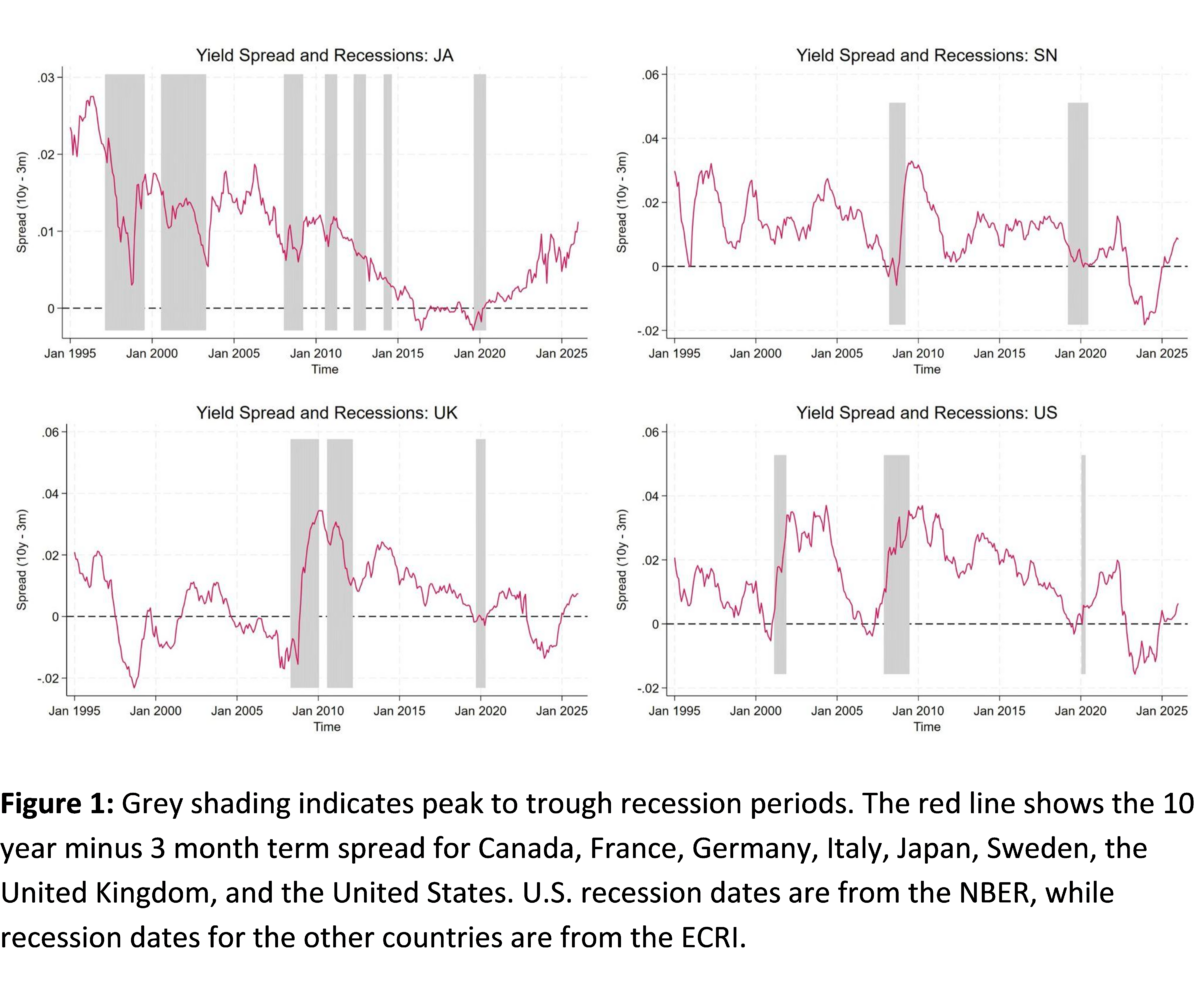
The relationship between the yield curve and recession is not uniform across countries. In the sample, not every recession is preceded by an inverted yield curve. At the same time, every country except Japan experienced a yield curve inversion in 2022, even though those inversions did not consistently lead to recession. If this visual relationship is uneven across countries, the next question is whether a simple forecasting model can still extract useful predictive information from it.
I estimate and compare three probit models for each country: one using the yield spread alone, one adding the short term interest rate, and one adding the debt service ratio. Each model predicts the probability of a recession 12 months ahead based on current financial conditions. The yield spread captures expectations about future economic activity, while the debt service ratio reflects the debt burden facing households and firms and may help capture financial vulnerabilities that the yield curve alone misses.
The figures below show 12-month ahead predicted recession probabilities and recession periods for each country by target month.
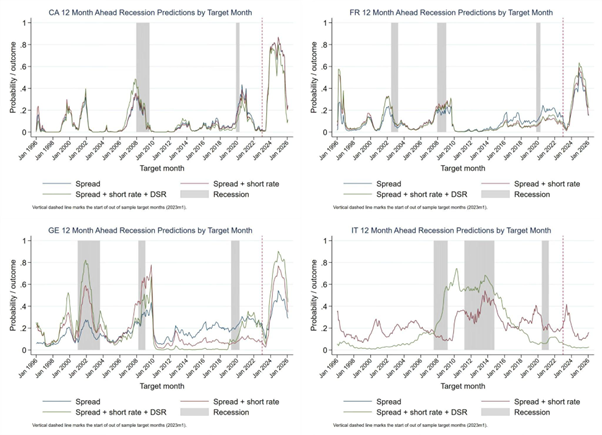
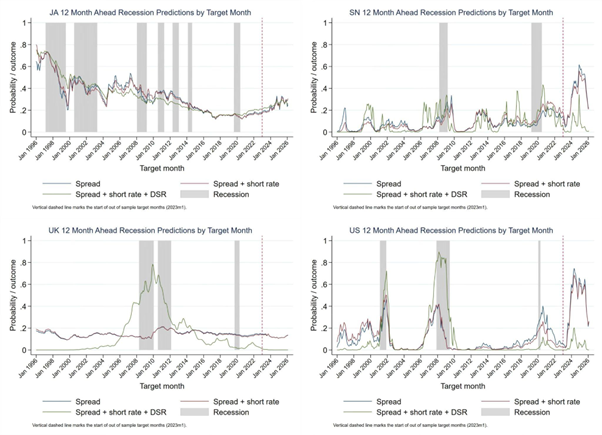
Figure 2: Grey shading indicates peak to trough recession periods. The blue, red, and green lines show estimated recession probabilities for each country. The red dashed line marks the out of sample forecast break. U.S. recession dates are from the NBER, while recession dates for the other countries are from the ECRI. Debt service ratio data come from the BIS.
The figures suggest that the yield curve still contains useful information about recession risk, particularly before 2022. In most countries, predicted recession probabilities rise around recession periods, suggesting that the pattern is not random. Even so, the models do not always push those probabilities above 0.5, a common threshold for predicting recession.
Adding the DSR also visibly changes the predicted recession probabilities in the 2023–25 period in some countries. This is especially clear in the United States, where both the spread-only and spread + short rate models predict a high likelihood of recession in 2024. A similar pattern is observed in Sweden. For the United Kingdom and Italy, adding the DSR visibly reduces the predicted probability of recession, although the original models do not cross the 0.5 threshold for predicting a recession. In contrast, the gains are less clear in Canada, France, and Germany. For Canada and France, the visual differences across specifications are less pronounced, while in Germany adding the DSR substantially raises predicted recession probabilities.
These results should be interpreted in light of the recession dating convention used here. The analysis relies on recession dates defined by the NBER and ECRI, which are converted into discrete 1/0 recession indicators. However, underlying economic conditions are continuous rather than purely binary, and recession dating is typically determined retrospectively using a broad range of indicators rather than a single mechanical rule. Therefore, predicted probabilities that deviate from actual recession outcomes may instead capture economic weakness or recession risk that either did not develop into, or was not ultimately classified as, a formal recession. This caveat is especially relevant for countries where industrial production or manufacturing activity weakened in the study period without being classified as a recession.
To formally assess whether adding the debt service ratio improves forecast performance, I compare models using the Brier score, a measure of the mean squared difference between predicted probabilities and actual outcomes.
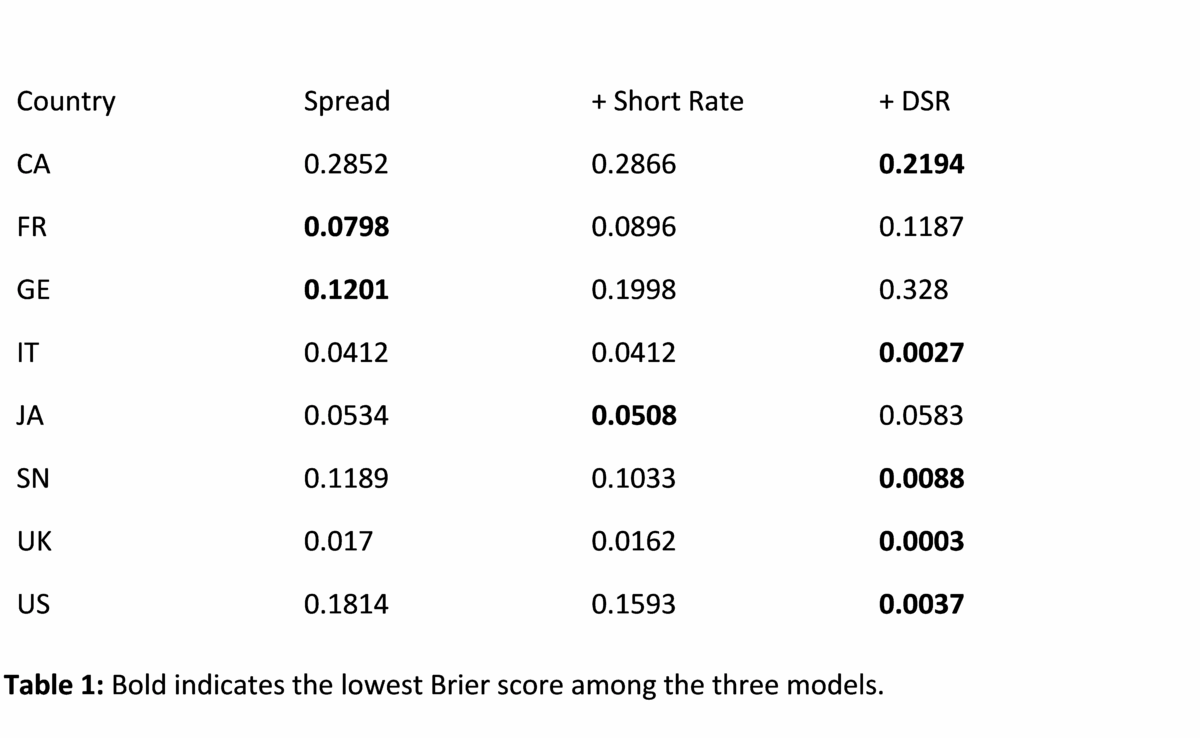
Table 1 compares the three models using the Brier score, where lower values indicate better forecast accuracy. For reference, a model that assigns a recession probability of 0.5 in every period would produce a Brier score of 0.25. This represents a neutral 50-50 prediction, so a Brier score below 0.25 suggests that the model’s predicted probabilities contain useful information beyond an uninformative benchmark. The best Brier scores in Table 1 are generally well below that benchmark.
Adding the debt service ratio improves performance in five of the eight countries in this sample: Canada, Italy, Sweden, the United Kingdom, and the United States. However, the pattern is not uniform, as forecast accuracy worsens in France, Germany, and Japan when the debt service ratio is added. These differences suggest that the role of debt burdens in recession forecasting varies substantially across countries.
Overall, the yield curve remains a useful predictor of recession risk, but its performance appears less consistent than in earlier periods. Adding the debt service ratio improves forecast accuracy in several countries, especially the United Kingdom and the United States. Taken together, these results suggest that debt burdens can provide useful additional information for recession forecasting, but that their value depends on country-specific macrofinancial conditions. Understanding the channels behind these cross-country differences remains an important question for future research.
This post written by Mufan Chen.