Let’s hope foreign non-official sector wants to hold on to US government debt.
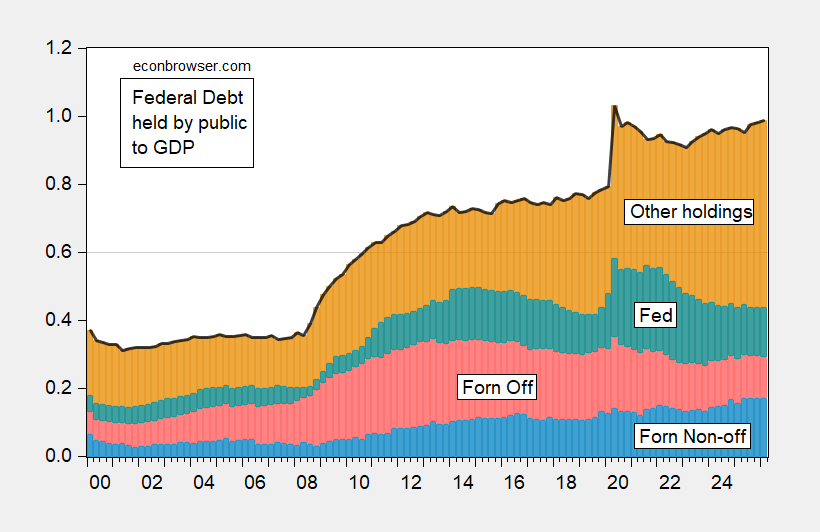
Figure 1: Federal debt held by the public as share of GDP (black line), foreign non-official sector (blue bar), foreign official sector (red bar), Federal Reserve Banks (teal bar), and other holdings (tan bars). Source: Treasury via FRED, BEA, and author’s calculations.
The foreign official sector (central banks) is pretty sated with Treasurys. Fed Chair designate Walsh wants to shrink the teal portion. We’ll see how malleable his views on this point are as long term rates rise (as I think they will).
It seems like the total foreign has been fairly steady although some has shifted from official to non-official. Could that be China and other governments trying to sanction protect their holdings without selling $US?
The “Other Holdings” seems to have done the majority of the work of absorbing US government undertaxing. To the extend that it is US insurance, annuity, retirement investments it would be stable. But I hear that some of the Wall Street gamblers have also gotten into this – that would be of concern.
Walsh has mostly been a political animal and I doubt he would grow a spine or any principles this late in his career. Trump may even have selected him because of this sadistic trait of enjoying to force people to humiliate themselves in public. I think he may force Walsh to buy more treasuries instead of selling.
Brad Setser has documented China’s shift of its Treasury holdings away from official custodial accounts. Information is power, and China doesn’t miss a chance to keep power away from the U.S. My guess is “monkey see, monkey do” for other U.S. adversaries and, increasingly, everybody else. Capriciousness is not a selling point for sovereign debt.
In response to this and the prior post, I’ll l just observe that the U.S. is probably in the best position of any country to run a high debt/GDP ratio, and there’s nothing magical about big round numbers. (Reinhart and Rogoff proved that, to their embarrassment.)
What is not sustainable when debt is high is g<r. That's our situation today, in large measure due to policy. We have limited control over g and r, more control over the size of the debt, so that's where we should look for a solution.
Unlike the private sector, government has strong control over both revenue and spending. There's a common assertion that raising tax rates can't raise revenue, but that'sjust dishonest claptrap; government can raise revenue at will. Higher tax rates, a broader base and better enforcement all serve to increase revenue. We know that because revenue falls as a share of income every time we cut rates, narrow the base or reduce enforcement.
A deficit at 5% of GDP outside recession and federal debt at 100% of GDP with no plan to reduce debt is a disaster in the making. Who's in charge here?
Finally Trump is making progress on groceries affordability. He is doing this by reversing a Biden era rule and deregulating refrigerants used by grocery stores. The Biden rule phased out the use of global warming HFC refrigerants in new refrigerator installations. Trump also eliminated HFC leakage requirements on refrigerated semi-trucks just as an added bonus.
You should see the savings on your grocery bill — never. But on the other hand, the winters should be milder because the old HFCs are 2,000 times as potent as CO2 for global warming.
Not sure what the effect will be on the price of Bruce Hall’s coffee.