In a previous post, I noted that the February CBO projection of debt would likely be an underestimate, and perhaps increasingly so over time, suggesting upward pressure on rates.
First, the IEEPA tariffs were ruled illegal. This means something on the order of $170 billion in refunds. While this has minimal impact on the debt level this year, it means any five year ahead debt projection should be revised upward relative to the February projection.
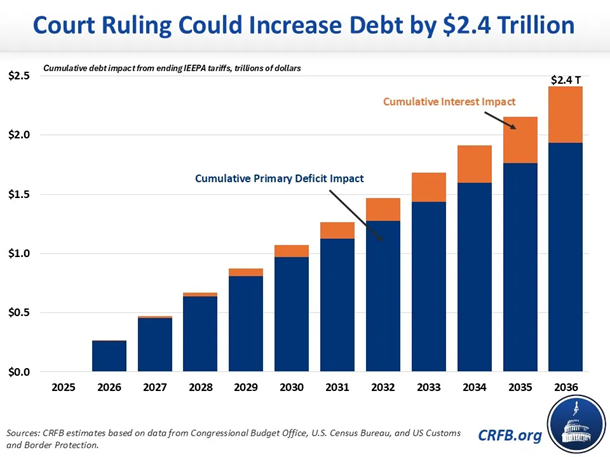
Source: CRFB (2026).
The IEEPA tariffs were partly replaced (economically speaking) by the Section 122 tariffs, which have been in part invalidated. If subsequently refunds are ordered, then first order there’ll be no net impact on debt.
The cumulative impact above includes additional interest costs, likely based on the CBO’s February projection. But the US-Iran war has pushed up interest rates.
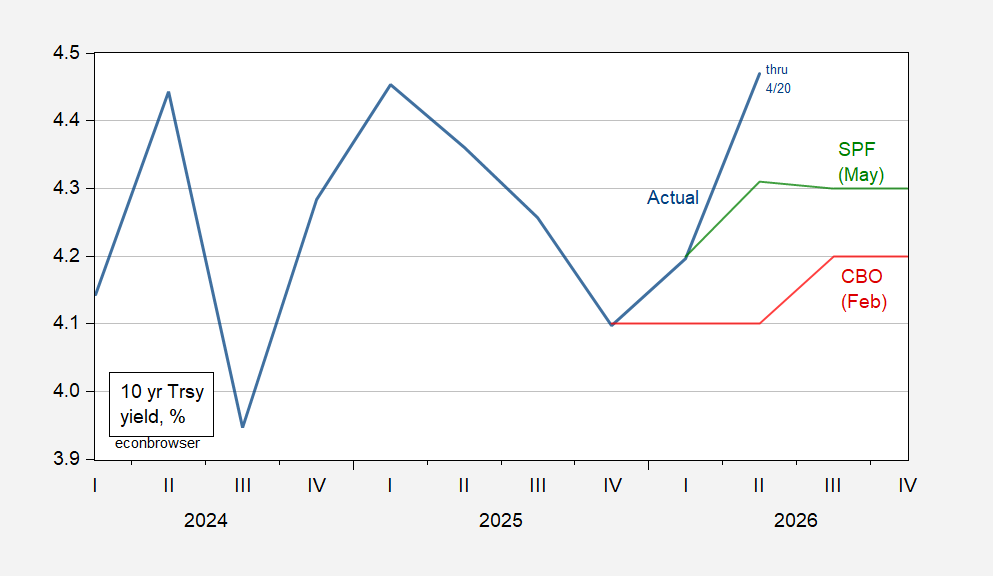
Figure 1: Actual ten year Treasury yields (blue), CBO (red), Survey of Professional Forecasters (green), all in %. Q2 actual is average for daily data through 4/20. Source: Treasury via FRED, February CBO Budget and Economic Outlook, Phildadelphia Fed (May).
What are the implications for the debt held by the public? I take the reimbursements at $175bn, the higher interest expenditures at $50 billion (the average Treasury 10 year yield assumed to be about 20 bps higher for the rest of the fiscal year than CBO assumed), and that expenditures in the US-Iran War at about $1 billion per day (in the lower mid-range of $500 mn-$2 bn). That means an additional $425 bn expenditures in FY2026 than CBO originally projected:
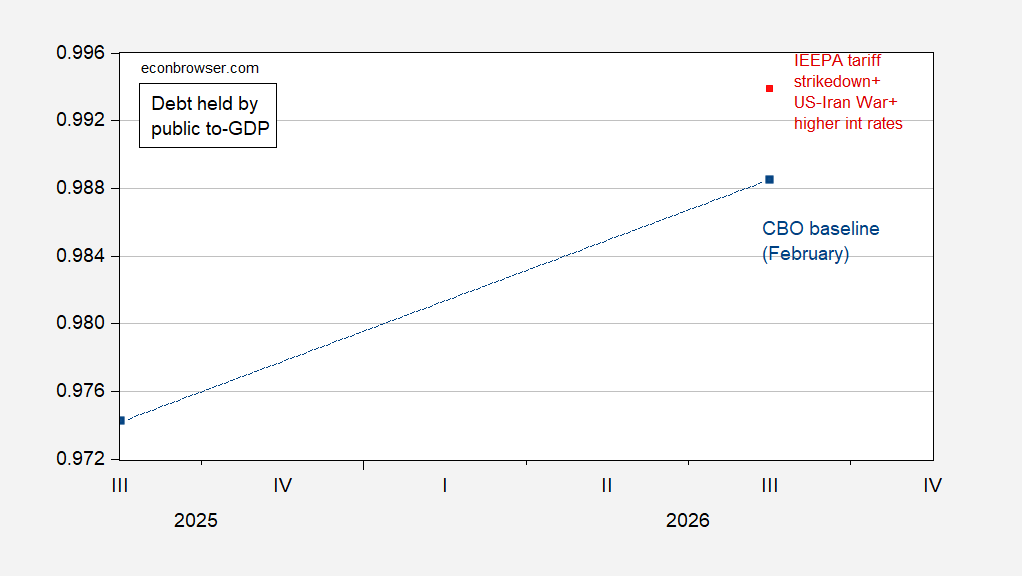
Figure 2: CBO baseline debt-to-GDP (held by public) (blue), and alternative incorporating IEEPA tariff decision and reimbursements, higher interest rates and war costs (red square). Source: February CBO Budget and Economic Outlook, and author’s calculations.
Other possible policy actions might further add to debt. A gas tax holiday lasting 4 months would cost another $11.5 bn.
In a rational expectations context, one could argue that current rates already incorporate the higher debt levels. After all the IEEPA decision was 3 months ago (although the reimbursements only started occurring much more recently). However, the war expenditures are only slowly being revealed (especially as duration is unknown), and the much higher interest rates are a more recent revelation.
This is a Cassandra post. We are facing the possibility of a future till now not contemplated. We cannot know whether a dreadful reckoning or a modest adjustment awaits us. Cannot know. It is lunacy to roll the dice and find out, yet we roll the dice to suit the greed and vanity of the powerful few. Pray, pray for a modest adjustment. Pray for another chance to do better.
So any bets on how long till Colbert is back at it?
It always amuses me to hear people tout the US as the richest nation in the world, yet complain that we don’t have enough money to pay our bills.
Just yesterday we had Jeff Bezos, one of the richest men in the world, state in an interview “We don’t have a revenue problem. We have a spending problem.” Which turns the old saw on its head “If you’re so rich, why aren’t you smart?”
Last year we had so-called genius Elon Musk state the same thing — so his DOGE cut a billion dollars from public radio — that’ll fix it. These are not smart people. They are profoundly ignorant people.
Mr. Bozo? Sir, it turns out, we actually have a revenue problem:
https://fred.stlouisfed.org/graph/?g=1Wy8i
Sir, what does a businessman like you try to do when revenue as a share of activity falls? Say “No more revenue!”? Hmmmm?
In the same interview Bezos yelled about New York City spending $44,000 per student. He neglected to mention that he sent his kids to the private Lakeside School in Seattle, the same one Bill Gates attended decades ago, which spends $58,000 per student. So when he talks about cutting spending he means for the common people, not for elites like himself.
It’s interesting that Lakeside School in the 1960s was the only elementary and high school in the country with access to a computer terminal connected to a remote mainframe. At this time computers access cost hundreds of dollars per hour (1960s dollars). Bill Gates and Paul Allen got their start in computers at Lakeside and without such elite access there would likely be no Microsoft. But, hey, we can’t keep spending money on education for the plebes.