IP at 0.1% m/m vs. 0.3% consensus.
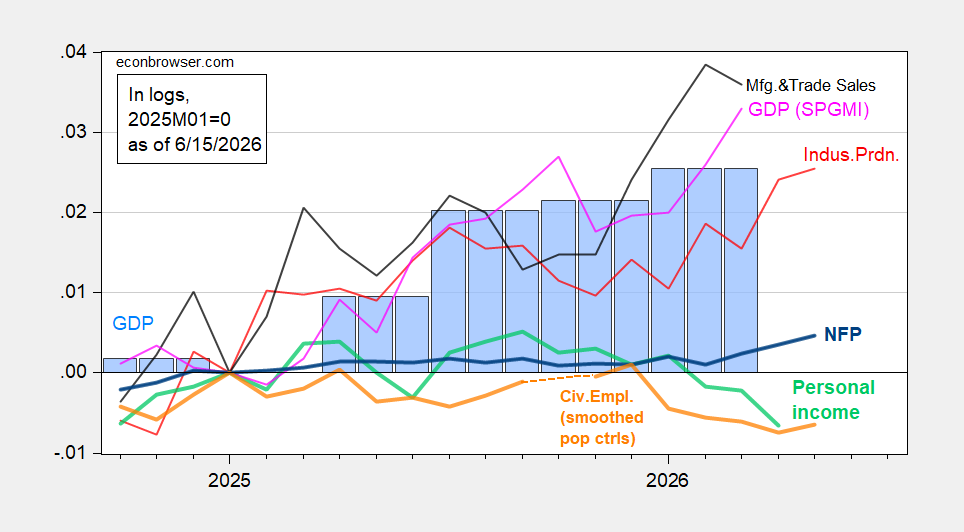
Figure 1: NFP employment (bold blue), civilian employment with smoothed population controls (bold orange), industrial production (red), personal income excluding current transfers in Ch.2017$ (bold light green), manufacturing and trade sales in Ch.2017$ (black), and monthly GDP in Ch.2017$ (pink), GDP (blue bars), all log normalized to 2025M01=0. Source: BLS via FRED, BLS, Federal Reserve, BEA 2026Q1 2nd release, S&P Global Market Insights (nee Macroeconomic Advisers, IHS Markit) (5/7/2026 release), and author’s calculations.
It bears repeating that real personal income ex-current transfers has been declining for three months.
In contrast to industrial production, manufacturing production was flat.
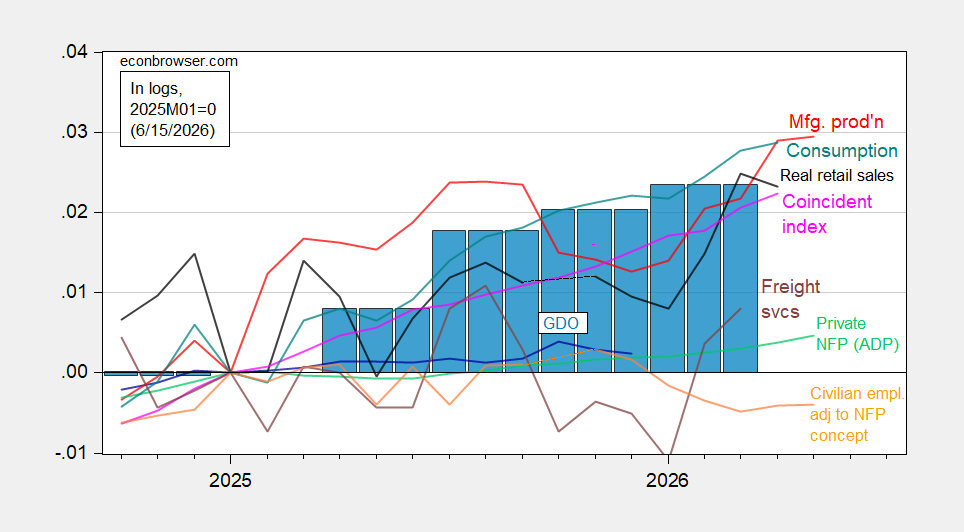
Figure 2: Civilian employment adjusted to NFP concept smoothed population controls (bold orange), manufacturing production (red), ADP private nonfarm payroll employment (light green), real retail sales, CPI deflated (black), freight services indexes (brown), and coincident index in Ch.2017$ (pink), GDO (blue bars), all log normalized to 2025M01=0. Source: BLS, ADP via FRED, Philadelphia Fed, Bureau of Transportation Statistics, Federal Reserve via FRED, BEA 2026Q1 2nd release, and author’s calculations.
Retail sales come out on Wednesday. Bloomberg consensus is for 0.5% m/m. With May CPI m/m inflation at 0.5%, this means flat real retail sales, after a April decline.
Off topic – Felon-in-chief gives Gavin Newsom a leg up in Drmocratic primaries:
https://www.theguardian.com/us-news/2026/jun/15/gavin-newsom-doj-investigation
As was said in Nixon’s time, “It’s an honor to be among the President’s enemies.” It’s also a help for name recognition.
Off topic – Diplomatic fallout from the war on Iran:
https://www.indianpunchline.com/india-signals-rethink-over-west-asia/
The gist is that India is moving toward Iran, away from the U.S.
While the article almost certainly overstates the extent of any shift as a practical matter, the direction of movement makes sense. The article gives the impression that India’s shift is the result of a U.S. attack which killed Indian sailors, also likely an ovestatement.
The U.S. had been courting India for decades, off and on. Then, suddenly, the felon-in-chief imposed tariffs on India, withdrew from constructive participation in the wider world and caused India no end of pain by putting oil and fertilizer in short supply. Meanwhile, Iran’s place in the region and the world has been elevated as a result of the war.
Any rational foreign policy would shift away from engagement with the U.S., toward Iran, merely in response to those changes, but India has more to think about. India is concerned about encirclement by China; China is courting Iran, so India will also court Iran. Pakistan has played a big part in ending the war on Iran, and India is on-and-off at war with Pakistan, so India has some catching up to do in courting Iran. Persian Gulf oil is nearby, while U.S. oil is distant. An easing of sanctions is likely to mean a substantial increase in Iranian oil exports, which will in turn boost Iran’s imports – India wants in on that.
So not just the attack on an India vessel, though certainly that makes the domestic politics easy. The attack on that vessel was part of a larger pattern of arrogance and harm inflicted by the U.S. on the rest of the world, India included.
Off topic – there’s a new Fed policy handicapping tool:
https://trinity.duke.edu/news/new-survey-finds-former-federal-reserve-insiders-saying-rate-hike-could-be-needed
Duke University and John Hilsenrath have begun surveying former FOMC members and staff regarding likely Fed monetary policy. The current call is, unsurprisingly, in line with market pricing – a modest tilt toward a rate hike this year.
Last one, I promise?
Recently, Ukraine has widely been reported as having turned the tide of the war, and is successfully attacking Russian military and oil infrastructure. At the G7 meeting, there is upbeat talk about the potential for peace negotiations*, partly predicated on those improved fortunes:
https://www.yahoo.com/news/articles/europeans-test-trump-iran-deal-040105566.html
Russia’s recently improved foreign earnings on oil are at risk as the re-opening of Hormuz nears.
Ther may, however, be a fly in the ointment. A fellow by the name of Frederick Lanchester came up with a model of attrition-style warfare in 1916, based on each sides’ ability to replenish losses of manpower, equipment and ammunition. The model has remained in use ever since, due to its relative accuracy at predicting major turning points in war. The gist is, when either side can only replace about 3/4 of its losses, there is a sharp acceleration in losses, and at 50% replacement, collapse. Based on a couple of runs of Lancaster-style models, late summer is looking bad for Ukraine.
Here’s a report of a Lanchester-style attrition model, run by Warwick Powell of Queensland U.:
https://warwickpowell.substack.com/p/the-attritional-war-in-ukraine
A replication of Powell’s results, run by Anusar Farooqui:
https://x.com/policytensor/status/2055194488516047341?s=20
An independent effort at modeling attrition from Peter Turchin:
https://osf.io/preprints/socarxiv/k5b42_v1
All find Ukraine to be nearing serious trouble.
It might change the calculation if, for instance, the U.S. would resume transfers of equipment and munitions to Ukraine, but some categories of U.S. stores are badly depleted. Defensive missiles, in particular, are running low and will be for years.
It’s posible the models don’t reflect the new reality of drone warfare. Ukraine is, for instance, using drones effectively to interrupt Russian resupply at the front line. The “front line” in a drone battle isn’t geographically localized. Russia’s economy is now weakening, so its ability to resupply may deteriorate.
Anyhow, just an FYI for those who still think about Ukraine.
* What can European G7 leaders do but talk enthusiastically about prospects for peace?
Using body exchange rates as a proxy for relative losses is… problematic at best. Exchange rates are an outcome of negotiation, which in turn is largely, although not entirely, based upon the value the two sides have in actually getting the bodies back.
I am quite familiar with Lanchester’s work, having three books on the topic and done some modeling of my own in the past. I don’t think the drone nature of the war makes any real difference, as it all comes down to losses at or near the front anyway. If it doesn’t affect losses at the front, one way or another, it isn’t important. If it does, its impact is already captured by the losses at the front.
Interesting, though.
All models are wrong, but some are horribly, breathtaking absurdly, useless.
Off topic – The term of the U.S./Iran MOU have been released. Here’s the New York Post’s report on the text, complete with invective:
https://nypost.com/2026/06/17/us-news/complete-14-point-us-iran-peace-deal-finally-revealed-by-trump-administration-read-text-in-full/
Here’s a summary, care of Barak Ravid, slightly edited to cut out fluff, [my comments in brackets]:
— Iran, the US and their allies will cease hostilities, including in Lebanon. [Iran say this means Israeli forces leave Lebanon. That’s gonna take some doing.]
— Iran reiterates its commitment not to develop or acquire nuclear weapons, the U.S. and Iran will talk about Iran’s nuclear program and stockpiles, and Iran won’t do anything different during the talks. [Nothing about nukes has been resolved, so no change yet as a result of the war.]
— The US will lift the naval blockade, won’t impose new sanctions nor increase forces in the region during the negotiations.
— Iran will ensure safe passage of commercial vessels through the Strait of Hormuz, free of charge, for 60 days. [This requires dealing with mines, but this may be less problematic than it has been made out to be.]
[The next four outline the bonanza for Iran that has critics howling.]
— US pledges to make frozen Iranian assets available for use with implementation of MoU
— Any final agreement will include a plan to establish a $300 billion fund for Iran’s reconstruction.
— US to give Iran temporary sanctions waivers to sell oil during negotiations.
— Negotiations will be held between Iran and Oman with the participation of Gulf policy to define “arrangements regarding shipping and maritime services”. [This leaves open the re-imposition of tolls after 60 days.]
— If a final agreement is reached, the US will withdraw its forces within 30 days and lift all sanctions on Iran [All sanctions? More than Obama’s JCPOA?].
https://x.com/DD_Geopolitics/status/2066948671560937496
joseph has noted in comments that Ravid is a mouthpiece for Israel. Well, yeah. And the fact that he leaked the deal before the White House reflects Israel’s unhappiness; the campaign to scuttle the deal is full tilt. Here’s the New York Post front page today:
https://blogger.googleusercontent.com/img/b/R29vZ2xl/AVvXsEjxpAyPAUM9WTC0HuuFlMTAaqkQcuoDDEnXevCoMb4EurXTbCN6_-bL6_WX8oP-shnw35AiH5IFe2J44ACaw7_lG_AVVaa13gXbiKUNy3oqPUvxTbgB0nvRqwkmuTjuiR5fGdhVpTH29MYW0vHYf6b9aGOipl9OM0yepUQjziKnlRJKF1k3cWJL/s1212/1000037590.jpg
FOMC 1, Warsh 0
The new Summary of Economic Projections shows the median estimate for the fed funds rate is now higher for this year, next year and the year after than was the case at the March FOMC meeting. Because expected inflation is also higher, the inflation-adjusted funds rate is actually lower this year and in 2028, though higher in 2027. Warsh should count his blessings; above target inflation through 2028 isn’t most people’s idea of “transitory”, so the “real” funds rate should arguably rise.
No dissents, which seems quite odd, given the recent pattern of multiple dissents. Perhaps a compromise so that Warsh’s first meeting can seem uncontentious? It means the chair(man) didn’t dissent, probably wise. The policy statement is very brief, perhaps reflecting Warsh’s preference for opacity – it is his document, after all.
Release of the memorandum of understanding, item 1:
The United States of America and the Islamic Republic of Iran and their allies in the current war are signing this MOU to declare the immediate and permanent termination of military operations on all fronts, including in Lebanon, and undertake from now on not to initiate any war or any military operation against each other, and to refrain from the threat or use of force against each other
Donald Trump today: “It’s a memorandum of understanding. If I don’t like it I we’ll go back to shooting at them, dropping bombs right smack in the middle of their head.
Oh, well, so much for refraining from threats or the use of force. Trump can’t even live up to the first item in the memorandum. This sure bodes well for the rest of the memorandum.
A deal with Trump is never a deal.
By the way, it looks like FOMC members, on average, expect AI to add 0.2 ppts to real GDP growth. That’s assuming the entire change in the median long-term growth forecast from a year ago and 2 years ago is due to AI. Was 1.8%, now 2.0%.
joseph – Uh Oh:
https://www.reuters.com/business/feds-warsh-flags-new-tasks-forces-study-fed-operations-2026-06-17/
Question for Chair(man) Warsh:
What is the obvious alternative to the Fed’s policy of abundant reserves?
Answer: A higher inflation target.
In reality, Warsh is being consistent – higher inflation and a smaller Fed portfolio. Let’s see if he admits to his preferences, or keeps talking about cherry-picking inflation measures. Oh, and let’s especially see if he supports a stop to paying interest on bank deposits at the Fed, ’cause that’s only justified in an abundant-reserves policy regime.
NYTimes Pitchbot: “Breaking | The Trump Administration is negotiating a deal to repaint Reflecting Pool to prior color, allow algae to stay.”
Macroduck: “joseph has noted in comments that Ravid is a mouthpiece for Israel.”
Uh, no, I didn’t say that. I said that Ravid is an embedded agent of the White House, which is worse. The White House wants to put out some propaganda, they call up Ravid, Ravid prints it verbatim.