From ADP, one sees that employment growth has accelerated, small firm employment, and employment share, has decelerated.
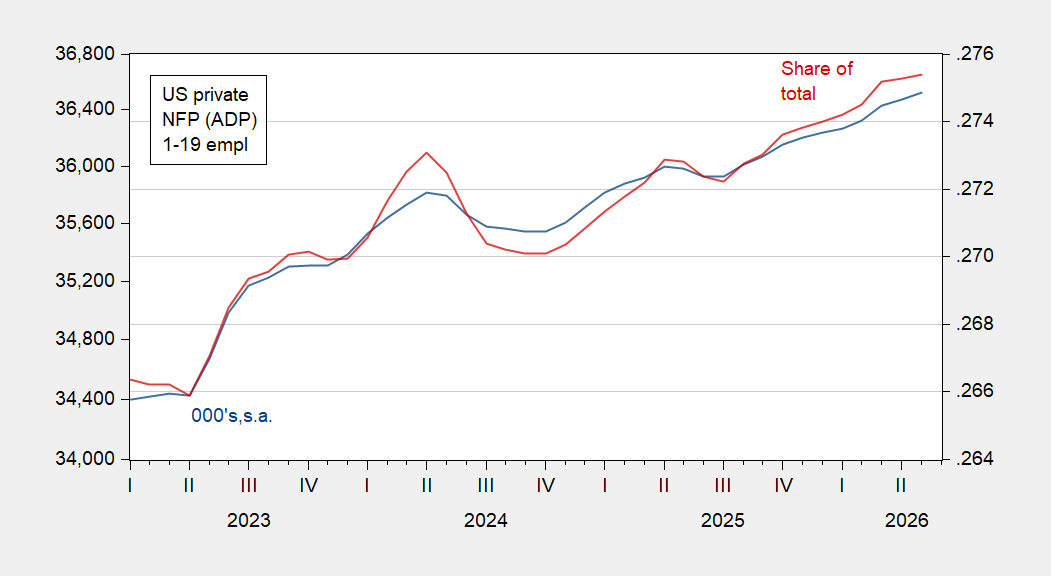
Figure 1: Private nonfarm payroll employment in firms 1-19 employees (blue), and share of total private nonfarm payroll employment (red), both s.a. Source: ADP via FRED.
Small firm employment (1-19 employees) constitutes a nontrivial share of total private employment, so it’s of interest to know what’s happening here, and what is likely to happen going forward.
The NFIB survey for May suggests lackluster hiring plans (median employment size for respondents in NFIB survey is 10-15 employees).
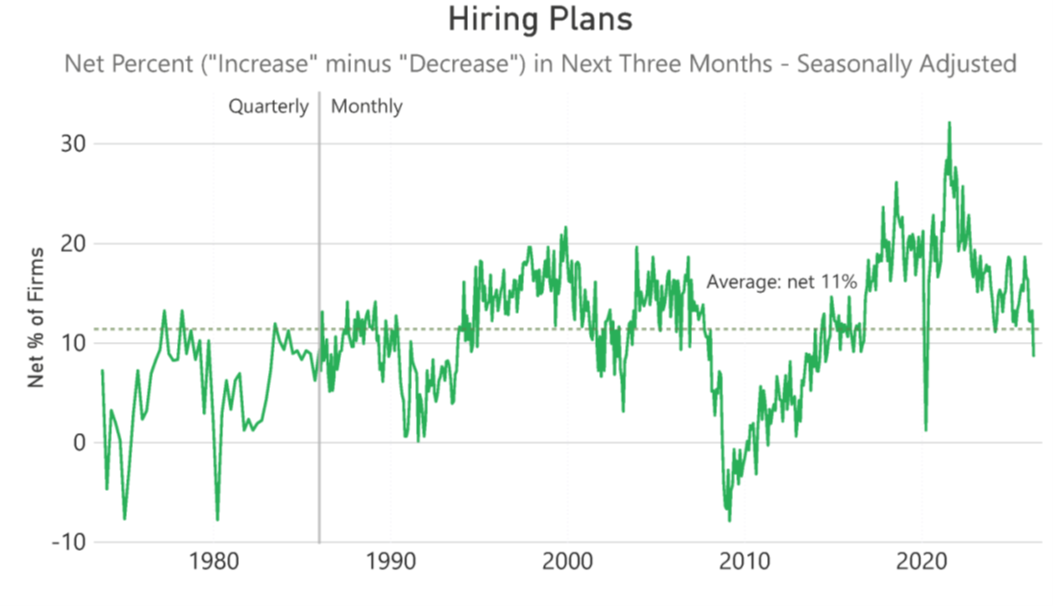
Source: May NFIB Jobs Report (4 June 2026).
From the report:
“A seasonally adjusted net 9% of owners plan to create new jobs in the next three months, down 4 points from April and marking the lowest level since May 2020. Plans to hire are now below its historical average of a net 11%.”
It’s no wonder small firms are not planning to hire. In general, optimism is quite low (although ot as low as during the high inflation period of 2022-24).
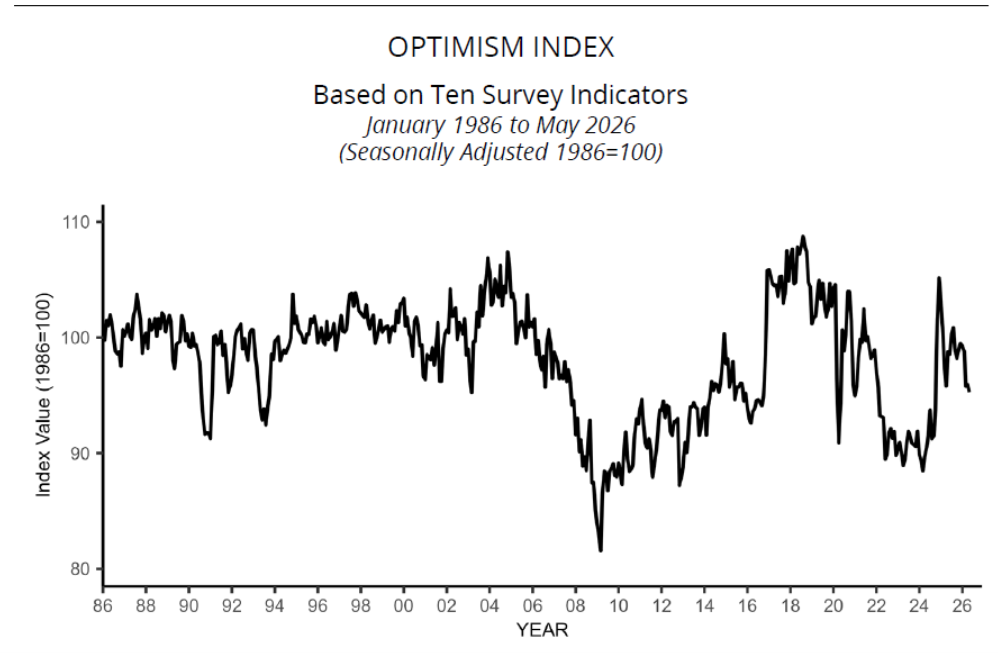
Source: NFIB May Small Business Economic Trends Report (9 June 2026).
I’m unfamiliar with the predictive power of the NFIB hiring plans differential for future NFP growth — Pantheon Economics asserts a 4 month lead. That being said, even if true, it’s not clear that negative employment growth would be sufficient to warrant a recession call given the small growth in labor force.
Odd that leisure and hospitality jobs are a big part of the reason acceleration in hiring, but small firms aren’t.
I suppose keeping full-time jobs to a minimum may have meant headcount at small-revenue firms has risen? New business applications have cooled off from the early Covid period, but remain high:
https://fred.stlouisfed.org/series/BAHBATOTALSAUS
If the rate of new businesses opening remains high – new firms tend to have small headcount – then perhaps new business failures are up.
Off topic – the Iran deal:
Looks like the decision which allowed agreement on a memorandum of understanding was to lower the bar. That has been the obvious step all along; maximalist demands are dumb. What’s odd is the lack of detail. We don’t yet know whether any funds will be released to Iran. Iran seems not to have agreed to turn over its uranium stocks. Iran says an end to Israel’s war in Lebanon is part of the deal, while Israel says it isn’t. We don’t know who’ll control Hormuz.
Of course, Iran can close Hormuz again at any time and can fire drones again at regional oil facilities at any time. So Iran’s ports open and Hormuz opens, and what else? Presumably, we’ll find out on Friday.
Israel is a problem. Either Bibi’s quest for Lebensraum ends or the deal doesn’t stick. Hormuz could close again. Bibi may be the one who decides whether oil will flow, at least until October.
With a deal, both sides will work to improve their position should hostilities resume. Iran most likely will reinforce its ability to move freight overland and to build trade and finance links outside U.S. reach. They’ll build inventories of essentials. They’ll improve their drone arsenal, based on the lessons of the war. I can’t think of much the U.S. and Israel can do that they haven’t already tried, but they’ll keep trying.
Very unstable. Kalshi doesn’t have bet on closing Hormuz again, but I’d expect active trade if that bet were available.
So if all of the trapped tankers and freighters hurriedly escape the Persian Gulf, how many of them will ever chance a return trip?
The answer is in part a business decision. How much will insurance cost? Don’t know. How much will fuel cost? Don’t know. How stable is policy? Don’t know.
A particularity interesting question is whether there are good alternatives for tankers. Will there be a bias toward sourcing outside the Persian Gulf, lowering the price of Gulf oil and boosting other sources? I think we do know the answer to this one with fair certainty.