That is Donald J. Trump, in May 2016. So why the surprise about debt worries? It was only a question of time.
First, a technical point. The headline (gross) Federal debt number is $40 trillion (as of yesterday); debt held by the public, which nets out intergovernnmental debt, is $32.3 trillion. Still, the picture is worrying.
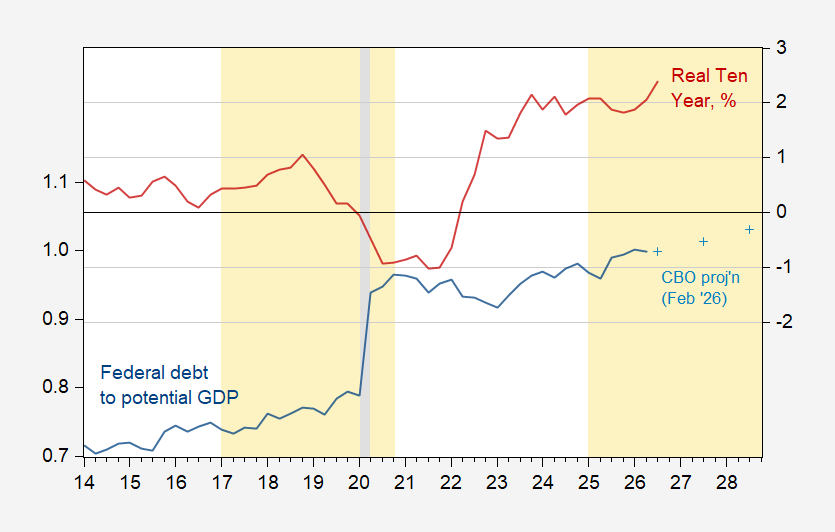
Figure 1: Debt held by public to potential GDP (blue, left scale), CBO projection of February 2026 (light blue +, left scale), 10 year TIPS yield, % (red, right scale). Q3 for TIPS yield is quarterly average through August 19. Light orange shadig denotes Trump administrations. NBER defined peak to trough recession dates. Source: CBO, Budget and Economic Outlook, Treasury via FRED, Treasury, and author’s calculations.
While the debt to GDP projection does not look too alarming, it’s important to realize that the projection was constructed prior to the onset of the US – Iran war, and the Supreme Court decision striking down the IEEPA based tariffs. For the first ten months of the FY 2026, the Bipartisan Policy Center estimates the budget deficit was $209 bn higher than projected due to announced actions (including the debatable $39 bn for DoD expenditures associated with the war). Prorating, this adds about $250 bn to the FY 2026 deficit.
Hence, the CBO projection should be considered somewhat “overtaken by events”, while pointing in the right direction for trend debt-to-GDP. I think part of the angst is driven by the uncertainty regarding fiscal policy (well, overall economic policy formulation in this administration), especially as the Administration evidences no coherent plan for reining in fiscal policy.
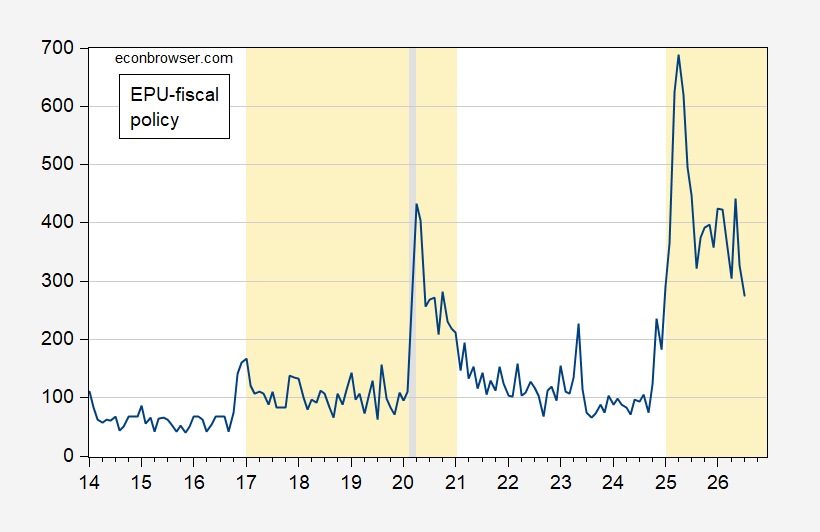
Figure 2: Economic Policy Uncertainty – fiscal policy category (blue). Light orange shadig denotes Trump administrations. NBER defined peak to trough recession dates. Source: policyuncertainty.com.
Treasury tens are already right back where they were yesterday, around the time of the announcement of increased buybacks. So much for the king of debt telling the market what to do.
If, however, somebody got wind of the announcement and bought bonds for a quick flip, that would have worked out great!
Off topic – fertilizer and voting:
https://www.cookpolitical.com/analysis/senate/senate-overview/texas-and-iowa-senate-races-move-toss-races-governor-also-move#txgov
Cook Political Report says 3 of 4 Iowa House seats are competitive, as is the governor’s race, and that this year’s Iowa senate race is now a toss-up, because of diesel and fertilizer prices. The felon-in-chief has said he doesn’t care about the midterms, so maybe this added risk to his Party’s hold on the Senate won’t matter.
Wouldn’t want to be the felon’s boy in the 2028 Iowa caucuses.
Diesel is running at $5.345 in Iowa right now, below the national average of $5.47:
https://www.oilpriceapi.com/diesel-prices/iowa
China’s troubles aren’t just a figbar of the imagination. Here’s Pettis + Setser on China’s economic troubles:
https://x.com/michaelxpettis/status/2089942689055691081
It’s what we know, but with these two in agreement, there’s less room for doubt. Construction collapse induced a shift to factory investment in order to hut GDP targets. Households aren’t absorbing the increase in factory output, so it goes into exports. Weak pricing if factory output has slowed factory investment, so infrastructure is the only investment target left, and there are few good infrastructure investment opportunities.
And speaking of debt, there was a record-lrage contraction in Chinese bank lending in July:
https://www.aol.com/articles/china-july-bank-loans-contract-093218000.html
That’s probably not good.
But maybe johnny will tell us this is all wrong, because (fill in the blank) doesn’t matter.
Most of that is related to “West’s liquidity”. The traditional Chinese system is well secure while population drops over the next 30 years easing resource concerns. The real interest is when the current American debt bubble pops. Unlike 2008-9 there won’t be any Chinese help bailing it out and the Western powers are forced to date finally cut living standards. A phoney global ponzi scheme based around the dollar wasn’t any better than the pound 100 years ago.
Whenever you see something like “The real interest is…”, what the author is actually saying is “I want to change the subject to my favorite topic.”
Johnny claims China is immune from financial shocks for some magic “traditional chinese system” reason. No explanation, just johnny claiming to know stuff, again.
No country which uses money, has banks, engages in borrowing and lending, is immune from financial shocks. Not one.
There’s another report of oil slipping through Hormuz:
“About 10 million barrels of oil a day — roughly half the pre-war volume — are being transported out of the strait and injected into the global energy market, the [unnamed U.S.] officials said.”
https://archive.is/oQBDM#selection-365.0-365.65
This report from Axios repeats what was reported by Bloomberg four days ago, but with different details:
https://finance.yahoo.com/energy/articles/covert-mideast-oil-flows-keeping-140457099.html
Axios reports that shipments have been going on for “the last several weeks”, while Bloomberg reports “for months”, Axios citing U.S. officials, Bloomberg “people with knowledge”, while hinting at industry sources. Bloomberg says some shipments have military cover.
Reports of leakage are consistent with prices below the horror-story levels of some forecasts and a regular drumbeat of “what’s wrong with this picture?” from market watchers and pundits. I’m not qualified to assess either the “rightness” of the price of oil nor the reports of leakage. Leakage could be part of the felon administrations decision to forego more bombing.
Oh, fudge. Claudia Sahm calls Kevin Warsh out for lying in his FOMC press conference:
“Warsh did not accurately explain the Committee’s current decision or its thinking about economic and financial market developments. Investors and the public, with only Warsh’s words and a nearly unchanged statement after the meeting, had to wait three weeks for the minutes to correct the record.”
Off topic – the felon-in-chief’s police state is ramping up its attack on freedom of expression and assembly:
https://talkingpointsmemo.com/news/dhs-exempted-itself-from-normal-law-for-undercover-investigation-into-protesters
Homeland Security has granted itself the right to violate the law while infiltrating anti-war gatherings.
Alot of signs the AI bubble has topped in 2026. Company I do contract work for is cutting AI investment 90% due to excessive debt. Its a smaller company that borrowed for 3 years(2024-26). But its happening to all firms outside mega caps. They borrowed later and will keep pumping debt for another year, but nope, total investment will be down to 400 billion overall.
This is exactly what happened in 99-00 investment. It’s happening again. By 2028 the mega caps will be done. Driving a epic crash as counter parties start blowing like 2008.
The tech crash occurred because it funded a bunch of websites that were worthless. This time around, we are funding real product (data centers) and AI technology that has real capabilities. So it is not a complete washout. Ut is just that the value and revenue of those items probably dont match the investment expectations. So there will be a loss, just not sure how much-although it wont be minimal. This is quite different from the dotcom bubble and pets.com. I see blood, but not a corpse.
The debt is the fault of donald trump grow a pair do not come back to Cincy mm