Not just for computers, peripherals and semiconductors – and running hot despite dollar appreciation. From MarketPlace, with Justin Ho, today:
without the cost of energy, import prices rose. In fact, they were up 4.5% from the same time a year ago. It’s the biggest year-over-year increase since 2022. The most significant imports that are getting more expensive are capital goods.
“Particularly capital goods that are computers and semiconductors,” said Sarah House, senior economist with Wells Fargo.
It’s not just computers, etc., though:
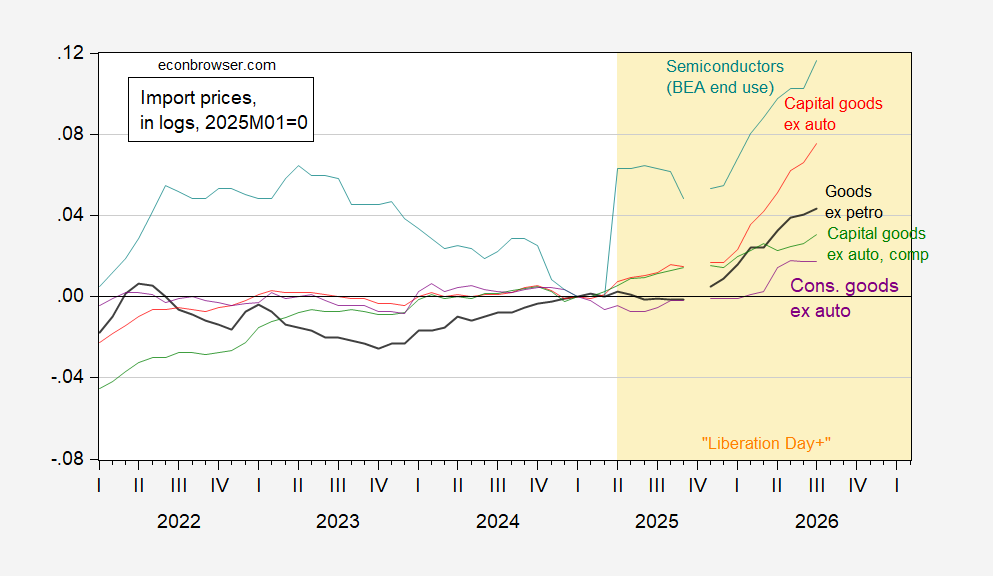
Figure 1: Import price for all goods excluding petroleum (black), capital goods ex-auto (red), capital goods ex-auto, computers, semiconductors (green), consumer goods ex-auto (purple), semiconductors, BEA end use (teal), all in logs 2025M01=0, n.s.a. Source: BLS, and author’s calculations.
The increases are surprising given the recent strength in the dollar that would typically restrain import prices. Exchange rate pass through for the US is typically in the range of 0.30 to 0.35. With the dollar appreciating an annualized 5.2% over the last three months ending July, one would’ve expected import prices to rise less than half a percentage point (annualized), instead of the 2.6% observed.
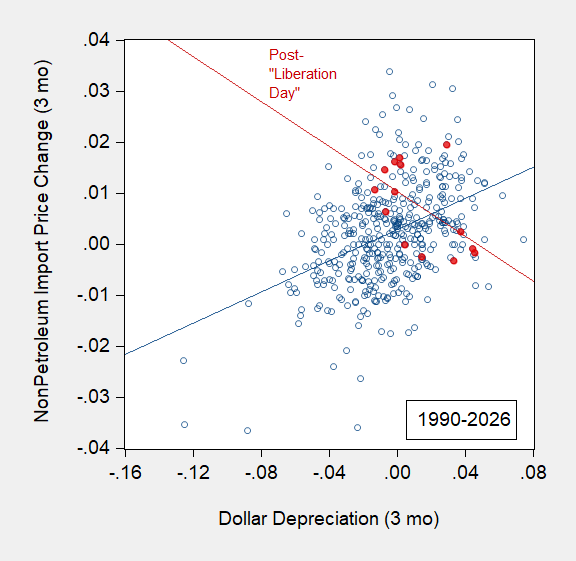
Figure 2: Three month change in import price for non-petroleum goods vs. three month broad dollar depreciation. Red dots denote observations for post-“Liberation Day”. Source: BLS, Federal Reserve Board, via FRED.
The breakdown in the correlation could be due to changing production costs in exporting countries, or exogenously changing demand in the US.
Note that even with fast import price inflation, estimates suggest a very muted pass through into either CPI or PCE.
Your numbers must be wrong. I have it on good authority (Trump, Bessent, Hassett) that import prices are down 10% due to the hundreds of billions in tariffs that foreigners are eating. They wouldn’t lie to me, would they?
Once again Donald Trump and his panel of incompetent idiots are going to demonstrate to the world that our government is not nearly as powerful as everybody used to think it was.
With the attack on Iran we demonstrated that even with military expenses more than the next 10 countries in the world combined we could not beat a second rank country into submission. The outcome was deterence destroyed and substantial increases in gas and oil prices.
With our secretary of the treasury intervening in long bond markets we will demonstrate to the world and financial markets that our President is clueless and helpless to bring down interest rates. The outcome will be —– ?
Figure 2 looks like an uncorrelated blob to me, I wouldn’t try to do linear regression on that.